
Bad Data, Bad AI: Poor-Quality Data Is Sabotaging Your In-Cabin AI Model
SHARE

Table of Contents

Table of Contents

Ensuring Accurate In-Cabin AI:
The Impact of Data Quality on Model Validation

In AI development, data quality is everything. Whether training models for in-cabin monitoring systems (ICMS), autonomous driving, or ADAS applications, the accuracy and performance of these systems depend on high-quality, diverse, and well-labeled datasets. 

As Driver Monitoring Systems (DMS) become a regulatory requirement and a key safety feature in modern vehicles, the quality of data used to train and validate these AI models is more crucial than ever.

  • High-quality data, especially physics-based simulated data ensures accurate detection, regulatory compliance, and robust AI performance.
  • Low-quality data, whether from biased or poorly labeled real-world sources, synthetic data generated by low-fidelity simulators, or AI-generated data lacking physical accuracy, can introduce bias, misclassification, gaps, and inconsistencies. These issues compromise the reliability of AI models, potentially making them unsafe for real-world applications.

Not all data is created equal. Ensuring high-quality data in in-cabin monitoring validation is crucial for meeting industry safety standards and securing regulatory approval.

Now, let’s explore the essential factors that define high-quality data and set it apart from the rest.

What Defines High-Quality Data?

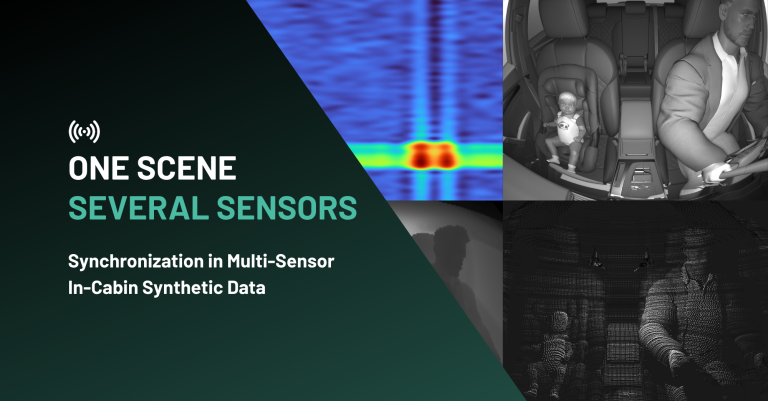
Quick heads-up! In-cabin monitoring systems rely on visual perception through image and radar sensors. So, whenever we mention synthetic data, we’re referring to visual data—not other types. Now let’s dive in!

High-quality data for AI training and validation must be:

✅ Accurate – Realistically represents real-world physics, sensor behavior, and environmental conditions.

✅ Diverse – Covers all possible scenarios with varied lighting, seating positions, demographics, occlusions (e.g., sunglasses, hats), and more.

✅ Bias-Free –  Avoids demographic and contextual bias, ensuring fair model performance across different user groups.

✅ Well-labeled – Comes with precise, pixel-level annotations, removing the risk of human labeling errors.

✅ Regulatory-Compliant – Meets Euro NCAP, GDPR, and other industry safety and privacy standards.

In contrast, low-quality data lacks accuracy, diversity, or reliability, which can confuse AI models, leading to poor generalization and critical safety failures.

Physics-Based Synthetic Data: New Benchmark for AI Training?

Physics-based simulation follows the laws of real-world physics and sensor behavior and creates realistic, sensor-accurate datasets by modeling in-cabin environments with:

  • True-to-life human biometrics, head poses, and gaze tracking
  • Correct depth, reflections, and lighting conditions


📌 Example: Physics-based simulation allows automakers to test their in-cabin AI systems on scenarios that would be too rare, expensive, or unsafe to capture in real life (Digital Engineering).

Some of its advantages include: 

✅ Realistic Sensor Simulation – Simulates data exactly as a camera, LiDAR, radar, or infrared sensor would capture it.

✅ Edge Case Coverage – Enables testing on rare but crucial scenarios like child presence detection, obstructions, diverse seating positions, sleeping passengers, and multi-occupant interactions. Learn more about similar occupant monitoring scenarios in our blogpost here. 

✅ Consistent & Scalable – Generates large-scale, balanced datasets without environmental or privacy constraints.

✅ Perfect Ground Truth Labels – Comes with pixel-perfect annotations, making training and validation 100% reliable.

These advantages make physics-based synthetic data the most reliable choice to replace or complement real-world data for training and validating in-cabin monitoring systems and ADAS models. By accurately simulating real-world physical conditions, it ensures the consistency and precision necessary for AI models to perform safely and effectively in complex environments like vehicle cabins.

Breaking Through the "Data Wall" of Real-World Data

AI engineers working with real-world data eventually hit a “data wall”—a point where collecting more real-world data no longer improves the model because of one of the following:

⚠️ Difficult-to-Capture Scenarios – AI models struggle with rare but critical situations, such as babies left unattended, passengers slumped over, or obscured faces.

⚠️ Privacy & Compliance Issues – Strict GDPR and data protection laws restrict in-cabin biometric data collection, limiting dataset diversity.

⚠️ High Costs & Time Delays – Collecting, annotating, and scaling real-world datasets is expensive and slow.

⚠️ Environmental Constraints – Real-world conditions change unpredictably, making consistent data collection difficult.

⚠️ Finite Data Resources – Both real-world data and the vast amount of information available on the internet are ultimately finite. This creates a hard limit on the volume and diversity of data that can be used for AI training.

As a result, automotive AI developers reach a point where real-world data can no longer fuel model improvement. As highlighted by OpenAI co-founder Ilya Sutskever, the future of AI development hinges on the ability to generate new, high-quality data that goes beyond what’s available in existing datasets. Without this, models risk stagnation, limiting their capacity to evolve and adapt to new challenges.

Engineers have several paths to explore, but they all ultimately lead to the use of synthetic data. While some simulators are experimenting with AI-generated data, as we’ll discuss in the next section, this approach presents significant risks for AI models. In contrast, physics-based synthetic data stands out as the most reliable option, providing the high-quality, trustworthy results needed to ensure continuous model improvement and robust performance.

AI-Generated Data: A Risky Alternative

While synthetic data is a powerful solution to the data wall, not all synthetic data is useful, and all synthetic data is not created equal.

Many AI-generated datasets, including those created using Generative Adversarial Networks (GANs) or diffusion models, introduce serious limitations:

⚠️ Lack of Physical Consistency – AI-generated images may look realistic but don’t follow real-world physics, leading to incorrect depth, lighting, or object interactions.

⚠️ Statistical Artifacts – AI-generated data can include unnatural patterns that mislead machine learning models.

⚠️ Missing Diversity & Edge Cases – AI-generated data may overfit on limited scenarios, reducing robustness.

⚠️ Annotation Inaccuracy – Poorly generated data might not have precise, pixel-perfect annotations, reducing training reliability.


📌 Example:  If an AI-generated dataset creates blurry or unnatural human faces, an in-cabin monitoring system trained on this data might fail to detect real human expressions, eye closures, or head poses accurately. As a result, it may misinterpret real-world driver drowsiness cues.


For high-risk applications like driver monitoring, flawed training data leads to failed compliance tests and safety risks.

⚠️ Hallucinations: Low-quality or poorly generated data can cause AI models to “hallucinate” — producing outputs that don’t align with real-world data. In safety-critical systems like in-cabin monitoring, this could mean misidentifying driver behavior, failing to detect distractions, or generating false alerts.

⚠️ Artifacts & Model Corruption: Inconsistent or inaccurate data can embed artifacts into the model, leading to skewed interpretations and compromised decision-making. Over time, these artifacts can directly corrupt the AI model, degrading its performance and making it less reliable in real-world scenarios.

This not only puts passenger safety at risk but also jeopardizes the model’s ability to meet regulatory standards. In the context of high-risk AI systems—such as those governed by the EU AI Act—such vulnerabilities can result in non-compliance, costly audits, and potential legal consequences.

To avoid these pitfalls, the use of high-quality, physics-based synthetic data becomes essential. It ensures models are trained on accurate, bias-free datasets, safeguarding both system integrity and public safety.

Fact: Research has shown that AI models trained on their own AI-generated outputs can experience progressive degradation, leading to data corruption risks and lower performance over time.

Regulations & The Impact of the EU AI Act

The new European AI regulation emphasizes that AI systems must be trained and validated using high-quality, reliable data that meets strict standards for data integrity and reliability. This requirement is designed to ensure that AI-driven applications, especially in safety-critical fields like in-cabin monitoring, are both trustworthy and safe for real-world use. By enforcing these data quality standards, the regulation aims to minimize risks, prevent system failures, and promote the development of AI technologies that operate responsibly and effectively.

Why In-Cabin Monitoring AI Is Classified as “High-Risk”

The EU Artificial Intelligence Act classifies in-cabin monitoring systems (ICMS) as high-risk AI due to their role in passenger safety and autonomous vehicle decision-making. This tiered approach ensures that regulatory measures are proportionate to the potential risks posed by different AI systems.

High-risk AI systems must meet strict requirements, including:

  • Data Governance – Article 10 of the EU AI Act mandates that AI training data be relevant, representative, free of errors, and complete (Artificial Intelligence Act).
  • Transparency – AI models must be explainable, with documented decision-making processes.
  • Robustness – Systems should be resilient and function reliably across various conditions.
  • Ongoing Audits – By 2026, companies must conduct annual AI safety audits to maintain compliance.


Failure to comply with EU AI Act requirements could result in fines of up to €35 million or 7% of global revenue.

📌 Example: Synthetic data platforms like that we have at Anyverse, are now crucial in AI compliance because they allow developers to create highly controlled, diverse, and bias-free datasets.

High-Quality vs. Low-Quality Data: A Side-by-Side Comparison

Feature

High-Quality Data 

Low-Quality Data 

Accuracy

✅ Matches real-world physics & sensors

❌ Can include unrealistic lighting & depth

Diversity

✅ Covers all age groups, lighting, seating positions

❌ May lack key edge cases

Bias-Free

✅ Designed to avoid demographic bias

❌ Can overfit on limited data distributions

Labeling Precision

✅ Automatic, pixel-perfect annotations

❌ AI-generated labels may be flawed

Scalability & Cost

✅ Fast & scalable synthetic data

❌ Expensive & slow real-world collection

Regulatory Compliance

✅ Meets EU AI Act, GDPR, and NCAP safety standards

❌ May fail safety validation tests

Future-Proof Your AI With High-Quality Data

So, what’s your take? After exploring the role of data quality in developing reliable and secure AI systems, it’s clear that high-quality data is essential. The next steps are yours to decide.

At Anyverse, we deliver high-fidelity, physics-based synthetic data designed for in-cabin monitoring AI.

Explore how Anyverse’s synthetic data solutions can optimize your AI validation process today!

📩 Contact us to learn more!
Enjoyed this article?

Add us as a Preferred Source on Google to see more content like this in Discover and Top Stories.

About Anyverse

With over 25 years of heritage in physics-based simulation and a 2008 Academy Technical Achievement Award, Anyverse is a leading provider of high-fidelity synthetic data and validation tools for advanced Perception AI.

While Anyverse remains a premier partner for the Automotive market, specializing in In-Cabin Monitoring systems and ADAS, its technology is increasingly adopted across Defence, Robotics, and Industry 4.0. Leveraging a proprietary physics-grounded engine, procedural synthetic data generation, and next-gen Generative AI, Anyverse produces datasets with unmatched realism and sensor-level accuracy (including RGB, NIR, Radar, LiDAR, and Thermal).

Its unified validation framework helps partners ensure compliance with specific regulations like Euro NCAP, as well as broader safety standards for autonomous systems. By bridging the gap between simulation and reality, Anyverse accelerates development, reduces costs, and ensures trustworthy perception for vehicles, robots, and intelligent machines.

Bad Data, Bad AI: Poor-Quality Data Is Sabotaging Your In-Cabin AI Model

SHARE

Table of Contents

Table of Contents

Ensuring Accurate In-Cabin AI:
The Impact of Data Quality on Model Validation

In AI development, data quality is everything. Whether training models for in-cabin monitoring systems (ICMS), autonomous driving, or ADAS applications, the accuracy and performance of these systems depend on high-quality, diverse, and well-labeled datasets. 

As Driver Monitoring Systems (DMS) become a regulatory requirement and a key safety feature in modern vehicles, the quality of data used to train and validate these AI models is more crucial than ever.

  • High-quality data, especially physics-based simulated data ensures accurate detection, regulatory compliance, and robust AI performance.
  • Low-quality data, whether from biased or poorly labeled real-world sources, synthetic data generated by low-fidelity simulators, or AI-generated data lacking physical accuracy, can introduce bias, misclassification, gaps, and inconsistencies. These issues compromise the reliability of AI models, potentially making them unsafe for real-world applications.

Not all data is created equal. Ensuring high-quality data in in-cabin monitoring validation is crucial for meeting industry safety standards and securing regulatory approval.

Now, let’s explore the essential factors that define high-quality data and set it apart from the rest.

What Defines High-Quality Data?

Quick heads-up! In-cabin monitoring systems rely on visual perception through image and radar sensors. So, whenever we mention synthetic data, we’re referring to visual data—not other types. Now let’s dive in!

High-quality data for AI training and validation must be:

✅ Accurate – Realistically represents real-world physics, sensor behavior, and environmental conditions.

✅ Diverse – Covers all possible scenarios with varied lighting, seating positions, demographics, occlusions (e.g., sunglasses, hats), and more.

✅ Bias-Free –  Avoids demographic and contextual bias, ensuring fair model performance across different user groups.

✅ Well-labeled – Comes with precise, pixel-level annotations, removing the risk of human labeling errors.

✅ Regulatory-Compliant – Meets Euro NCAP, GDPR, and other industry safety and privacy standards.

In contrast, low-quality data lacks accuracy, diversity, or reliability, which can confuse AI models, leading to poor generalization and critical safety failures.

Physics-Based Synthetic Data: New Benchmark for AI Training?

Physics-based simulation follows the laws of real-world physics and sensor behavior and creates realistic, sensor-accurate datasets by modeling in-cabin environments with:

  • True-to-life human biometrics, head poses, and gaze tracking
  • Correct depth, reflections, and lighting conditions


📌 Example: Physics-based simulation allows automakers to test their in-cabin AI systems on scenarios that would be too rare, expensive, or unsafe to capture in real life (Digital Engineering).

Some of its advantages include: 

✅ Realistic Sensor Simulation – Simulates data exactly as a camera, LiDAR, radar, or infrared sensor would capture it.

✅ Edge Case Coverage – Enables testing on rare but crucial scenarios like child presence detection, obstructions, diverse seating positions, sleeping passengers, and multi-occupant interactions. Learn more about similar occupant monitoring scenarios in our blogpost here. 

✅ Consistent & Scalable – Generates large-scale, balanced datasets without environmental or privacy constraints.

✅ Perfect Ground Truth Labels – Comes with pixel-perfect annotations, making training and validation 100% reliable.

These advantages make physics-based synthetic data the most reliable choice to replace or complement real-world data for training and validating in-cabin monitoring systems and ADAS models. By accurately simulating real-world physical conditions, it ensures the consistency and precision necessary for AI models to perform safely and effectively in complex environments like vehicle cabins.

Breaking Through the "Data Wall" of Real-World Data

AI engineers working with real-world data eventually hit a “data wall”—a point where collecting more real-world data no longer improves the model because of one of the following:

⚠️ Difficult-to-Capture Scenarios – AI models struggle with rare but critical situations, such as babies left unattended, passengers slumped over, or obscured faces.

⚠️ Privacy & Compliance Issues – Strict GDPR and data protection laws restrict in-cabin biometric data collection, limiting dataset diversity.

⚠️ High Costs & Time Delays – Collecting, annotating, and scaling real-world datasets is expensive and slow.

⚠️ Environmental Constraints – Real-world conditions change unpredictably, making consistent data collection difficult.

⚠️ Finite Data Resources – Both real-world data and the vast amount of information available on the internet are ultimately finite. This creates a hard limit on the volume and diversity of data that can be used for AI training.

As a result, automotive AI developers reach a point where real-world data can no longer fuel model improvement. As highlighted by OpenAI co-founder Ilya Sutskever, the future of AI development hinges on the ability to generate new, high-quality data that goes beyond what’s available in existing datasets. Without this, models risk stagnation, limiting their capacity to evolve and adapt to new challenges.

Engineers have several paths to explore, but they all ultimately lead to the use of synthetic data. While some simulators are experimenting with AI-generated data, as we’ll discuss in the next section, this approach presents significant risks for AI models. In contrast, physics-based synthetic data stands out as the most reliable option, providing the high-quality, trustworthy results needed to ensure continuous model improvement and robust performance.

AI-Generated Data: A Risky Alternative

While synthetic data is a powerful solution to the data wall, not all synthetic data is useful, and all synthetic data is not created equal.

Many AI-generated datasets, including those created using Generative Adversarial Networks (GANs) or diffusion models, introduce serious limitations:

⚠️ Lack of Physical Consistency – AI-generated images may look realistic but don’t follow real-world physics, leading to incorrect depth, lighting, or object interactions.

⚠️ Statistical Artifacts – AI-generated data can include unnatural patterns that mislead machine learning models.

⚠️ Missing Diversity & Edge Cases – AI-generated data may overfit on limited scenarios, reducing robustness.

⚠️ Annotation Inaccuracy – Poorly generated data might not have precise, pixel-perfect annotations, reducing training reliability.


📌 Example:  If an AI-generated dataset creates blurry or unnatural human faces, an in-cabin monitoring system trained on this data might fail to detect real human expressions, eye closures, or head poses accurately. As a result, it may misinterpret real-world driver drowsiness cues.


For high-risk applications like driver monitoring, flawed training data leads to failed compliance tests and safety risks.

⚠️ Hallucinations: Low-quality or poorly generated data can cause AI models to “hallucinate” — producing outputs that don’t align with real-world data. In safety-critical systems like in-cabin monitoring, this could mean misidentifying driver behavior, failing to detect distractions, or generating false alerts.

⚠️ Artifacts & Model Corruption: Inconsistent or inaccurate data can embed artifacts into the model, leading to skewed interpretations and compromised decision-making. Over time, these artifacts can directly corrupt the AI model, degrading its performance and making it less reliable in real-world scenarios.

This not only puts passenger safety at risk but also jeopardizes the model’s ability to meet regulatory standards. In the context of high-risk AI systems—such as those governed by the EU AI Act—such vulnerabilities can result in non-compliance, costly audits, and potential legal consequences.

To avoid these pitfalls, the use of high-quality, physics-based synthetic data becomes essential. It ensures models are trained on accurate, bias-free datasets, safeguarding both system integrity and public safety.

Fact: Research has shown that AI models trained on their own AI-generated outputs can experience progressive degradation, leading to data corruption risks and lower performance over time.

Regulations & The Impact of the EU AI Act

The new European AI regulation emphasizes that AI systems must be trained and validated using high-quality, reliable data that meets strict standards for data integrity and reliability. This requirement is designed to ensure that AI-driven applications, especially in safety-critical fields like in-cabin monitoring, are both trustworthy and safe for real-world use. By enforcing these data quality standards, the regulation aims to minimize risks, prevent system failures, and promote the development of AI technologies that operate responsibly and effectively.

Why In-Cabin Monitoring AI Is Classified as “High-Risk”

The EU Artificial Intelligence Act classifies in-cabin monitoring systems (ICMS) as high-risk AI due to their role in passenger safety and autonomous vehicle decision-making. This tiered approach ensures that regulatory measures are proportionate to the potential risks posed by different AI systems.

High-risk AI systems must meet strict requirements, including:

  • Data Governance – Article 10 of the EU AI Act mandates that AI training data be relevant, representative, free of errors, and complete (Artificial Intelligence Act).
  • Transparency – AI models must be explainable, with documented decision-making processes.
  • Robustness – Systems should be resilient and function reliably across various conditions.
  • Ongoing Audits – By 2026, companies must conduct annual AI safety audits to maintain compliance.


Failure to comply with EU AI Act requirements could result in fines of up to €35 million or 7% of global revenue.

📌 Example: Synthetic data platforms like that we have at Anyverse, are now crucial in AI compliance because they allow developers to create highly controlled, diverse, and bias-free datasets.

High-Quality vs. Low-Quality Data: A Side-by-Side Comparison

Feature

High-Quality Data 

Low-Quality Data 

Accuracy

✅ Matches real-world physics & sensors

❌ Can include unrealistic lighting & depth

Diversity

✅ Covers all age groups, lighting, seating positions

❌ May lack key edge cases

Bias-Free

✅ Designed to avoid demographic bias

❌ Can overfit on limited data distributions

Labeling Precision

✅ Automatic, pixel-perfect annotations

❌ AI-generated labels may be flawed

Scalability & Cost

✅ Fast & scalable synthetic data

❌ Expensive & slow real-world collection

Regulatory Compliance

✅ Meets EU AI Act, GDPR, and NCAP safety standards

❌ May fail safety validation tests

Future-Proof Your AI With High-Quality Data

So, what’s your take? After exploring the role of data quality in developing reliable and secure AI systems, it’s clear that high-quality data is essential. The next steps are yours to decide.

At Anyverse, we deliver high-fidelity, physics-based synthetic data designed for in-cabin monitoring AI.

Explore how Anyverse’s synthetic data solutions can optimize your AI validation process today!

📩 Contact us to learn more!
Enjoyed this article?

Tap to add us as a Preferred Source on Google to see more content like this.

About Anyverse

With over 25 years of heritage in physics-based simulation and a 2008 Academy Technical Achievement Award, Anyverse is a leading provider of high-fidelity synthetic data and validation tools for advanced Perception AI.

While Anyverse remains a premier partner for the Automotive market, specializing in In-Cabin Monitoring systems and ADAS, its technology is increasingly adopted across Defence, Robotics, and Industry 4.0. Leveraging a proprietary physics-grounded engine, procedural synthetic data generation, and next-gen Generative AI, Anyverse produces datasets with unmatched realism and sensor-level accuracy (including RGB, NIR, Radar, LiDAR, and Thermal).

Its unified validation framework helps partners ensure compliance with specific regulations like Euro NCAP, as well as broader safety standards for autonomous systems. By bridging the gap between simulation and reality, Anyverse accelerates development, reduces costs, and ensures trustworthy perception for vehicles, robots, and intelligent machines.