Table of Contents
Table of Contents
DMS Compliance: When 5 Stars Are Just the Beginning
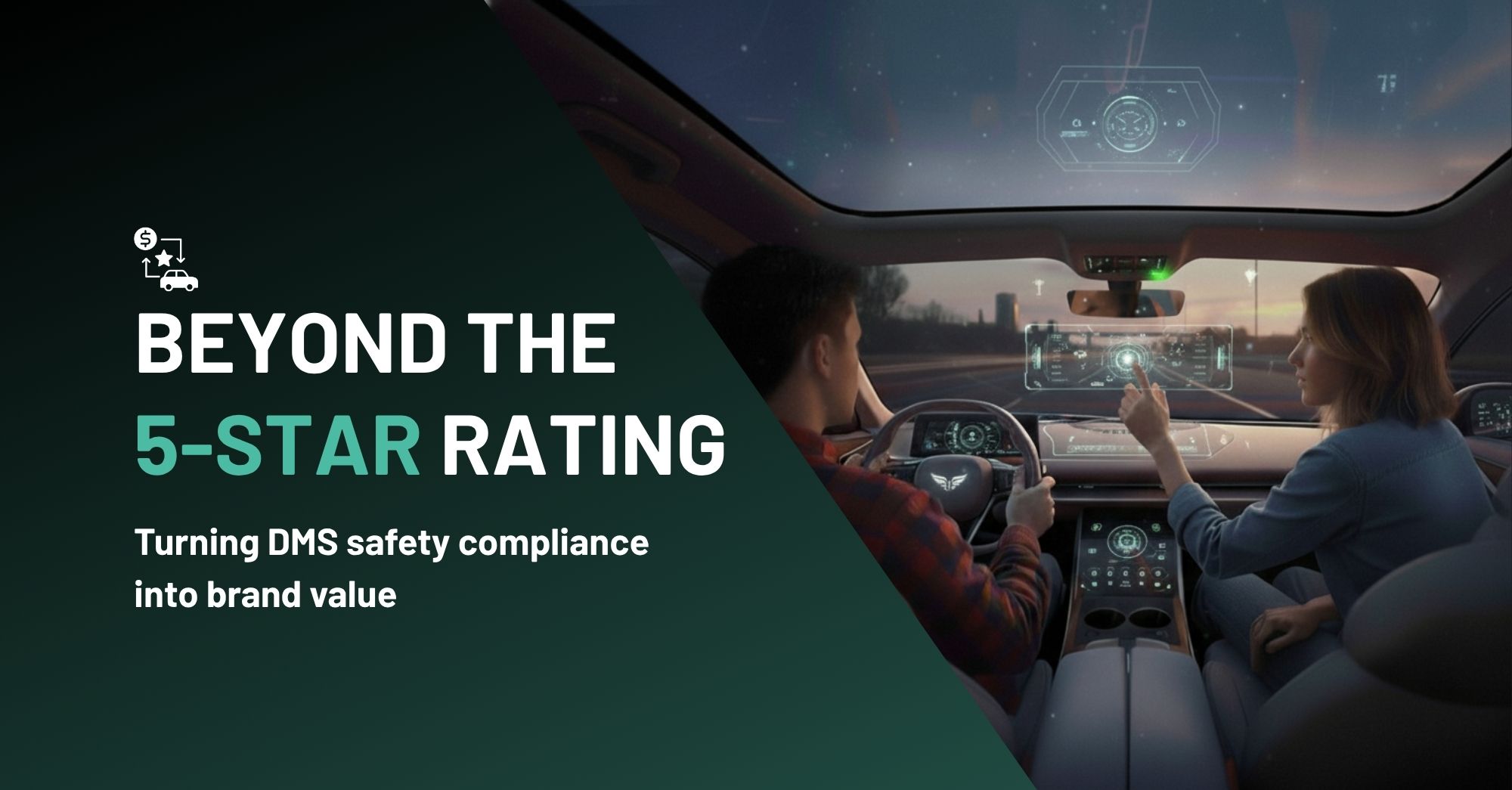
Over the past decade, Euro NCAP has achieved what few regulatory frameworks can: it successfully transformed advanced safety technologies from luxury differentiators into non-negotiable industry standards. Features like Driver Monitoring Systems (DMS) and Occupant Monitoring Systems (OMS) are now essential for any new vehicle aiming for a five-star safety rating.
But this very success has created a new challenge: compliance has become the baseline. A top Euro NCAP score is no longer a competitive advantage; it is the price of entry. As we look toward Euro NCAP 2026 and beyond, every major OEM will be equipped with a similar suite of compliant sensors. The critical question is no longer who will pass, but who will leverage this mandated hardware to build something truly unique.
Forward-thinking automakers are already making this pivot. They are beginning to view the in-cabin AI sensor suite not as a compliance cost center, but as a strategic R&D platform. This is where the real battle for brand leadership will be fought, by using the foundational data from these systems to deliver enhanced safety, personalized comfort, and trust. The goal is to move from generic alerts to emotionally intelligent, human-centric experiences.
In this new paradigm, regulation is the springboard, not the ceiling. The brands that will lead the next decade will use these mandated technologies as creative building blocks, transforming a checklist of safety requirements into a foundation for lasting brand value. Just as crash-test scores once defined public perception of safety, the intelligence and responsiveness of the in-cabin experience will soon define a brand’s perceived care, innovation, and sophistication.
To understand how this transformation works, we can look to a masterclass in branding: Volvo. By examining how they built their entire identity around safety, we can see a clear blueprint for turning today’s in-cabin AI from a mandate into a market-leading advantage.

The Volvo Legacy – A Blueprint for Safety as a Brand Pillar
Volvo’s enduring market leadership demonstrates the profound value of defining safety standards, rather than just following them. Long before safety was a common marketing claim, Volvo embedded it as the core of its brand identity, building a legacy of trust that continues to pay dividends.
This strategy dates back to 1959, when Volvo engineer Nils Bohlin invented the three-point safety belt. In a defining move, Volvo open-sourced the patent, prioritizing universal safety over a temporary competitive advantage. This decision cemented safety as Volvo’s brand DNA and established a template for leadership: true differentiation comes from delivering measurable customer benefits that exceed the minimum requirements.
How Volvo’s Blueprint Applies to In-Cabin AI
The strategic parallel for today’s OEMs is clear. The mandated sensor suites for DMS and OMS are the modern equivalent of the seatbelt anchor points, a foundational component. The real brand value, however, won’t be found in the hardware itself, but in the sophisticated AI and unique software experiences built on top of it.
Action | Strategic Significance | The In-Cabin AI Parallel |
Exceeded standards, set a new industry benchmark | Move beyond basic distraction alerts to predictive safety & wellness. | |
Open-sourced the patent | Built immense trust and credibility | Use open safety platforms or exceed standards to build consumer trust. |
Introduced side-impact protection and whiplash reduction systems ahead of regulations | Demonstrated innovation leadership | Launch branded comfort & safety features that anticipate future regulations. |
Volvo’s history shows that safety leadership is a continuous journey of innovation. For the in-cabin domain, this means leveraging the compliance-mandated sensor data to create features that feel less like a watchdog and more like a guardian. Potential areas for differentiation include:
- Predictive Safety: AI that doesn’t just alert to distraction but anticipates driver fatigue, suggesting a break before it becomes critical.
- Proactive Protection: Systems capable of detecting a medical emergency or an unattended child and initiating a calibrated response.
- Personalized Experience: Using occupant awareness to automatically adjust seating, climate, and infotainment, creating a seamless, tailored cabin environment.
The lesson from Volvo is that the foundational technology, whether a seatbelt or a camera, is just the start. The brands that will lead are those that see this hardware as a platform to build AI-driven experiences that customers value and trust.
The next section breaks down how to architect these experiences and, crucially, what it takes to make them robust enough to be a reliable brand promise.
From Generic Safety to Branded Experiences: Three Pathways to Differentiation
The in-cabin sensor suite, mandated for Euro NCAP compliance, represents a strategic platform for OEMs to build unique brand value. By deploying advanced AI on this hardware, manufacturers can move beyond generic alerts to create intelligent, context-aware experiences that fundamentally strengthen safety, comfort, and personalization. Here are three pathways to transform a compliance cost into a competitive asset.
1. The Comfort & Wellness Layer: From Monitoring to Well-Being
Objective: Shift from reactive safety alerts to a proactive system that enhances occupant well-being.
Examples & Applications:
- Fatigue mitigation: AI detects micro-sleep indicators and gaze patterns, then adjusts cabin lighting, initiates seat micro-massage, and provides gentle haptic feedback on the steering wheel to restore alertness.
- Stress and cognitive load management: By monitoring facial tension and posture, the system can dynamically adjust audio (e.g., introducing calming sounds), ambient lighting, or temperature to reduce cognitive load during heavy traffic.
- Intelligent break suggestions: The AI integrates with navigation to recommend rest stops based on analyzed driver fatigue levels and journey progress.
- Adaptive wellness routines: Vehicles could integrate with wearable devices to adjust cabin settings according to sleep quality, heart rate variability, or stress indicators.
Micro-scenario: A long-distance commuter shows signs of early fatigue. The AI dims cabin lighting, adjusts the seat lumbar support, and recommends a nearby rest stop, all before the driver consciously realizes fatigue is setting in.
Benefit: Transforms safety from an obligation into a tangible, branded experience that feels intuitive and human-centric.
2. The Proactive Guardian Layer: Anticipating Risk Before the Crash
Objective: Extend safety beyond collision mitigation to anticipate and prevent emerging risks in real-time.
Examples & Applications:
- Child presence detection: AI identifies a child left in the back seat, triggering escalating alerts (in-cabin, via smartphone) and activating climate control to maintain a safe temperature.
- Medical emergency response: Systems detect driver unresponsiveness and can automatically slow the vehicle, activate hazards, and contact emergency services with precise location data.
- Occupant behavior prediction: AI detects high-risk behaviors like unbuckled seatbelts and provides targeted, real-time interventions.
- Environmental hazard detection: Detection of smoke, elevated temperatures, or carbon monoxide allows the system to alert occupants, adjust ventilation, and initiate safety protocols.
Micro-scenario: During a family trip, the AI detects that a toddler in the rear seat is unbuckled and crying. It alerts the driver, automatically engages door locks, adjusts the climate for comfort, and sends a notification to the parent’s smartphone.
Benefit: Builds profound trust by positioning the vehicle as a vigilant guardian, demonstrating a level of care that transcends standard safety protocols.
3. The Personalized Convenience Layer: The Seamless Cabin
Objective: Leverage occupant awareness to deliver seamless, contextualized convenience.
Examples & Applications:
- Automatic occupant profiling: Seats, mirrors, infotainment, and climate settings automatically adjust upon recognizing a specific driver or passenger.
- Rear-seat customization: Child locks, climate zones, and entertainment settings adjust dynamically based on detected occupants.
- Context-aware automation: Notifications and AI interactions adapt based on context minimizing distractions during a stressful commute versus enabling more interaction on a relaxed highway drive.
- Multimodal personalization: AI integrates voice commands, gestures, and gaze detection to anticipate passenger needs, such as adjusting music when multiple occupants are present or silencing notifications during calls.
Micro-scenario: A shared family vehicle recognizes a parent driving to work and configures the seat and climate accordingly. That afternoon, when a child is detected in the back, the system automatically enables child safety locks and selects their preferred entertainment.
Benefit: Elevates the user experience from functional to effortlessly personalized, creating a sticky, brand-loyalty-driving ecosystem.
Key Takeaways
- The compliance-mandated sensor suite is a launchpad for creating layered value through advanced AI.
- True differentiation is achieved through predictive safety, proactive wellness, and contextual personalization, capabilities that lie entirely outside the regulatory scope.
- These features transform the in-cabin experience from a series of transactions into a trusted relationship, building the kind of customer loyalty that commands a market premium.
However, implementing these “brand promise” features introduces a monumental engineering challenge. A compliant system can be “good enough,” but an In-Cabin Monitoring System must be exceptionally robust. The AI cannot fail in edge cases; a single false negative in a child detection system or a false positive in a fatigue monitor doesn’t just create a poor experience, it shatters the very trust the brand seeks to build.
This level of reliability requires training data that is comprehensive, perfectly labeled, and rich in rare but critical edge cases. In the next section, we will dissect why this data challenge is the primary bottleneck and how leading OEMs are solving it.



Beyond Compliance in Action — How Innovators Are Building Brand Value
Leading OEMs are no longer waiting for regulations to dictate their next move. They are proactively leveraging their in-cabin AI sensor suites to create branded experiences that build loyalty and justify a premium position. Here’s how industry front-runners are translating the theory of differentiation into practice, and more importantly, what their success implies about the underlying technology required.
Mercedes-Benz: Engineering the Intelligent Occupant Experience
- Differentiation Strategy: Fusing ultimate comfort with proactive safety to reinforce its premium, luxury identity.
- Beyond Compliance: The MBUX interior assistant and cabin monitoring systems don’t just detect distraction; they use driver state to create a holistic wellness environment. Detected fatigue triggers not just an alert, but a coordinated response from the seat (micro-massage, bolster adjustment), climate control, and lighting to restore alertness.
- Brand impact: Positions Mercedes as a brand that doesn’t just protect you but cares for you, transforming the cabin into an intelligent sanctuary.
Tesla: The Integrated Software-Defined Cabin
- Differentiation Strategy: Leveraging its centralised, software-first architecture to deliver seamless, over-the-air updatable experiences.
- Beyond Compliance: Tesla’s cabin camera is the cornerstone of a deeply integrated system. Its data feeds into a continuous learning loop, enabling features like context-aware cabin pre-conditioning, adaptive driver alerts that escalate based on engagement level, and personalized settings that feel intuitive rather than programmed.
- Brand impact: Reinforces Tesla’s core identity as a tech company on wheels, where the car’s intelligence evolves and improves, creating a constantly refreshing value proposition.
BMW: The Driver-Centric Co-Pilot
- Differentiation Strategy: Using sensing technology to enhance the “Ultimate Driving Machine” ethos with a focus on precision and situational awareness.
- Beyond Compliance: BMW’s holistic cabin sensing (using camera and radar) goes beyond occupant detection to interpret gestures and postures. This enables context-aware features like automatically dimming the central display when the driver looks away, or adjusting driving dynamics and cabin ambiance based on detected driver focus or stress levels.
- Brand impact: Strengthens BMW’s driver-centric brand promise by making the vehicle feel like an attentive co-pilot that adapts to the driver’s state and intentions.
Key Takeaways: The Unseen Foundation
These examples demonstrate that the race for in-cabin differentiation is already underway. The winners are using the same foundational sensor hardware as everyone else, but they are winning with superior AI software and data strategy.
The critical insight for any OEM or Tier-1 is this: These brand-defining features are not just software features; they are manifestations of exceptionally robust and well-trained AI models. The “Mercedes Sanctuary” or “Tesla Intuition” cannot tolerate frequent false alarms or failures in edge cases. A single instance where the “proactive wellness” system fails, or the in-cabin monitoring system misses a critical event, can irrevocably damage the brand trust these features are designed to build.
Therefore, the true barrier to entry is not the idea, but the ability to generate the vast, diverse, and perfectly labeled training data required to make these AI systems reliable enough to be a brand promise. This leads us to the central technical hurdle that every automaker must now overcome.

The Technical Hurdle: Why "Good Enough" AI Isn't Enough for Brand-Level Reliability
Transitioning from compliance to brand differentiation fundamentally changes the performance requirements for in-cabin AI. A compliance system can be “good enough,” but a feature marketed as a core brand promise must be exceptionally robust. The challenge is building AI that operates with near-perfect reliability across millions of real-world scenarios. For the consumer, a single failure, a missed child, a false fatigue alert, or an unresponsive Driver State Monitoring System doesn’t just create a poor experience; it shatters the very trust the brand seeks to build.
1. Complexity of Edge Cases
While compliance systems are trained on curated datasets of common scenarios, brand-level AI must confidently handle the endless “long tail” of edge cases.
- Extreme Demographic Diversity: Accurately perceiving occupants of all ages, sizes, ethnicities, and with diverse physical abilities.
- Unconstrained Behaviors: Interpreting unconventional poses, complex interactions between passengers, and activities that occlude key features.
- Adverse Environmental Conditions: Performing flawlessly in challenging lighting (direct sun, pitch darkness, rapid transitions) and with visual noise like reflections and obstructions.
Example: A “Proactive Guardian” system must reliably detect a child’s foot hidden under a blanket in a rear-facing seat during a night drive, Fa scenario far outside a standard compliance test.
2. The Multi-Sensor Fusion Imperative
Modern cabins use a suite of sensors (RGB, IR, ToF, radar). Fusing this data consistently is a core challenge.
- Data Reconciliation: AI must intelligently resolve conflicts, such as an IR sensor suggesting drowsiness while an RGB camera is temporarily blinded by glare.
- System Degradation: Algorithms must be robust enough to handle potential calibration drift or the failure of a single sensor over the vehicle’s lifespan.
Example: If an IR camera detects low movement (driver fatigue), but the RGB camera is affected by glare, AI must reconcile the data to avoid false alerts.
3. Real-Time Performance & Safety Constraints
Brand-defining AI isn’t just about accuracy; it’s about accuracy at speed.
- Latency is a Failure: An Occupant Monitoring System detecting a medical emergency has milliseconds to initiate a life-saving protocol. Any delay is unacceptable.
- Predictive Precision: A “Comfort & Wellness” system must identify the onset of fatigue to be effective, requiring predictive capabilities far beyond simple reaction.
Example: A Driver Monitoring System detecting driver unconsciousness must initiate braking, hazard signaling, and emergency calls in milliseconds. There is simply no margin for delay.
4. The Insurmountable Data Bottleneck
This is the root of all preceding challenges. The traditional approach of collecting and labeling real-world data is fundamentally inadequate for building brand-level AI.
- Prohibitive Cost & Time: Physically capturing millions of miles of driving scenarios, especially the rare but critical edge cases, is economically and logistically impossible.
- The “Uncapturable” Scenario: How do you safely and ethically collect thousands of examples of a driver having a medical emergency, or a child being left alone in a car? You can’t. This creates critical gaps in the AI’s training.
The Implications for OEMs
Achieving brand-level reliability is not a matter of simply writing more complex algorithms. It is a data problem. To build an AI that customers can trust with their safety and comfort, the training pipeline must be fed with a virtually infinite volume of diverse, perfectly labeled, and scenarially complete data that encompasses both the common and the critical rare event.
The limitations of real-world data collection make this seem like an impossible hurdle. But what if you could generate this perfect dataset on demand? This leads us to the foundational technology enabling the next leap in automotive AI.

The Data Foundation: Building Trustworthy AI with Synthetic Data
The previous section outlined a stark reality: brand-defining AI requires a data foundation that is virtually impossible to build with real-world collection alone. The solution to this data bottleneck is synthetic data, a paradigm shift that allows OEMs to generate infinite, perfectly labeled, and photorealistic training scenarios on demand.
Synthetic data is not just an alternative to real-world data; it is the only scalable method to achieve the comprehensive coverage needed for AI that customers can truly trust. It enables the precise engineering of the “long tail” of edge cases, transforming them from un-capturable unknowns into a controlled, manageable training set.
From Data Gap to Strategic Advantage: The Power of Synthetic Data
Synthetic data directly addresses the core technical hurdles, turning them from blockers into opportunities:
- Solving the Edge Case Problem: Generate millions of variations of rare but critical scenarios, from medical emergencies to complex occupant interactions, that are too dangerous, expensive, or rare to capture physically.
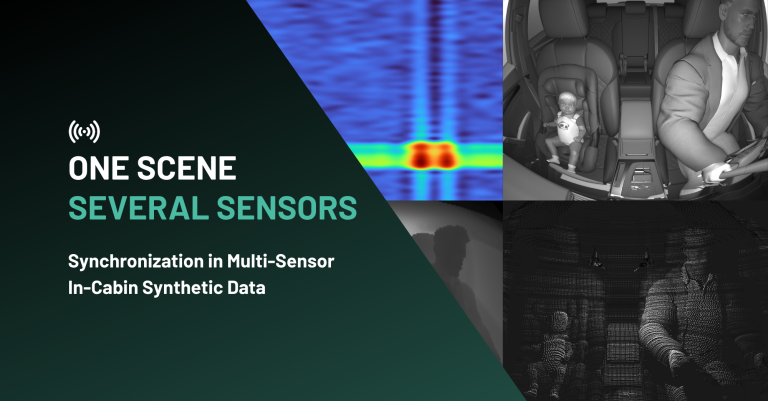
- Ensuring Multi-Sensor Robustness: Create perfectly synchronized data streams from sensor-realistic models of RGB, IR, and ToF cameras, training fusion algorithms to be resilient to conflicts, noise, and simulated sensor degradation.
- Validating Real-Time Performance: Build massive datasets of time-series scenarios to stress-test AI latency and predictive accuracy under controlled, repeatable conditions before a single real-world mile is driven.
Engineering the “Trust Engine” with the Anyverse Platform
To bridge the gap from compliance to differentiation, OEMs need more than just synthetic data; they need a production-grade pipeline for it. The Anyverse InCabin platform is engineered specifically to provide the foundational data for building this “trust engine.”
Its capabilities are tailored to the demands of brand-level AI:
- Sensor-Realistic Simulation: We don’t just generate images; we simulate the physical properties of specific camera, IR, and ToF sensors. This ensures that AI models trained on our data perform predictably and reliably when deployed on real-world hardware.
- Holistic Scenario Control: Define every variable from cabin geometry and material textures to dynamic lighting conditions and intricate human activities. This allows for the systematic coverage of edge cases, ensuring your AI is tested against the scenarios that matter most to your brand promise.
- Diverse & Programmable Human Models: Populate your virtual cabins with a vast array of human avatars, controlling not just demographics but also precise poses, gestures, and behaviors to reflect the full spectrum of real-world human diversity and interaction.
Example in action: Consider an in-cabin monitoring feature for child presence detection. With Anyverse, you can generate tens of thousands of scenarios of children in rear-facing seats, partially obscured by blankets, under the challenging lighting of a setting sun, a comprehensive validation suite that would be logistically and ethically impossible to create in the real world.
By adopting a synthetic-data-first strategy powered by a platform like Anyverse, OEMs can finally build the robust, reliable, and emotionally intelligent in-cabin experiences that define a brand. This is how you move from simply passing tests to earning the unwavering trust of your customers, the ultimate competitive advantage in the modern automotive landscape.

DMS Sensor Fusion + Synthetic Data to Ensure In-Cabin Safety
Engineering Your Brand's Trust Engine
The era of in-cabin AI as a mere compliance exercise is over. The sensor suite mandated for a five-star rating is no longer a cost center, but a strategic asset, the hardware foundation for your next great brand differentiator. As we’ve seen, the path to leadership lies in transforming these regulatory requirements into intelligent experiences that customers value and trust.
The journey from compliance to differentiation rests on three pillars:
- From Reactive to Predictive Safety: Evolving from distraction alerts to AI that anticipates driver fatigue and mitigates risk before it escalates, building profound consumer confidence.
- From Generic to Personalized Comfort: Leveraging occupant awareness to deliver context-aware adjustments that make the cabin feel like a seamless extension of the driver and passengers.
- From “Good Enough” to Brand-Level Reliability: Ensuring these features perform flawlessly across the infinite complexity of the real world, because a brand promise broken is trust eroded.
Achieving this level of reliability is the fundamental challenge. It requires a data foundation that is both comprehensive and precise. This is where synthetic data transitions from a useful tool to a strategic necessity. Platforms like Anyverse InCabin provide the essential “trust engine”, generating the sensor-realistic, perfectly labeled data needed to build and validate AI that is not just functional, but truly dependable.
The road ahead is clear. The automakers who will define the next decade are those who invest not just in the algorithms, but in the data strategy that makes them robust. They will be the ones to engineer in-cabin experiences that are safer, more comfortable, and intuitively responsive, transforming the vehicle into a trusted partner.
The ultimate differentiator is no longer just the technology itself, but the trust it inspires. That trust is the new luxury, the new premium, and the new standard of automotive excellence.