
Table of Contents
Table of Contents
The Rising Role of Driver and In-Cabin Monitoring in Euro NCAP 2026
Across the automotive industry, the definition of safety is shifting. For decades, programs like Euro NCAP focused primarily on crash performance and structural protection. Today, however, as vehicles evolve into software-defined vehicles (SDVs), where driver monitoring cameras, or AI-powered gaze detection, increasingly depend on sophisticated software and sensor integration, the greatest risks are often found inside the cabin. Driver distraction contributes to an estimated 20–30% of crashes in Europe, while in the U.S., more than 91,000 police-reported crashes each year involve drowsy drivers. These figures underscore why Euro NCAP’s shift toward evaluating in-cabin driver and occupant monitoring is a logical response to real-world dangers. It marks a significant step toward comprehensive in-cabin safety standards that reflect real-world risks
Recognizing this shift, Euro NCAP has outlined an ambitious roadmap for 2026 that elevates driver and in-cabin monitoring systems (DMS/IMS) to core assessment criteria. These technologies are now critical for achieving 5-star ratings and, by extension, consumer trust. This means that driver and in-cabin monitoring performance will directly influence safety ratings and, ultimately, market competitiveness.
For automakers, Euro NCAP 2026 in-cabin safety protocols compliance is no longer a regulatory checkbox. It’s a measure of technological maturity and safety leadership. It shapes brand identity and competitive positioning.
In the following sections, we’ll examine how leading OEMs are responding. Volvo leads the charge with its dual-camera “Driver Understanding System” that reportedly exceeds compliance targets. BMW combines AI and infrared vision for a premium, human-centric experience. And Tesla pursues a unique data-driven, vision-only approach. Let’s look at how leading automakers are positioning their in-cabin monitoring technologies for Euro NCAP 2026 readiness.

Volvo: Advancing Vision Zero with Dual-Camera Driver Monitoring
Volvo positions its driver monitoring systems as foundational to its safety strategy, fully integrated into its Vision Zero commitment. The company’s Driver Understanding System represents a new benchmark in monitoring sophistication, designed not only to meet but to exceed expected Euro NCAP 2026 requirements. In the recently announced ES90 car model, Volvo employs a dual-camera DMS architecture, with two infrared cameras positioned to reduce blind spots and maximize driver visibility in a variety of conditions.
Technical Approach
- Infrared dual-camera monitoring: The dual-camera setup enables tracking of eye movement, head orientation, and signs of drowsiness across multiple viewing angles. This configuration addresses potential blind spots caused by arm placement or partial obstructions. Infrared cameras allow consistent monitoring of driver attention, gaze, and facial expressions, even in low-light conditions.
- Real-time driver state evaluation: The system continuously monitors for signs of distraction, fatigue, or other impairment. When inattentive or impaired behavior is detected, tiered safety interventions are triggered, ranging from visual and auditory alerts to vehicle deceleration or other automated corrective measures. This ensures that the DMS acts proactively to reduce risk without overwhelming the driver.
- Cabin safety integration: Volvo aims to combine DMS with seatbelt pre-tensioning, braking intervention, and other safety systems, such as occupant sensing and climate control, to create a cohesive in-cabin monitoring environment that aligns with its broader ADAS framework and enhances overall occupant safety.
- Full system fusion: The DMS is part of a fully fused sensor ecosystem that includes cameras, radars, ultrasonic sensors, and lidar, among others.
Strategic Priorities
- Advanced compliance: Volvo frames its DMS design as ahead of typical OEM plans, specifically, the ES90’s dual-camera setup is positioned as surpassing baseline requirements for driver monitoring in future regulations.
- Brand and safety alignment: For Volvo, the DMS is not merely a regulatory response. It reflects the company’s Vision Zero ethos, signaling to consumers that in-cabin safety is a core element of the brand promise.
- Continuous enhancement: Volvo highlights that its monitoring capabilities are designed for ongoing improvement through software updates, allowing the system to adapt to new insights, edge-case scenarios, and evolving Euro NCAP protocols.
👉 Outlook: Volvo’s approach demonstrates that safety can be deeply embedded into the vehicle, rather than simply layered on top for compliance purposes. The dual-camera DMS illustrates a system that not only meets Euro NCAP 2026 readiness criteria but sets a higher benchmark for the industry. By combining robust hardware, AI-driven software, and seamless integration with ADAS, Volvo shows that proactive, predictive in-cabin monitoring is now central to modern automotive safety.
BMW: Human-Centric Safety with AI-Enhanced Driver Monitoring
While Volvo focuses on uncompromising safety integration, BMW emphasizes a human-centric, premium approach to in-cabin monitoring. Its driver monitoring system (DMS) uses infrared cameras to track driver attention, gaze, and signs of drowsiness or distraction under a wide range of lighting conditions. These cameras are complemented by AI-driven algorithms that adapt to individual drivers and seating positions, helping reduce false alerts while ensuring accurate detection of inattentive or fatigued driving.
Technical Approach
- Camera-based driver monitoring tracks head position, gaze direction, and facial cues to identify potential distractions or signs of drowsiness. Seeing Machines and BMW have collaborated to integrate advanced vision-based monitoring under varying lighting conditions.
- Infrared-based cameras: BMW employs infrared emitters and sensors to enhance visibility in low light, ensuring reliable gaze and facial tracking.
- Infrared-based cameras: BMW employs infrared emitters and sensors to enhance visibility in low light, ensuring reliable gaze and facial tracking.
- AI-enhanced recognition models continuously refine monitoring performance across different drivers and edge-case scenarios, helping BMW align with Euro NCAP’s 2026 requirements
- Multimodal sensing: BMW combines camera data with vehicle dynamics, such as steering behavior and lane-keeping metrics, to improve detection accuracy and minimize false positives.
Strategic Priorities
- User comfort and trust: BMW’s DMS system is designed to be effective yet unobtrusive, aligning with expectations of the premium segment.
- Continuous improvement: advancing AI capabilities, ongoing refinement of monitoring algorithms, ensuring adaptability to changing conditions and emerging safety protocols, and edge-case handling through internal research and external collaboration (for instance with Aptiv, Seeing Machine, and Smart Eye).
- Safety as luxury: BMW positions its DMS as part of a broader philosophy of intelligent, human-centered design, demonstrating that safety and comfort can coexist seamlessly.
- Partnerships: BMW and Qualcomm have co-developed the Snapdragon Ride Pilot platform, a centralized compute system that powers BMW’s next-generation vehicles with camera-based driver and in-cabin monitoring, integrating features like driver engagement tracking and occupant detection.
👉 Outlook: BMW exemplifies how user experience and AI sophistication can converge within a cohesive strategy aiming at in-cabin monitoring systems aligned with Euro NCAP 2026 driver state requirements.. While BMW emphasizes refinement and human-centric integration, Tesla takes a radically different route, relying on a vision-only, data-driven strategy that challenges conventional approaches to in-cabin safety.
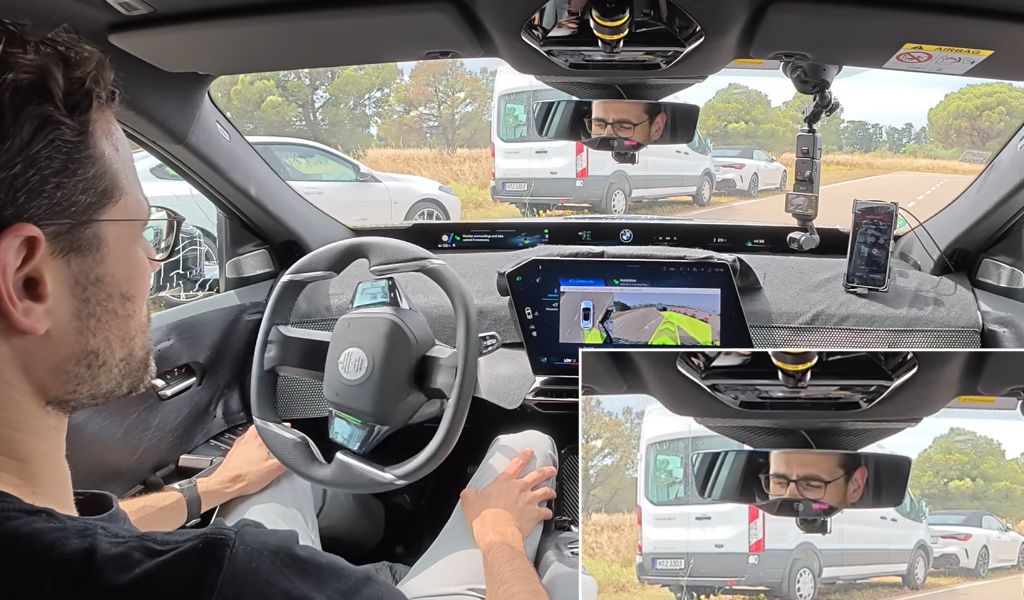
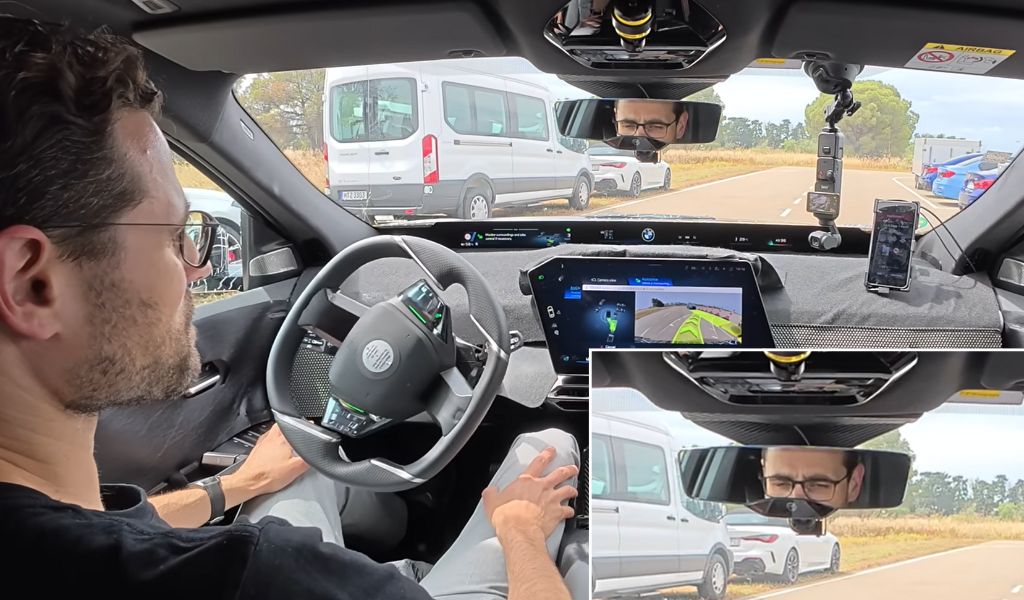
BMW iX3 – Source: YouTube (Autogefühl)
Tesla: Data-Driven Monitoring and the Vision-Only Approach
Tesla’s approach to driver monitoring systems stands apart from traditional OEM strategies. It stands out for its software-centric, data-driven development model. While most automakers integrate multiple sensing modalities and work closely with Tier-1 suppliers, Tesla follows a software-centric, vision-only philosophy rooted in real-world data and fleet-scale AI learning.ms through large-scale, real-world data collection.
Technical Approach
- Camera-Based Monitoring: Tesla’s DMS uses a single, in-cabin camera to monitor driver attentiveness, tracking gaze direction and head orientation, and presence. This system is integrated within Tesla’s broader “Tesla Vision” architecture, which eliminates radar and other inputs.
- Fleet-Based AI Learning: With owner consent, the company collects anonymized data from its global vehicle fleet to train AI models and enhance the robustness of its DMS. This large-scale learning loop enables continuous improvement across diverse real-world conditions, including lighting, driver demographics, and seating positions, which would be difficult to replicate in laboratory environments.
- Continuous Software Iteration: Unlike traditional OEMs, Tesla treats its in-cabin monitoring as a software product.. Over-the-air (OTA) updates allow frequent algorithm enhancements, new features, and calibration improvements for driver state detection — without requiring new hardware.
- Integration with Autopilot/FSD: The DMS operates in tandem with Tesla’s Autopilot and Full Self-Driving systems. It monitors driver engagement and can trigger escalating alerts or system disengagement if the driver appears inattentive, drowsy, or disengaged.
Strategic Priorities
- Rapid Adaptation: Over-the-air updates give Tesla the agility to align its DMS with evolving Euro NCAP protocols or local regulations without redesigning hardware.
- Compliance and Innovation Balance: Tesla must ensure monitoring systems satisfy Euro NCAP criteria while maintaining minimal user friction.
- Data-Driven Optimization: Continuous feedback from millions of vehicles allows for iterative refinement of driver monitoring algorithms, effectively creating a live validation pipeline.
- Minimal Friction, Maximum Insight: Tesla’s goal is to ensure driver attentiveness with minimal intrusiveness, reflecting its user-experience-first philosophy.
- Alignment with Brand Identity: The software-centric model aligns with Tesla’s broader brand identity as a tech innovator, emphasizing software intelligence over traditional component integration.agile automaker.
Controversies and Challenges
Despite its innovative approach, Tesla’s driver monitoring system has faced criticism and scrutiny from regulators and safety experts:
- Privacy Concerns: The company emphasizes user privacy in its driver monitoring system: by default, images and video from the cabin camera remain in the vehicle and are not transmitted unless data sharing is enabled. However, this approach has faced scrutiny, with reports alleging that some Tesla employees shared private footage recorded by customer vehicles, including sensitive content. Additionally, Elon Musk reportedly considered using the cabin camera footage to defend Tesla in potential lawsuits, raising concerns about the extent of data utilization. These incidents have sparked debates about the balance between data collection for safety and the protection of user privacy.
- Inconsistent Driver Monitoring: Some testing and recalls have suggested that the DMS does not always reliably detect driver disengagement when Autopilot is active, prompting NHTSA investigations into system robustness and communication clarity.
- Regulatory Scrutiny: The National Highway Traffic Safety Administration (NHTSA) has raised concerns about Tesla’s Full Self-Driving software, particularly regarding its communication and the potential for misuse.
- Euro NCAP Readiness Questions: As Euro NCAP 2026 places greater weight on in-cabin and driver state monitoring, Tesla’s reliance on a single-camera, software-only setup may face validation challenges in meeting comprehensive assessment criteria, particularly around gaze robustness, child presence detection, and occupant interaction monitoring.
These issues highlight the challenges Tesla faces in balancing innovation with privacy and safety standards.
👉 Outlook: Unlike OEMs such as BMW and Volvo, which rely on Tier-1 partnerships and standardized DMS components to meet Euro NCAP 2026 requirements, Tesla pursues a distinct, software-centric in-cabin monitoring strategy. Leveraging fleet-scale data and rapid over-the-air updates, this approach enables continuous learning and swift adaptation, though it introduces challenges in meeting regulatory expectations for redundancy, explainability, and full occupant coverage. In contrast, other OEMs—including Mercedes-Benz, Stellantis, Hyundai, and Toyota—favor multimodal sensing, AI-enhanced algorithms, and Tier-1 collaboration, balancing compliance, safety robustness, and scalable deployment across their vehicle portfolios.
Other OEMs to Watch: Mercedes-Benz, Stellantis, Hyundai, Toyota
Beyond BMW, Volvo, and Tesla, several other automakers are actively preparing their driver and in-cabin monitoring systems (DMS/IMS) for Euro NCAP 2026. While their strategies differ, a common theme emerges: integrating AI-enhanced sensing, scalable architectures, and supplier collaboration to achieve both safety compliance and production efficiency.
Technical Approach
- Mercedes-Benz: A long-time leader in safety innovation, Mercedes-Benz is advancing multimodal monitoring that combines camera-based vision, radar, and sensor fusion for comprehensive driver and occupant state assessment. The company’s “Attention Assist” and “Interior Assistant” platforms are evolving toward more continuous, AI-driven driver monitoring, designed to detect fatigue, distraction, or unresponsive behavior.
- Stellantis: The Stellantis Group is prioritizing scalability and brand adaptability across its portfolio (Peugeot, Jeep, Fiat, Citroën, and others). By partnering with Tier-1 suppliers, Stellantis is implementing cost-efficient DMS/IMS solutions that can be standardized yet flexibly tuned per brand. Its STLA AutoDrive platform, which includes eyes-off autonomous capabilities, is expected to integrate advanced driver state monitoring as part of its hands-free, Euro NCAP-aligned safety design.

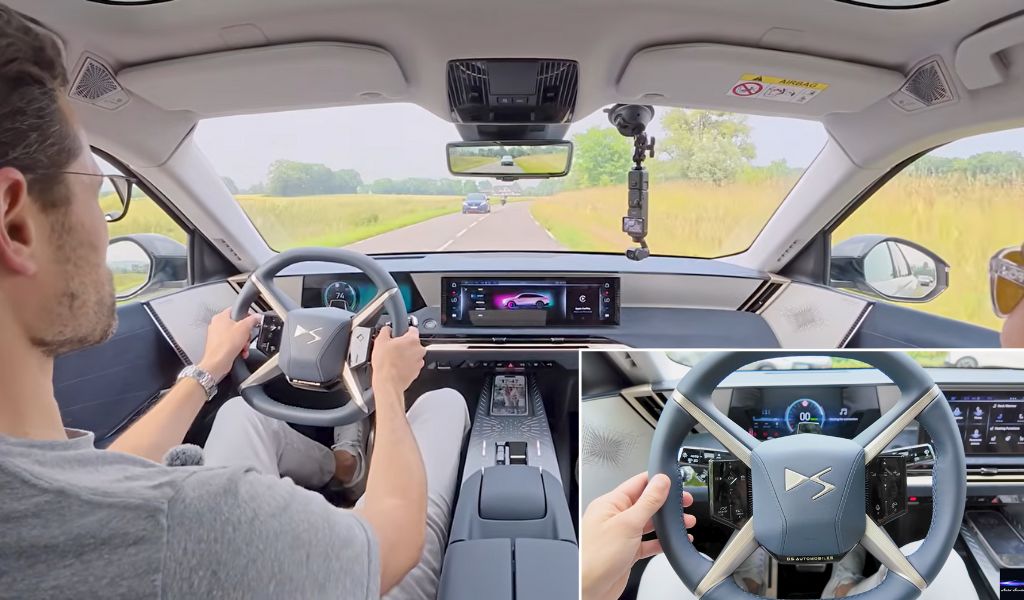
DS8 – Source: YouTube (Autogefühl)
- Hyundai integrates advanced safety technologies through its SmartSense suite, including Driver Attention Warning (DAW) to detect drowsiness or inattention, and Forward Collision-Avoidance Assist (FCA) with Pedestrian Detection to help prevent collisions. Connected features via Bluelink+, such as Geo-Fence, Curfew, and Speed Alerts, further enhance driver safety and vehicle oversight.
- Toyota enhances driver safety through its T-Mate Driving Assistance suite, which includes the Driver Monitor Camera (DMC). This camera, located above the steering wheel, monitors the driver’s alertness and condition. If the system detects signs of fatigue or inattention, it delivers a warning to the driver. These inputs are also utilized to enhance the performance of the Emergency Driving Stop System (EDSS), facilitating earlier detection of inattentiveness. The integration of Toyota Safety Sense further ensures that in-cabin awareness data contributes directly to predictive ADAS behavior.
Strategic Priorities
- Collaboration and supplier partnerships: Most OEMs are leveraging Tier-1 expertise in AI vision, sensor calibration, and validation, accelerating readiness for Euro NCAP 2026 without building every system in-house.
- Balancing compliance and cost: scalable software-defined architectures enable regulatory compliance while maintaining production efficiency.
- Technology differentiation: Mercedes-Benz and Toyota use multimodal sensing and predictive algorithms to reinforce brand safety leadership, while Hyundai and Stellantis emphasize adaptability and volume deployment.
👉 Industry Outlook: These varied approaches illustrate a converging industry trajectory: automakers are unifying driver state monitoring, occupant safety, and child presence detection into a common Euro NCAP framework. What differs is execution, whether via sensor fusion, AI learning loops, or data simulation workflows.

Euro NCAP 2026 Snapshot: Comparing Automaker Approaches to In-Cabin Safety
To provide a clear overview of how different automakers are approaching Euro NCAP 2026 in-cabin monitoring, the table below summarizes technical approaches, strategic focus, and alignment with Euro NCAP requirements.
OEM | Sensor Approach / Technology | Strategic Focus | Euro NCAP Alignment / Readiness |
Volvo | Dual in-cabin cameras (center console + dashboard), infrared sensors, AI | Safety-first, Vision Zero integration, comprehensive monitoring | Exceeds standard Euro NCAP requirements, early adopter of advanced monitoring |
BMW | Cameras + multimodal sensors + AI | Premium experience, human-centric, comfort, and trust | Early alignment, edge-case handling, safety as luxury |
Tesla | Camera-centric, software-driven, OTA updates | Software agility, fleet-based learning, rapid iteration | Vision-only focus, adapts quickly, debates on compliance robustness |
Mercedes-Benz | Cameras + radar + sensor fusion | Premium safety leadership, multimodal integration | Robust compliance, multimodal redundancy for occupant safety |
Stellantis | Camera-centric, Tier-1 partnerships | Scalable, cost-efficient solutions | Compliance across multiple brands, standardized DMS/IMS |
Hyundai | Driver Attention Warning, Forward Collision-Avoidance, SmartSense suite | Driver and occupant safety, reliability, EV safety leadership | Five-star Euro NCAP rating, advanced driver assistance integrated |
Toyota | Driver Monitor Camera, T-Mate Driving Assistance, Safety Sense suite | Driver alertness, collision avoidance, lane support | Strong alignment with Euro NCAP, T-Mate exceeds standard monitoring expectations |
Key Takeaways:
- Premium vs. mass-market OEMs: Premium OEMs (BMW, Mercedes-Benz, Volvo) favor multimodal, AI-enhanced systems for robustness and user experience, while mass-market OEMs (Stellantis, Hyundai, Toyota) emphasize cost-effective, scalable solutions.
- Software vs. sensor-first strategies: Tesla’s camera-first, software-driven approach is distinct and has sparked industry debate regarding robustness and compliance, contrasting with multimodal strategies used by other OEMs.
- Convergence: Across all OEMs, driver state monitoring and child safety are central, reflecting the priorities set by Euro NCAP 2026 protocols.
This overview shows how automakers are taking varied approaches to meet Euro NCAP 2026 in-cabin monitoring requirements. Premium OEMs prioritize multimodal, AI-enhanced systems, mass-market OEMs focus on scalable, cost-efficient solutions, and Tesla emphasizes software-driven, camera-centric monitoring. These differences highlight broader industry trends, including the centrality of driver state and child safety, and set the stage for exploring what this means for the industry in terms of challenges, opportunities, and enabling technologies.

What This Means for the Industry
The strategies outlined across OEMs reveal several key trends shaping in-cabin monitoring and Euro NCAP 2026 compliance.
Convergence on Safety Priorities
- Driver state monitoring, including drowsiness, distraction, and impairment detection, along with child presence detection, has become central to every OEM strategy. Across both premium and mass-market brands alike, these functions are now integral to achieving top Euro NCAP ratings.
- AI-enhanced sensing is increasingly being deployed to analyze driver gaze, head orientation, facial cues, and micro-behavior patterns in real-time. By combining cameras, infrared sensors, radar, and multimodal systems, automakers can monitor occupant state accurately across diverse cabin layouts, lighting conditions, and seating positions.
Balancing Compliance and Privacy
- As Euro NCAP 2026 raises the bar for in-cabin monitoring, OEMs face the dual challenge of ensuring regulatory compliance while maintaining occupant trust. Modern systems must operate effectively yet unobtrusively, respecting privacy expectations.
- Many automakers are leveraging on-device AI and edge processing, which allows sensitive monitoring data to remain within the vehicle, processed locally, and only used to trigger safety interventions. This approach aligns with Euro NCAP requirements and mitigates potential concerns about data misuse, creating a balance between safety and privacy.
Industry Implications
The in-cabin monitoring market appears to be entering a period of gradual stabilization and early maturity, shaped largely by the growing influence of upcoming regulations such as Euro NCAP 2026. Across recent industry discussions and events, there is a sense that key players, from OEMs to Tier-1 and Tier-2 suppliers, are aligning around clearer requirements, shared safety priorities, and proven technological approaches. As a result, the landscape seems to be consolidating, with established players strengthening their positions while new entrants focus on niche innovations and software differentiation.
While this evolution is still unfolding, it signals a market moving from early experimentation toward more standardized, interoperable, and performance-driven solutions. The convergence around core safety functions, careful management of data privacy, and adoption of enabling technologies all point to an ecosystem finding its footing under the guidance of regulation.
Within this context, synthetic data is emerging as a critical enabler in DMS development. Platforms such as Anyverse InCabin enable OEMs and suppliers to accelerate validation, reduce development risk, and ensure that their monitoring systems are prepared for Euro NCAP 2026 readiness.

Synthetic Data for Euro NCAP 2026 In-Cabin Monitoring Assessments
As Euro NCAP 2026 raises the bar for in-cabin monitoring systems, OEMs and suppliers must validate Driver Monitoring Systems (DMS), Occupant Monitoring Systems (OMS), and Child Presence Detection (CPD) across a wide spectrum of real-world scenarios. Market stakeholders have recognized that traditional data collection methods are insufficient to test all complex interior situations, making synthetic data a necessary tool for system assessment.
Aligning with Euro NCAP Test Cases
Anyverse InCabin provides Euro NCAP-aligned synthetic datasets covering all required test scenarios and extending beyond them, enabling automakers to validate their systems comprehensively. Key areas currently evaluated by Euro NCAP include:
Driver Engagement & State Monitoring
- Distraction
- Impairment
Microsleep - Sleep
- Unresponsive Driver
Occupant & Safety Monitoring
- Seatbelt Usage
- Rear Seat Occupancy
- Correct Belt Routing (driver only)
- Occupancy Classification
- Passenger Airbag Deactivation
- Out-of-Position Detection
- Close Proximity to Airbag
- Feet on Dashboard
- Stature Classification (Driver & Passenger)
- Occupant Presence
- Child Presence Detection (CPD)
- Crash Occupancy
By simulating these conditions with parameterized synthetic data, OEMs can ensure that their DMS and OMS are tested under diverse lighting, seating, occupant, and behavior scenarios, covering situations difficult to replicate physically.
Research Collaboration with Euro NCAP
Anyverse has initiated research with Euro NCAP to explore the integration of high-fidelity synthetic data into their assessment framework. This research reflects market growing recognition of synthetic data as a valid, scalable method for system validation and compliance benchmarking. The focus is on:
- Standardizing evaluation protocols for in-cabin monitoring using synthetic data.
- Enhancing testing efficiency, reducing reliance on costly and time-consuming real-world trials.
- Improving safety outcomes by providing repeatable, controlled scenarios across the full range of Euro NCAP test cases.
This research enables OEMs and suppliers to better understand Euro NCAP expectations, validate system robustness, and prepare for 2026 assessments with confidence.
Benefits for OEMs
Using Anyverse InCabin, manufacturers can:
- Validate system performance against all Euro NCAP monitoring requirements.
- Accelerate development cycles by generating on-demand, Euro NCAP-aligned, fully labeled datasets.
- Reduce risk and cost by minimizing exhaustive physical testing
- Demonstrate compliance confidently to regulators and auditors before vehicle deployment.
For more details on how Anyverse is helping OEMs prepare for Euro NCAP 2026 assessments, see: Anyverse & Euro NCAP: Synthetic Data for In-Cabin Monitoring Assessment.

Conclusion: Navigating Global Driver & In-Cabin Monitoring Standards
As 2026 approaches, the real measure of success won’t be just achieving compliance. It will deliver measurable, trusted safety inside every cabin. Compliance with Euro NCAP 2026 protocols is a moving target. OEMs must continuously balance safety, user experience, and technology advances to ensure their vehicles meet evolving standards while maintaining occupant trust.
Looking ahead, stricter Euro NCAP requirements will increasingly shape global product roadmaps. The automakers best positioned to succeed will be those who adapt early, integrate advanced monitoring technologies, and leverage tools like synthetic data to efficiently test, validate, and scale in-cabin monitoring systems, achieving both compliance and robust occupant safety.
👉 Explore the Anyverse In-Cabin Demo to see how Euro NCAP-aligned synthetic data accelerates validation, reduces testing costs, and ensures readiness for 2026 assessments.