
Table of Contents
Table of Contents
In-cabin monitoring systems are redefining vehicle safety, driver awareness, and occupant detection, but their effectiveness hinges on one critical factor: lighting robustness. Whether it’s the harsh glare of a low winter sun, deep shadows during twilight, or the near-total darkness of a night drive, lighting variability remains one of the hardest challenges for vision-based AI. These changing conditions can severely degrade the performance of computer vision models tasked with detecting distracted drivers, unbuckled passengers, or even forgotten infants in the back seat.
For AI to work 24/7 in such environments, models must be trained on data that reflects real-world lighting extremes, including visible and non-visible spectrums such as Near-Infrared (NIR). But collecting this kind of diverse, labeled data at scale is nearly impossible using traditional methods. That’s where high-fidelity, physics-based synthetic data becomes a game-changer, enabling controlled simulation of edge-case lighting conditions, precise annotation, and robust sensor modeling, including NIR and Radar fusion.
To design truly resilient in-cabin perception systems, we must first understand how lighting conditions directly affect model performance. From sensor noise to false detections, the impact of illumination shifts is both subtle and severe, and often overlooked.
Let’s break down why lighting is a critical factor in developing robust in-cabin AI.

Why Lighting Matters for In-Cabin AI
Vehicle interiors are highly dynamic environments where lighting conditions change constantly due to time of day, weather, geographic location, and even passenger behavior. These changes can disrupt vision-based perception models, leading to degraded performance or false outputs, especially in safety-critical applications
Consider just a few common lighting challenges:
- Natural light shifts throughout the day and seasons, introducing strong shadows, glares, and color distortions. Harsh daylight through side windows can overexpose facial features, while shadows from pillars or visors can obscure the driver’s eyes or expression.
- Artificial lighting from dashboard LEDs, street lamps, or infotainment screens, creates inconsistent white balance, reflections, and confusing contrast.
- Rapid transitions, such as tunnels, overpasses, or oncoming headlights, cause sudden exposure swings that can confuse perception models mid-inference.
- Nighttime driving significantly limits the utility of RGB cameras, making it necessary to integrate alternate sensing technologies like Near-Infrared (NIR) or Radar.
These lighting dynamics directly affect Driver Monitoring Systems (DMS), Occupant Monitoring Systems (OMS), and Child Presence Detection (CPD). Errors such as missed blinks, misclassified gaze direction, or undetected passengers can lead to system failures with serious safety implications.
To address this, many OEMs and Tier 1 suppliers are turning to multi-sensor architectures. By fusing data from RGB, NIR, depth cameras, and Radar, these systems can maintain reliable performance under varying illumination. A recent McKinsey report on autonomous vehicle safety highlights sensor robustness across environmental conditions, with lighting variability as a key consideration in the development of perception stacks.
Lighting Robustness Is Critical for Euro NCAP and Safety Certification
In addition to real-world performance, lighting robustness is essential for regulatory compliance and safety certification. For instance, to meet Euro NCAP requirements, systems like Driver Monitoring (DMS) must function reliably across a wide range of lighting conditions, from bright daylight to night driving, and through rapidly changing scenarios like tunnels or sunset glare. These evaluations are designed to assess not just feature availability, but consistent performance under all environmental conditions. Failure to demonstrate lighting-invariant accuracy can result in lower safety ratings or delays in approval. As regulatory bodies continue to raise the bar for in-cabin safety, proving system reliability under diverse lighting is no longer optional — it’s mandatory for certification and market readiness.

Why RGB Alone Isn’t Enough
While RGB cameras are often the default choice for training perception models, they’re inherently limited when it comes to low-light, high-glare, or extreme contrast scenarios — all of which are common in real-world driving. Standard RGB sensors rely entirely on visible light, which means their performance degrades sharply in conditions like night driving, backlighting, or sudden exposure shifts (e.g., when entering or exiting a tunnel).
These limitations pose serious challenges for in-cabin AI systems responsible for tasks like gaze estimation, eye tracking, and occupant detection. For instance, an RGB-based system might fail to detect whether a driver’s eyes are closed if shadows fall across the face, or miss a rear-seat occupant during nighttime due to poor illumination.
To overcome these blind spots, automotive developers are increasingly turning to multi-sensor architectures that combine RGB with complementary modalities such as Near-Infrared (NIR) and Radar. These sensors provide additional data channels less affected by lighting variability, enabling more robust and lighting-invariant perception.
Near-Infrared (NIR): Vision in the Dark
Near-Infrared (NIR) light, invisible to the human eye, is a game-changer for in-cabin monitoring in low or no-light conditions. Automotive NIR systems typically emit wavelengths between 850–1000 nm, enabling cameras to “see” inside the vehicle cabin even when it’s completely dark.
Why NIR is Critical for In-Cabin AI:
- Clear imaging in darkness: NIR provides reliable visual input when RGB cameras fail due to insufficient ambient light.
- Non-intrusive monitoring: Since NIR is invisible to drivers and passengers, it allows continuous observation without causing distraction or discomfort.
- Consistent performance: NIR cameras maintain stable output regardless of varying cabin lighting, shadows, or glare.
A recent report by Yole Group’s “Driving Towards Growth: A $14.3 Billion Automotive Sensor Market Opportunity by 2029,” highlights the accelerating adoption of NIR sensors in new vehicles, both for Advanced Driver Assistance Systems (ADAS) and in-cabin safety features. This growth underscores the importance of multi-modal sensing to achieve robust, lighting-invariant perception.
However, simulating NIR data accurately is far from trivial. Effective modeling must consider not only light intensity but also material-specific reflectance properties, how human skin reacts to infrared light, and how sensors capture and interpret these signals.
At Anyverse, our hyperspectral renderer generates physically accurate synthetic NIR data up to 1000 nm, allowing your AI models to train on visuals that closely mimic real-world sensor inputs, ensuring superior performance across all lighting environments.
Physics-Based NIR Simulation for In-Cabin AI — Sample Generated with Anyverse InCabin
Radar: Going Beyond Vision
Radar technology is rapidly gaining traction in in-cabin monitoring, complementing cameras by detecting depth, movement, and presence in conditions where optical sensors often fail. Unlike RGB or NIR cameras, Frequency-Modulated Continuous Wave (FMCW) radar doesn’t rely on light; it uses electromagnetic waves to create detailed environmental maps and capture subtle micro-movements.
Why Radar Matters for In-Cabin AI:
- Detects presence through occlusions: Radar can identify occupants hidden by blankets or seats, making it ideal for Child Presence Detection (CPD).
- Measures vital signs: By analyzing Doppler shifts, radar can track heart rate and respiration non-invasively.
- Works in extreme conditions: Unlike cameras, radar functions reliably in complete darkness, smoke, or when the view is partially obstructed.
Millimeter-wave (mmWave) radar is already being integrated into production vehicles for passive vital sign monitoring, transforming passenger safety by enabling continuous, contactless observation.
At Anyverse, we simulate radar signals using advanced Shooting and Bouncing Ray (SBR) methods. Our simulation incorporates realistic parameters such as chirp design, MIMO antenna configurations, and generates detailed range-Doppler-angle point clouds. This enables developers to train AI models on rich, sensor-accurate radar data, achieving perception capabilities beyond what camera-only systems can offer.
For a deeper dive, check out our blog post on radar-based in-cabin sensing.

DMS Sensor Fusion + Synthetic Data to Ensure In-Cabin Safety
Sensor Fusion: Smarter Together
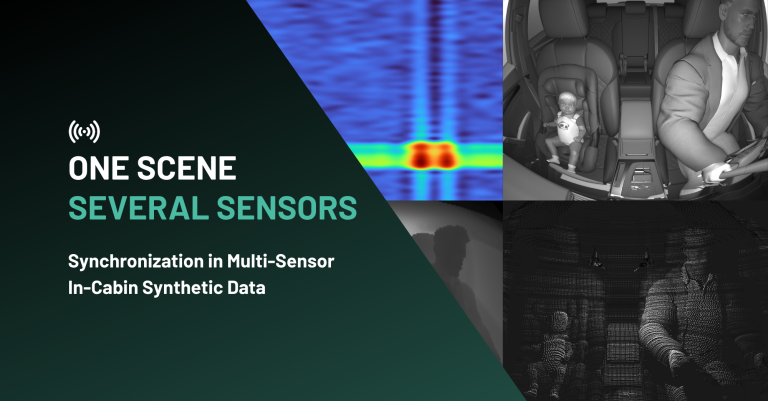
The future of in-cabin perception lies in multi-modal sensor fusion, combining data from NIR, Radar, RGB cameras, and even Time-of-Flight (ToF) sensors to build a comprehensive, reliable understanding of vehicle occupants and their behavior.
Consider how sensor fusion enhances robustness:
- If NIR vision is blocked by sunglasses or reflections, Radar can still detect movement.
- If Radar misses subtle posture changes, NIR can supply visual details.
- When one or more sensors are compromised by environmental factors, fusion AI integrates the available data to make accurate, confident decisions no single sensor could achieve alone.
This redundancy and complementary sensing are critical for safety-critical applications, providing fail-safe perception even when individual sensors experience noise, occlusion, or failure.
To develop and validate such sophisticated fusion models, synchronized and physically accurate synthetic datasets spanning all sensor modalities are essential. This is where the Anyverse InCabin platform excels, offering developers Euro NCAP-aligned, multi-sensor synthetic data generation tailored for NIR, Radar, RGB, and ToF sensors. With Anyverse, training lighting-robust, sensor-fused AI models becomes efficient, scalable, and grounded in real-world physics.

Synthetic Data: The Foundation for Generalization and Compliance
Collecting real-world data that covers every possible lighting condition and sensor scenario is practically impossible. Consider the challenges:
- Continuous 24/7 recordings across all weather, lighting, and environmental conditions.
- Capturing dozens of human subjects in diverse, safety-critical situations, such as sleeping children or drivers wearing sunglasses.
- Obtaining painstaking, pixel-level annotations perfectly synchronized across multiple sensor modalities.
These hurdles make synthetic data indispensable for developing in-cabin AI systems that are both robust and scalable.
With the Anyverse InCabin platform, developers can procedurally generate photorealistic, sensor-accurate synthetic scenarios tailored to complex real-world challenges, including:
- Glare from sunroofs, windows, and digital screens
- Drivers entering and exiting tunnels with rapidly changing illumination
- Nighttime Child Presence Detection (CPD) with occlusions and varying posture
- Realistic motion blur, lens artifacts, and infrared bloom effects
Each synthetic frame comes with automated, pixel-perfect ground-truth annotations perfectly aligned across all sensor types – RGB, NIR, Radar, and ToF. This multi-sensor accuracy is crucial for training AI models that generalize well to unseen conditions and sensor inputs.
Moreover, Anyverse’s synthetic data generation is designed to support Euro NCAP compliance and validation workflows. By simulating edge cases and lighting extremes required by Euro NCAP’s rigorous testing protocols, Anyverse helps developers validate and certify their in-cabin AI systems with confidence and efficiency, reducing time-to-market and regulatory risk.
For a deeper dive into rare but critical scenarios, see our blog post on in-cabin AI edge cases and how synthetic data addresses these challenges.

Integrating Synthetic Lighting Scenarios into Your AI Pipeline
Synthetic data is not a replacement for real-world data — it’s a powerful tool to complement and enhance your training and validation efforts by filling critical blind spots, especially in challenging lighting conditions. Here’s a proven workflow to maximize its impact:
Step 1: Identify Lighting Edge Cases
Map out specific scenarios where your current model struggles, such as backlit passengers, dark tunnels, or low-light winter evenings.
Step 2: Configure Your Virtual Sensor Suite
Customize synthetic data generation to match the specifications of your in-cabin sensors — whether RGB, NIR, Radar, or Time-of-Flight (ToF).
Step 3: Generate Realistic Synthetic Data
Create varied datasets featuring authentic environmental conditions, lighting transitions, and sensor artifacts to simulate real-world complexity.
Step 4: Conduct Lighting-Focused Validation
Evaluate your model’s performance across diverse lighting scenarios, leveraging fused sensor inputs to ensure robustness before deployment.
Step 5: Iterate and Improve
Use validation feedback to refine simulations and retrain models, closing performance gaps by targeting the toughest lighting challenges.
By integrating synthetic data early and continuously in your pipeline, you can stress-test AI models against any lighting environment, accelerating development and ensuring safer, more reliable in-cabin systems.

In-Cabin and AI Lighting: More Than a Technical Challenge
Reliable performance of in-cabin AI under all lighting conditions goes beyond a technical achievement—it directly impacts road safety and regulatory compliance. A Driver Monitoring System (DMS) blinded by harsh sunlight glare may fail to detect drowsiness, increasing accident risk. Similarly, a Child Presence Detection (CPD) system that misses a sleeping toddler hidden in darkness could lead to tragic consequences.
Automotive OEMs now face growing pressure from regulatory bodies like Euro NCAP and the US NHTSA to meet stringent safety benchmarks across diverse scenarios, including low-light, glare, and occluded environments. Meeting these standards requires AI models that are robust to every lighting challenge.
How Synthetic Data Powers Safer In-Cabin AI
- Drowsiness Detection at Night: Training with synthetic NIR data simulating varied nighttime lighting conditions improves detection of micro-sleeps and prolonged eye closures.
- Child Detection in Shadows: Synthetic scenarios recreate children obscured by car seats or blankets in dim cabins, boosting CPD recall rates.
- Radar in Low Visibility: High-fidelity synthetic radar data supports accurate occupant tracking when cameras struggle in glare or darkness.
Ensuring consistent, lighting-invariant AI performance isn’t just innovation — it’s a matter of saving lives, meeting evolving safety regulations, and building consumer trust in the next generation of connected, autonomous vehicles.
Conclusion: Lighting the Path to Safer AI
From bright daylight to complete darkness, in-cabin AI systems must perform flawlessly to ensure passenger safety at all times. By leveraging advanced sensor fusion with Near-Infrared (NIR) and Radar technologies—combined with physics-based synthetic data—developers can build perception models that operate reliably, regardless of lighting conditions.
At Anyverse, we provide a powerful platform tailored for multi-sensor simulation and fusion, delivering high-fidelity synthetic data that accelerates AI training, testing, and validation. Our solutions are designed to help automotive developers future-proof their in-cabin AI systems against the unpredictable and complex lighting environments found inside vehicles.
Ready to see how Anyverse InCabin can transform your AI development? Request a demo or contact us today to learn more about building lighting-robust, safety-compliant in-cabin perception systems.