
How Simulation Solves the Challenges of Building Robust Radar-Based In-Cabin Sensing Systems
How-Simulation-Solves-the-Challenges-of-Building-Robust-Radar-Based-In-Cabin-Sensing-Systems-Featured
SHARE

Table of Contents

Table of Contents

Automotive safety technologies are evolving rapidly, with in-cabin monitoring systems (ICMS) becoming essential for ensuring driver safety, occupant well-being, and compliance with emerging regulations. These systems are responsible for detecting drowsiness, tracking occupant presence, and even monitoring vital signs—contributing to reducing accidents and helping vehicles meet future safety standards.

To achieve precise and reliable in-cabin sensing systems, manufacturers increasingly rely on advanced technologies, particularly sensor fusion, which combines camera and radar systems. Cameras provide rich visual data, while radar enhances depth perception, movement tracking, and even heart rate monitoring. However, training and validating AI models to accurately interpret data from both sensors presents a challenge, requiring high-quality, diverse, and scalable datasets. This is where simulation and synthetic data, especially when combined with real-world data, prove invaluable. Physics-based simulation offers a compliant, safe, and accurate means of pre-validating (or virtually validating) systems before real-world testing.

In this article, we will explore the fundamentals of radar-based in-cabin monitoring systems, discuss their advantages and challenges, and uncover how simulation can help build more robust and reliable radar-based systems. Radar technology is especially powerful when combined with camera sensors, enabling a safer and more accurate in-cabin monitoring solution through sensor fusion.

Let’s start from the beginning—why can’t in-cabin monitoring systems rely on just one type of sensor?

Seeing or Sensing? Why In-Cabin Monitoring Can't Rely on Just One Technology

In-cabin monitoring systems must function accurately across a wide range of real-world conditions—day and night, sun or fog, eyes open or closed. Relying on a single sensing technology simply isn’t enough. That’s why modern systems increasingly turn to a fusion of camera and radar sensors, each offering unique and complementary strengths.

  • Camera-Based In-Cabin Monitoring Systems: Camera sensors excel at facial expression analysis, gaze tracking, and gesture recognition, making them ideal for detecting driver attention, behavior, and emotional state.
  • Radar-Based In-Cabin Monitoring Systems: Radar sensors detect depth, movement, and even micro-movements like heartbeats and breathing rates. It enables continuous monitoring even in low-light or occluded conditions, darkness and fog, or when the line of sight is blocked.
  • Camera and Radar-Based In-Cabin Monitoring Systems: Sensor Fusion (cameras + radar) significantly enhances accuracy by compensating for each technology’s limitations. It reduces false positives and boosts reliability in complex real-world environments.

By combining camera-based visual interpretation with radar’s depth and motion sensing, AI-powered in-cabin monitoring becomes more robust, adaptable, and trustworthy—meeting the demands of both safety-critical performance and regulatory compliance. Read more about in-cabin monitoring system technology in our previous blogpost. 

Beyond Vision: How Radar Unlocks New In-Cabin AI Capabilities

While camera-based systems play a vital role in monitoring driver and occupant behavior, they have inherent limitations—particularly in unpredictable or low-visibility conditions. Relying on visual data alone can lead to blind spots, reducing system effectiveness in scenarios where safety matters most.

Camera-only systems often struggle in conditions such as:

  • Low-light environments (e.g., tunnels, nighttime driving).
  • Obstructions (e.g., sunglasses, hats, hands covering the face).
  • Occlusions (e.g., when an occupant is partially hidden by a seatbelt or airbag).

Radar technology overcomes these limitations by adding a new layer of perception:

  • Vital Sign Detection: Measures heart rate and breathing patterns to detect drowsiness, stress, or medical emergencies.
  • Occupant Presence Sensing: Detects people, including children, left in vehicles, even under blankets or behind seats.
  • All-Condition Reliability: Radar operates in darkness, fog, and through material and objects like clothing or seats. 
  • Beyond Line-of-Sight Sensing: Detect movement behind objects like seats or through barriers like blankets, making it crucial for child presence detection.
  • Micro-movement tracking: Captures subtle posture shifts or breathing patterns invisible to the human eye or camera.

By integrating radar with cameras, AI models can detect subtle movements that cameras alone might miss, improving safety, regulatory compliance, and user experience.

The Doppler Effect: Enhancing Radar's Sensitivity

A fundamental principle in radar technology is the Doppler Effect, which refers to the change in frequency of a wave in relation to an observer moving relative to the wave source.

  • In in-cabin monitoring, the Doppler Effect enables radar systems to detect even the slightest movements, such as a sleeping infant’s gentle breathing or an adult’s heartbeat.
  • These micro-Doppler signatures are crucial for accurately monitoring occupant status, detecting drowsiness, and assessing medical emergencies.


By combining radar’s deep sensing capabilities with the rich visual context provided by cameras, in-cabin AI systems can deliver a more complete, reliable, and context-aware understanding of what’s happening inside the vehicle. This fusion not only enhances safety and compliance with emerging regulations but also paves the way for smarter, more intuitive user experiences.

The Challenge: Training and Validating AI for In-Cabin Monitoring Systems

Developing AI algorithms for next-generation in-cabin monitoring systems—especially those that rely on camera and radar sensor fusion—demands large-scale, high-quality datasets. These datasets must reflect the vast diversity of real-world conditions, behaviors, and edge cases, including:

  • Occupant behavior variation: sleeping, interacting with a phone, leaning back, slouching, or moving unpredictably.
  • Environmental diversity: daylight glare, complete darkness, fogged or tinted windows, or fast-changing lighting conditions.
  • Rare but critical edge cases: detecting a child hidden under a blanket or identifying an unresponsive driver in motion.
Why Real-World Data Collection Falls Short

Collecting enough real-world data to train robust AI models presents major challenges:

  • High Cost and Time Investment: – Capturing thousands of hours of synchronized sensor data in multiple environments is slow and expensive.
  • Privacy and Compliance Risks: – Using real occupants, especially children, raises major concerns around GDPR, consent, and personal data security
  • Poor Edge Case Coverage – Real-world scenarios are unpredictable, and safety-critical edge cases are often too rare—or dangerous—to capture in practice.
Validation: A Hidden but Critical Bottleneck

Beyond training, validating AI systems is equally complex. Traditional physical prototyping methods introduce additional challenges:

  • Fragmented Development Workflow: Developers must independently design, build, test, and analyze each component—sensor stack, perception algorithm, and the driver or occupant monitoring system itself (DMS/OMS).


  • Real-World Testing Limitations: To validate across realistic driving scenarios, teams may need to close public roads (often requiring support from local authorities), coordinate test drivers, and safely simulate edge cases—all of which adds cost, risk, and complexity.


  • Human Variation is Hard to Capture: Achieving coverage across diverse demographics—age, gender, ethnicity, body types—as well as accessories (glasses, hats), seating positions, and behaviors, is resource-intensive and logistically challenging.


  • Dynamic Regulations: Evolving legislation and NCAP safety scoring protocols require systems to be revalidated frequently as standards change.
The Bottom Line: Physical Testing Alone Isn’t Enough

Validation is not optional—it’s essential to achieving regulatory approval and NCAP compliance. However, relying solely on physical testing is unviable due to the virtually infinite number of scenarios and edge cases that must be covered. This is where virtual simulation and physics-based synthetic data become critical. They offer a scalable, safe, and efficient way to both train and validate AI models under controlled, repeatable, and diverse conditions—bridging the gap between development goals and real-world readiness.

Synthetic Data: A Scalable Solution for AI Training and Validation

Synthetic data—highly realistic data that simulates real-world sensor inputs—has become a game-changing tool in the development of AI-powered in-cabin monitoring systems. With Anyverse’s physics-based simulation, it’s possible to generate camera and radar data with full control over every variable, accelerating development while solving the key challenges of training and validation.

How Anyverse Simulation Solves Real Development Challenges
  • Diverse & Scalable: Generate an unlimited range of scenarios, including rare and safety-critical edge cases—like a child hidden under a coat or an unresponsive driver slumping in the seat—without needing to stage or capture them in real life.
  • Cost-Effective & Fast: Eliminate the need to physically record, annotate, and manage thousands of hours of multi-sensor data. Simulation dramatically reduces development time and cost.
  • Privacy-Compliant by Design: Because synthetic data involves no real people, it avoids privacy issues and complies fully with data protection regulations like GDPR.
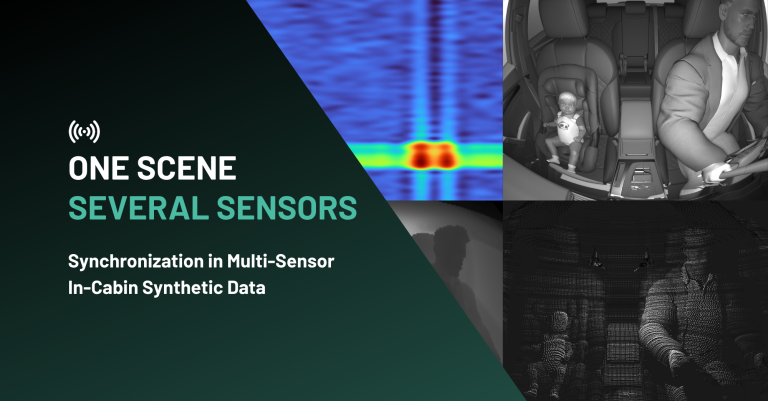
  • Sensor-Fusion Ready: Anyverse ensures perfect synchronization and alignment between camera and radar data, improving AI model accuracy and robustness in complex multi-modal scenarios.
  • Realistic Simulation of Complex Interactions: For instance, synthetic data can simulate radar waves reflecting off a sleeping passenger’s chest while aligning this with a camera feed showing the person’s face in darkness—scenarios that are nearly impossible to capture in real life.
Added Benefits for In-Cabin System Development

Anyverse simulation doesn’t just improve AI training—it transforms the entire system development pipeline:

  • Safer Testing: Reduce the risk and complexity of dangerous physical test scenarios.
  • Infinite Variation: Effortlessly model passengers of different ages, genders, ethnicities, body types, and behaviors.
  • Accessory & Pose Diversity: Simulate the impact of glasses, hats, blankets, seat positions, phone use, and more.
  • Accelerated Validation: Test perception models against evolving NCAP requirements and global regulations with repeatable, traceable, and automated virtual test cases.

How to Use Anyverse InCabin to generate Data for Radar + CameraIn-Cabin AI Models

Training AI models for in-cabin monitoring doesn’t have to be complicated. With Anyverse InCabin, generating high-quality synthetic data for radar and camera sensor fusion is fast, intuitive, and fully customizable—no deep simulation expertise required.

Here’s how it works:

1. Log In and Explore Use Cases

Get started instantly by browsing a library of pre-built in-cabin safety scenarios, from Driver Monitoring Systems (DMS) to Occupant Monitoring (OMS) and Child Presence Detection (CPD). Every use case is aligned with the latest safety standards, such as Euro NCAP and the EU AI Act.

2. Define Critical Scenarios

Identify and configure the key safety scenarios you want to simulate, such as:

  • Drowsy driving: Slow blinks, head nods, irregular heart rate.
  • Child presence: Covered objects in the rear seat with micro-movement detection.
  • Medical emergencies: Sudden stillness, interrupted breathing patterns.
3. Select and Customize Your Cabin

Choose from pre-configured vehicle cabins or upload your own 3D cabin model. You can customize seat layouts, materials, sensor positions, and more, making it easy to mirror real-world vehicle environments.

4. Tailor the Dataset

Define key simulation parameters like:

  • Occupant age, gender, body type, and behavior.

  • Sensor modalities, placement, and characteristics (camera + radar).

  • Lighting, weather, occlusion scenarios, and object interactions.

You can even fine-tune statistical distributions to ensure your dataset is balanced and bias-free—crucial for ethical and robust AI performance.

5. Launch & Generate with One Click

Once configured, Anyverse handles the heavy lifting. The platform automatically generates fully annotated, structured, and physically accurate datasets—with perfect radar-camera alignment, realistic sensor noise, and environmental variability.

6. Download and Integrate

Seamlessly download the dataset directly from the platform and plug it into your machine learning pipeline for training and validation. It’s that simple.

By combining this streamlined workflow with the power of physics-based simulation, Anyverse helps teams build more accurate, safer, and regulation-ready AI systems—faster and with greater confidence.

Conclusion: Building Safer In-Cabin AI with Sensor Fusion and Simulation

Creating next-generation in-cabin monitoring systems requires more than just advanced sensors—it demands a smarter approach to AI development. Throughout this article, we’ve seen why relying on a single sensor type isn’t enough:

  • Cameras provide rich visual data but struggle in low light or obstructed views.
  • Radar adds crucial depth and motion sensing, even in darkness or through materials.
  • Together, they enable more reliable, accurate, and safe monitoring systems—especially for critical scenarios like drowsy driving, child presence detection, and medical emergencies.

But combining camera and radar also introduces complexity. Training AI to interpret and fuse both sensor types calls for massive, diverse, and high-quality datasets—far beyond what real-world data alone can provide. That’s where physics-based synthetic data from platforms like Anyverse becomes essential.

By integrating physics-based synthetic data, automotive OEMs and suppliers can:

  • Accelerate AI development timelines with fast, automated dataset generation
  • Reduce costs and privacy risks associated with real-world data 
  • Improve accuracy and sensor fusion performance across edge cases and rare scenarios
  • Enhance validation with scalable, repeatable simulations that support safety certifications

As in-cabin monitoring becomes a regulatory requirement and a competitive differentiator, simulation and synthetic data are no longer optional—they’re critical. Combining sensor fusion with virtual validation is the most efficient path to building reliable, regulation-ready in-cabin AI systems.
Enjoyed this article?

Add us as a Preferred Source on Google to see more content like this in Discover and Top Stories.

About Anyverse

With over 25 years of heritage in physics-based simulation and a 2008 Academy Technical Achievement Award, Anyverse is a leading provider of high-fidelity synthetic data and validation tools for advanced Perception AI.

While Anyverse remains a premier partner for the Automotive market, specializing in In-Cabin Monitoring systems and ADAS, its technology is increasingly adopted across Defence, Robotics, and Industry 4.0. Leveraging a proprietary physics-grounded engine, procedural synthetic data generation, and next-gen Generative AI, Anyverse produces datasets with unmatched realism and sensor-level accuracy (including RGB, NIR, Radar, LiDAR, and Thermal).

Its unified validation framework helps partners ensure compliance with specific regulations like Euro NCAP, as well as broader safety standards for autonomous systems. By bridging the gap between simulation and reality, Anyverse accelerates development, reduces costs, and ensures trustworthy perception for vehicles, robots, and intelligent machines.

How Simulation Solves the Challenges of Building Robust Radar-Based In-Cabin Sensing Systems

How-Simulation-Solves-the-Challenges-of-Building-Robust-Radar-Based-In-Cabin-Sensing-Systems-Featured
SHARE

Table of Contents

Table of Contents

Automotive safety technologies are evolving rapidly, with in-cabin monitoring systems (ICMS) becoming essential for ensuring driver safety, occupant well-being, and compliance with emerging regulations. These systems are responsible for detecting drowsiness, tracking occupant presence, and even monitoring vital signs—contributing to reducing accidents and helping vehicles meet future safety standards.

To achieve precise and reliable in-cabin sensing systems, manufacturers increasingly rely on advanced technologies, particularly sensor fusion, which combines camera and radar systems. Cameras provide rich visual data, while radar enhances depth perception, movement tracking, and even heart rate monitoring. However, training and validating AI models to accurately interpret data from both sensors presents a challenge, requiring high-quality, diverse, and scalable datasets. This is where simulation and synthetic data, especially when combined with real-world data, prove invaluable. Physics-based simulation offers a compliant, safe, and accurate means of pre-validating (or virtually validating) systems before real-world testing.

In this article, we will explore the fundamentals of radar-based in-cabin monitoring systems, discuss their advantages and challenges, and uncover how simulation can help build more robust and reliable radar-based systems. Radar technology is especially powerful when combined with camera sensors, enabling a safer and more accurate in-cabin monitoring solution through sensor fusion.

Let’s start from the beginning—why can’t in-cabin monitoring systems rely on just one type of sensor?

Seeing or Sensing? Why In-Cabin Monitoring Can't Rely on Just One Technology

In-cabin monitoring systems must function accurately across a wide range of real-world conditions—day and night, sun or fog, eyes open or closed. Relying on a single sensing technology simply isn’t enough. That’s why modern systems increasingly turn to a fusion of camera and radar sensors, each offering unique and complementary strengths.

  • Camera-Based In-Cabin Monitoring Systems: Camera sensors excel at facial expression analysis, gaze tracking, and gesture recognition, making them ideal for detecting driver attention, behavior, and emotional state.
  • Radar-Based In-Cabin Monitoring Systems: Radar sensors detect depth, movement, and even micro-movements like heartbeats and breathing rates. It enables continuous monitoring even in low-light or occluded conditions, darkness and fog, or when the line of sight is blocked.
  • Camera and Radar-Based In-Cabin Monitoring Systems: Sensor Fusion (cameras + radar) significantly enhances accuracy by compensating for each technology’s limitations. It reduces false positives and boosts reliability in complex real-world environments.

By combining camera-based visual interpretation with radar’s depth and motion sensing, AI-powered in-cabin monitoring becomes more robust, adaptable, and trustworthy—meeting the demands of both safety-critical performance and regulatory compliance. Read more about in-cabin monitoring system technology in our previous blogpost. 

Beyond Vision: How Radar Unlocks New In-Cabin AI Capabilities

While camera-based systems play a vital role in monitoring driver and occupant behavior, they have inherent limitations—particularly in unpredictable or low-visibility conditions. Relying on visual data alone can lead to blind spots, reducing system effectiveness in scenarios where safety matters most.

Camera-only systems often struggle in conditions such as:

  • Low-light environments (e.g., tunnels, nighttime driving).
  • Obstructions (e.g., sunglasses, hats, hands covering the face).
  • Occlusions (e.g., when an occupant is partially hidden by a seatbelt or airbag).

Radar technology overcomes these limitations by adding a new layer of perception:

  • Vital Sign Detection: Measures heart rate and breathing patterns to detect drowsiness, stress, or medical emergencies.
  • Occupant Presence Sensing: Detects people, including children, left in vehicles, even under blankets or behind seats.
  • All-Condition Reliability: Radar operates in darkness, fog, and through material and objects like clothing or seats. 
  • Beyond Line-of-Sight Sensing: Detect movement behind objects like seats or through barriers like blankets, making it crucial for child presence detection.
  • Micro-movement tracking: Captures subtle posture shifts or breathing patterns invisible to the human eye or camera.

By integrating radar with cameras, AI models can detect subtle movements that cameras alone might miss, improving safety, regulatory compliance, and user experience.

The Doppler Effect: Enhancing Radar's Sensitivity

A fundamental principle in radar technology is the Doppler Effect, which refers to the change in frequency of a wave in relation to an observer moving relative to the wave source.

  • In in-cabin monitoring, the Doppler Effect enables radar systems to detect even the slightest movements, such as a sleeping infant’s gentle breathing or an adult’s heartbeat.
  • These micro-Doppler signatures are crucial for accurately monitoring occupant status, detecting drowsiness, and assessing medical emergencies.


By combining radar’s deep sensing capabilities with the rich visual context provided by cameras, in-cabin AI systems can deliver a more complete, reliable, and context-aware understanding of what’s happening inside the vehicle. This fusion not only enhances safety and compliance with emerging regulations but also paves the way for smarter, more intuitive user experiences.

The Challenge: Training and Validating AI for In-Cabin Monitoring Systems

Developing AI algorithms for next-generation in-cabin monitoring systems—especially those that rely on camera and radar sensor fusion—demands large-scale, high-quality datasets. These datasets must reflect the vast diversity of real-world conditions, behaviors, and edge cases, including:

  • Occupant behavior variation: sleeping, interacting with a phone, leaning back, slouching, or moving unpredictably.
  • Environmental diversity: daylight glare, complete darkness, fogged or tinted windows, or fast-changing lighting conditions.
  • Rare but critical edge cases: detecting a child hidden under a blanket or identifying an unresponsive driver in motion.
Why Real-World Data Collection Falls Short

Collecting enough real-world data to train robust AI models presents major challenges:

  • High Cost and Time Investment: – Capturing thousands of hours of synchronized sensor data in multiple environments is slow and expensive.
  • Privacy and Compliance Risks: – Using real occupants, especially children, raises major concerns around GDPR, consent, and personal data security
  • Poor Edge Case Coverage – Real-world scenarios are unpredictable, and safety-critical edge cases are often too rare—or dangerous—to capture in practice.
Validation: A Hidden but Critical Bottleneck

Beyond training, validating AI systems is equally complex. Traditional physical prototyping methods introduce additional challenges:

  • Fragmented Development Workflow: Developers must independently design, build, test, and analyze each component—sensor stack, perception algorithm, and the driver or occupant monitoring system itself (DMS/OMS).


  • Real-World Testing Limitations: To validate across realistic driving scenarios, teams may need to close public roads (often requiring support from local authorities), coordinate test drivers, and safely simulate edge cases—all of which adds cost, risk, and complexity.


  • Human Variation is Hard to Capture: Achieving coverage across diverse demographics—age, gender, ethnicity, body types—as well as accessories (glasses, hats), seating positions, and behaviors, is resource-intensive and logistically challenging.


  • Dynamic Regulations: Evolving legislation and NCAP safety scoring protocols require systems to be revalidated frequently as standards change.
The Bottom Line: Physical Testing Alone Isn’t Enough

Validation is not optional—it’s essential to achieving regulatory approval and NCAP compliance. However, relying solely on physical testing is unviable due to the virtually infinite number of scenarios and edge cases that must be covered. This is where virtual simulation and physics-based synthetic data become critical. They offer a scalable, safe, and efficient way to both train and validate AI models under controlled, repeatable, and diverse conditions—bridging the gap between development goals and real-world readiness.

Synthetic Data: A Scalable Solution for AI Training and Validation

Synthetic data—highly realistic data that simulates real-world sensor inputs—has become a game-changing tool in the development of AI-powered in-cabin monitoring systems. With Anyverse’s physics-based simulation, it’s possible to generate camera and radar data with full control over every variable, accelerating development while solving the key challenges of training and validation.

How Anyverse Simulation Solves Real Development Challenges
  • Diverse & Scalable: Generate an unlimited range of scenarios, including rare and safety-critical edge cases—like a child hidden under a coat or an unresponsive driver slumping in the seat—without needing to stage or capture them in real life.
  • Cost-Effective & Fast: Eliminate the need to physically record, annotate, and manage thousands of hours of multi-sensor data. Simulation dramatically reduces development time and cost.
  • Privacy-Compliant by Design: Because synthetic data involves no real people, it avoids privacy issues and complies fully with data protection regulations like GDPR.
  • Sensor-Fusion Ready: Anyverse ensures perfect synchronization and alignment between camera and radar data, improving AI model accuracy and robustness in complex multi-modal scenarios.
  • Realistic Simulation of Complex Interactions: For instance, synthetic data can simulate radar waves reflecting off a sleeping passenger’s chest while aligning this with a camera feed showing the person’s face in darkness—scenarios that are nearly impossible to capture in real life.
Added Benefits for In-Cabin System Development

Anyverse simulation doesn’t just improve AI training—it transforms the entire system development pipeline:

  • Safer Testing: Reduce the risk and complexity of dangerous physical test scenarios.
  • Infinite Variation: Effortlessly model passengers of different ages, genders, ethnicities, body types, and behaviors.
  • Accessory & Pose Diversity: Simulate the impact of glasses, hats, blankets, seat positions, phone use, and more.
  • Accelerated Validation: Test perception models against evolving NCAP requirements and global regulations with repeatable, traceable, and automated virtual test cases.

How to Use Anyverse InCabin to generate Data for Radar + CameraIn-Cabin AI Models

Training AI models for in-cabin monitoring doesn’t have to be complicated. With Anyverse InCabin, generating high-quality synthetic data for radar and camera sensor fusion is fast, intuitive, and fully customizable—no deep simulation expertise required.

Here’s how it works:

1. Log In and Explore Use Cases

Get started instantly by browsing a library of pre-built in-cabin safety scenarios, from Driver Monitoring Systems (DMS) to Occupant Monitoring (OMS) and Child Presence Detection (CPD). Every use case is aligned with the latest safety standards, such as Euro NCAP and the EU AI Act.

2. Define Critical Scenarios

Identify and configure the key safety scenarios you want to simulate, such as:

  • Drowsy driving: Slow blinks, head nods, irregular heart rate.
  • Child presence: Covered objects in the rear seat with micro-movement detection.
  • Medical emergencies: Sudden stillness, interrupted breathing patterns.
3. Select and Customize Your Cabin

Choose from pre-configured vehicle cabins or upload your own 3D cabin model. You can customize seat layouts, materials, sensor positions, and more, making it easy to mirror real-world vehicle environments.

4. Tailor the Dataset

Define key simulation parameters like:

  • Occupant age, gender, body type, and behavior.

  • Sensor modalities, placement, and characteristics (camera + radar).

  • Lighting, weather, occlusion scenarios, and object interactions.

You can even fine-tune statistical distributions to ensure your dataset is balanced and bias-free—crucial for ethical and robust AI performance.

5. Launch & Generate with One Click

Once configured, Anyverse handles the heavy lifting. The platform automatically generates fully annotated, structured, and physically accurate datasets—with perfect radar-camera alignment, realistic sensor noise, and environmental variability.

6. Download and Integrate

Seamlessly download the dataset directly from the platform and plug it into your machine learning pipeline for training and validation. It’s that simple.

By combining this streamlined workflow with the power of physics-based simulation, Anyverse helps teams build more accurate, safer, and regulation-ready AI systems—faster and with greater confidence.

Conclusion: Building Safer In-Cabin AI with Sensor Fusion and Simulation

Creating next-generation in-cabin monitoring systems requires more than just advanced sensors—it demands a smarter approach to AI development. Throughout this article, we’ve seen why relying on a single sensor type isn’t enough:

  • Cameras provide rich visual data but struggle in low light or obstructed views.
  • Radar adds crucial depth and motion sensing, even in darkness or through materials.
  • Together, they enable more reliable, accurate, and safe monitoring systems—especially for critical scenarios like drowsy driving, child presence detection, and medical emergencies.

But combining camera and radar also introduces complexity. Training AI to interpret and fuse both sensor types calls for massive, diverse, and high-quality datasets—far beyond what real-world data alone can provide. That’s where physics-based synthetic data from platforms like Anyverse becomes essential.

By integrating physics-based synthetic data, automotive OEMs and suppliers can:

  • Accelerate AI development timelines with fast, automated dataset generation
  • Reduce costs and privacy risks associated with real-world data 
  • Improve accuracy and sensor fusion performance across edge cases and rare scenarios
  • Enhance validation with scalable, repeatable simulations that support safety certifications

As in-cabin monitoring becomes a regulatory requirement and a competitive differentiator, simulation and synthetic data are no longer optional—they’re critical. Combining sensor fusion with virtual validation is the most efficient path to building reliable, regulation-ready in-cabin AI systems.

Enjoyed this article?

Tap to add us as a Preferred Source on Google to see more content like this.

About Anyverse

With over 25 years of heritage in physics-based simulation and a 2008 Academy Technical Achievement Award, Anyverse is a leading provider of high-fidelity synthetic data and validation tools for advanced Perception AI.

While Anyverse remains a premier partner for the Automotive market, specializing in In-Cabin Monitoring systems and ADAS, its technology is increasingly adopted across Defence, Robotics, and Industry 4.0. Leveraging a proprietary physics-grounded engine, procedural synthetic data generation, and next-gen Generative AI, Anyverse produces datasets with unmatched realism and sensor-level accuracy (including RGB, NIR, Radar, LiDAR, and Thermal).

Its unified validation framework helps partners ensure compliance with specific regulations like Euro NCAP, as well as broader safety standards for autonomous systems. By bridging the gap between simulation and reality, Anyverse accelerates development, reduces costs, and ensures trustworthy perception for vehicles, robots, and intelligent machines.