
Impairment Detection Validation: A Ground Truth Problem, Not an Algorithm Problem
NIR driver monitoring frame: inferred impairment for impairment detection validation
SHARE

Table of Contents

Accurate against what?

Consider a routine question in impairment detection validation: what is the detection rate for a driver at 0.5 g/L blood alcohol (0.05% BAC), 40 minutes into a night drive, observed by a NIR driver monitoring camera? Answering it requires a dataset that records which drivers were at 0.5 g/L, when they reached it, and which drivers were not impaired at all. The driver and values are illustrative; the requirement is general.

A common explanation is that impairment detection models are not accurate enough yet. The reading is reasonable, since a low score looks like a weak model. But accuracy is a measurement against a reference, meaning an independently verified record of the state each sample shows. Where the reference is missing or bounded, “not accurate enough” is an untested claim.

Impairment detection is constrained by the limited availability of valid ground truth, not by model capability. This is a data validity problem.

Take the driver above. A detector can be scored against a label inferred from the footage, but the score then measures agreement with the label’s assumptions as much as the detector’s performance.

The sections that follow define impairment and explain how Euro NCAP credits its detection. They set out what valid ground truth requires, show why naturalistic footage cannot supply it and why controlled studies supply it only within bounds, and describe how synthetic data can, including where its own validity comes from.

What counts as impairment in driver monitoring

Impairment is a reduction in the driver’s capacity to perform the driving task, caused by a substance or an acute medical event. It persists until the cause resolves, and the driver cannot correct it by redirecting attention. Driver impairment detection, as used here, means identifying that state from in-cabin sensing.

Two neighboring states already have dedicated warning systems. Distraction is attention directed away from the road, with driving capacity intact and the state transient; advanced driver distraction warning (ADDW) addresses it. Drowsiness is declining arousal that develops over time; driver drowsiness and attention warning (DDAW) addresses it.

The scope here is intoxication (alcohol and drugs) and sudden incapacitation, meaning unresponsiveness. Euro NCAP’s 2026 Driver Engagement protocol uses “impairment” more broadly, to include drowsiness. The two states in scope here correspond to two separate items in that protocol, covered in the next section. Emotional and cognitive states such as stress or panic fall outside this scope, and the protocol does not score them.

The boundary with drowsiness needs care, because the categories can overlap in one driver. Severe drowsiness can converge on unresponsiveness, and a fatigued driver can also be intoxicated; the illustrative driver above is both. The same decline in arousal counts as drowsiness when sleep pressure and time on task cause it, and as impairment when a sedating substance does. The categories therefore differ by cause and dynamics, not necessarily by what the camera sees, which is why cause has to be part of the record.

Impairment detection is rated, not mandated

The General Safety Regulation (GSR), Regulation (EU) 2019/2144, mandates two driver-state warning systems for categories M and N. DDAW applies to new vehicle types from 6 July 2022 and to all new vehicles from 7 July 2024; ADDW applies to new types from 7 July 2024 and to all new vehicles from 7 July 2026. Their technical rules are set in Delegated Regulations 2021/1341 and 2023/2590.

GSR does not mandate impairment detection. The only alcohol-related system Article 6(1) lists is alcohol interlock installation facilitation, a standardized interface for fitting aftermarket interlock devices.

Impairment enters through Euro NCAP, a voluntary rating program. Its 2026 Driver Engagement protocol awards 2 of its 25 Driver Monitoring points for a warning and intervention when the system detects impairment unrelated to fatigue, such as from alcohol or drugs, and and 2 more when an emergency function brings an unresponsive driver’s vehicle to a safe stop or below 10 km/h. Interlock interfaces are excluded from the impairment credit.

Credit is awarded on the basis of a manufacturer dossier, with spot checks by the test laboratory. The dossier reports a true positive rate and false alerts per hour, measured on datasets the dossier describes. In the dossier guidance (SD-201, version 1.1), the true positive datasets for non-transient states have no defined subject count, and non-fatigue impairment is the one non-transient state without an indicative true positive rate. The guidance labels its indicative values as not pass criteria.

GSR mandates. Euro NCAP rates.
Impairment detection appears only in the rating.
GSR, Regulation (EU) 2019/2144
Mandates systems for type approval
6 Jul 2022
DDAW, new vehicle types
7 Jul 2024
DDAW, all new vehicles
ADDW, new vehicle types
7 Jul 2026
ADDW, all new vehicles
Impairment detection is not mandated. The only alcohol-related system it lists is interlock installation facilitation, a standardized interface for fitting aftermarket devices.
Euro NCAP 2026, Driver Engagement protocol
Awards points in a voluntary rating
Driver Monitoring: 25 points
Transient states Non-transient states
15
2
2
2
2
2
Non-fatigue impairment2 points: warning 0.5, intervention 1.5
Unresponsive driver2 points: emergency function brings the vehicle to a safe stop or below 10 km/h
Drowsiness, microsleep, and sleep: 2 points each
SD-201 dossier guidance (v1.1): non-transient true positive datasets have no defined subject count, and non-fatigue impairment has no indicative true positive rate.
Sources: Regulation (EU) 2019/2144; Euro NCAP Safe Driving, Driver Engagement protocol v1.2 (July 2026); Euro NCAP Technical Bulletin SD-201 v1.1.

For OEMs and Tier-1s, the consequence is direct: credit for impairment depends on evidence of how a system performs across impairment states, and that evidence can be no stronger than the ground truth it was measured against. Synthetic data provides parameterized evidence that can support a validation argument; the OEM constructs and owns that argument.

What valid ground truth requires

Ground truth for driver monitoring is an independently verified record of the state a sample represents, established when the sample is captured or generated, not inferred from the sample afterward. For impairment, that record has five components:

  • Cause or causes, including co-occurring states such as fatigue.
  • Severity, measured on a defined scale such as blood alcohol in g/L, not rated by an observer.
  • Onset and trajectory, needed to measure time to detection.
  • Verified negatives, including look-alikes such as a fatigued but sober driver, squinting into glare, eyewear, and age-related eyelid changes, needed to measure the false-positive rate.
  • Reproducibility: the same state can be produced again under the same conditions, so a result can be re-run.

Not every driver state is equally hard to document. Whether the eyes are open or closed is in the frame, and a labeler can verify it. Drowsiness is not in the frame, so DDAW validation measures participants on the Karolinska Sleepiness Scale (KSS). Alternatives such as EEG, PERCLOS, and expert video rating are allowed, but each must be shown equivalent to the KSS threshold (Delegated Regulation 2021/1341). 

The Euro NCAP protocol likewise refers to a KSS level or an equivalent metric for drowsiness; for impairment unrelated to fatigue, it names none. Where an intervention ends because the impaired state has passed, the protocol asks the manufacturer to substantiate how the vehicle determines that, which is a verified-negative question in all but name.

Where the reference lives
The camera is the same in each case. What changes is where the reference sits, and whether one is named.
Checkable from the frameNo named reference
Eyes open or closed
Reference
In the frame
Validation uses
A labeler verifies it directly
Verifiable
Drowsiness
Reference
Outside the frame
Validation uses
KSS self-report, or an alternative shown equivalent to it
DDAW, Delegated Regulation (EU) 2021/1341
Proxy reference
Non-fatigue impairment
Reference
Outside the frame
Validation uses
No reference named in the rating protocol
Euro NCAP names KSS or an equivalent for drowsiness, none for this state
No named reference
Valid ground truth records cause, severity, onset and trajectory, verified negatives, and reproducibility.
Sources: Commission Delegated Regulation (EU) 2021/1341; Euro NCAP Safe Driving, Driver Engagement protocol v1.2 (July 2026).

Ground truth for impairment is also temporal. A per-frame “impaired” label cannot express onset or trajectory, so it cannot support the metrics validation depends on. Trajectory is also a variable in alcohol research: a study of acute tolerance compares effects at the same blood alcohol level on the rising and falling limbs of the curve.

The illustrative driver shows what this demands. Valid ground truth means the blood alcohol value, when it was reached, whether it was rising or falling at minute 40, the co-occurring fatigue state on a defined scale, and a matched sober sequence. The next section applies these five components to real-world footage.

Three ways real-world footage falls short

Naturalistic footage and controlled studies meet the five components very differently. Three limits keep each short of the ground truth that validation needs, though not equally: the third applies to naturalistic footage only. 

Ethical limits on induction

Controlled induction exists, and it produces measured ground truth. One peer-reviewed study tested 20 volunteers sober and at blood alcohol levels titrated to 0.5 and 0.9 g/L, in a simulator and on a closed track. A camera dataset recorded 60 participants in three breath-measured alcohol bands (sober, 0.5 to 0.7 g/L, and 0.8 g/L and above) with RGB, infrared, and 3D facial video, and a separate simulator study used driver monitoring cameras with 30 participants. Drug studies exist as well, such as one in which 16 drivers received a benzodiazepine in real-world and simulated driving.

These datasets are also bounded. The camera dataset is simulator-based, and its authors note that studying people who drive under the influence is impractical for legal reasons. A 2025 clinical study tested four drugs (oxycodone, lorazepam, lisdexamphetamine, and cannabis) in 48 healthy volunteers, 12 per drug, staying within therapeutic doses, and its authors state that abuse-level doses cannot be tested safely in healthy volunteers. Sudden incapacitation is different in kind. Euro NCAP classifies a driver as unresponsive by observable criteria, such as eyes closed for six seconds or more, and an actor can perform those. The real event cannot be induced: a participant cannot be made unresponsive at the wheel, so the way an actual collapse presents is missing from collected data, and footage of a real event does not by itself record its cause.

No shared signature

At a matched blood alcohol level, people still differ. The camera dataset’s authors cite drinking habit and age among the factors reported to change the response, and they normalize each participant against that person’s own sober baseline. Causes can also point in opposite directions: in the same clinical study, oxycodone constricted pupils and lisdexamphetamine dilated them. 

Severity is continuous, but the camera dataset labels it in three bands set with reference to legal limits, and assigns one band to each 10-minute drive, so the label cannot show how blood alcohol changed within it. In real footage of the illustrative driver, the two causes arrive together, and the frames carry no measured split between them.

Labels without a reference

In naturalistic footage, labelers infer an internal state from external cues. Inter-annotator agreement measures how consistent labelers are with each other, not whether they are right. This limit applies to naturalistic footage; in controlled studies, cause and severity are measured. Euro NCAP’s dossier guidance describes false alerts per hour as measured on naturalistic recordings in which detections are reviewed; it does not describe a measured record of the driver’s state. 

Collecting more naturalistic footage multiplies unverified labels. The barrier is validity, not volume.

The table compares what each source can verify. Its last row is the one criterion where real recordings win: they capture the native sensor domain, which synthetic data has to model.

Criterion

Naturalistic footage

Controlled studies

Synthetic data

Cause known (incl. co-occurring states)

Not by default

Yes; co-occurring states only if measured

Yes (specified)

Severity measured

Not by default

Yes, within the dosed range

Any specified value

Onset and trajectory

Not by default

Partly (dosing time, set test points)

Yes (specified)

Verified negatives

Not by default

Yes (sober sessions)

Yes (specified)

Reproducibility

No

Partly

Yes (specified)

Same subject, only severity varied

No

Partly (separate sessions)

Yes

Native sensor domain

Yes

Depends on rig

Modeled; residual sim-to-real gap 

Specifying impairment instead of inferring it

A common framing treats synthetic data for driver monitoring as a patch for gaps in real-world datasets, mostly rare scenarios. For impairment, that framing understates the role. Outside the bounds described above, there is no measured dataset to patch.

Parameters, not labels

In synthetic generation, the state is an input. Cause, severity, onset, and trajectory are specified before any frame is rendered, so the label is the specification. The parameter space has four axes:

  • State: cause class, severity value, onset time, trajectory, and co-occurring states such as fatigue level.
  • Behavioral manifestation: eyelid closure dynamics and PERCLOS, blink duration and frequency, gaze dispersion and saccade behavior, pupil diameter, head-pose sway, postural change, response latency.
  • Subject: age, sex, stature, skin complexion, eyelid aperture, facial morphology, eyewear, facial hair.
  • Cabin and sensor: ambient light, NIR wavelength and illuminator placement, camera position and field of view, occlusions such as masks, hats, and hand position.

Euro NCAP’s protocol lists several of these axes, with ranges, as noise variables, among them Fitzpatrick skin types 1 to 6, eyelid aperture from 6.0 to 12.0 mm, and ambient light from 1 to 100,000 lux. The axes come from the problem itself: a system scores Driver Monitoring points only if it covers the full range of each listed variable.

Counterfactual pairs

A counterfactual pair holds the subject, cabin, and illumination fixed and changes one variable. A sweep of the illustrative driver runs the same subject at 0.0, 0.3, 0.5, 0.8, and 1.2 g/L, with the co-occurring fatigue state held at one specified level, which makes the detection threshold measurable. The same logic isolates trajectory, with 0.5 g/L reached on a rising and on a falling course. Hard negatives follow from the same mechanism: the sober driver after 40 minutes of night driving, the driver squinting into low sun, the driver in heavy eyewear.

Holding illumination fixed, or sweeping it explicitly, matters. The authors of the 2025 clinical study note that a sober pupil is large in dim light, which makes dilation harder to detect, and small in bright light, which makes constriction harder to detect. 

Traceability

Every sample links to the parameters that defined it. A detection failure then traces to a parameter region, such as missed detections concentrated at low severity under one illumination condition, instead of to an unexplained label. Real-world labels have no equivalent trace unless the state was independently recorded, as in controlled studies. Auditable here means a reviewer can see what each sample represents, and why.

For the parts of the space that collection cannot reach, synthetic data is the only path to auditable ground truth: causes and doses that cannot be administered, states such as sudden incapacitation that cannot be induced, and comparisons in which a single variable changes while everything else stays fixed. Controlled studies provide it within their bounds.

Where synthetic ground truth gets its validity

The strongest objection to synthetic ground truth is that a synthetic label is only as valid as the model of how impairment looks. If the behavioral model is wrong, every label it produces is wrong with full confidence. The answer has three parts.

  • Assumptions can be made explicit. Each behavioral parameter can map to a declared source in published physiological and clinical findings. Real-world labels rest on similar assumptions, but those sit inside annotator judgment, where no one can review them.
  • The sensor side is modeled physically. Here “physics-based” refers to the sensing chain, not to motion or dynamics: the image is computed from modeled light transport, material reflectance, and sensor response, not from visual plausibility. A NIR camera does not record an RGB image. Its output depends on skin and eye reflectance at the illuminator’s wavelength, the illuminator’s placement and pattern, the lens, the image signal processor, and low-light noise, and the Euro NCAP protocol itself ties sunglasses transmittance to the wavelength the camera operates at. Spectral rendering with a sensor model addresses that axis of the sim-to-real gap.
  • Real data changes role. Controlled-study recordings at measured blood alcohol, like those described above, check the behavioral model instead of supplying its labels: parameter distributions such as blink duration, PERCLOS, and gaze dispersion are compared at matched severity. A mismatch then points to a specific parameter to revise.

What remains is the behavioral model, which is the residual sim-to-real gap. Where matched recordings exist, the model can be checked against them; where they do not, as with sudden incapacitation, it rests on published findings alone. Because the assumptions are declared, they can be updated, and the data regenerated as the evidence grows.

For the illustrative driver, every assumption behind a sequence can be written down and attributed to a source, from the blink-duration shift to the gaze dispersion to the fatigue contribution. For a real-world clip labeled “possibly impaired,” the label records none of them. Auditable does not mean correct. It means checkable: a reviewer can find the error and fix it.

What to ask before comparing detection rates

The opening question asked for the detection rate of a model for the illustrative driver, 40 minutes into a night drive at 0.5 g/L. Answering it takes a reference that records that state, and the sections above set out what such a reference contains. The constraint in impairment detection is the availability of valid ground truth, not the model.

That changes how two results should be compared. Before comparing impairment detection validation results, ask the questions that map to the five components of valid ground truth: which cause or causes the sequences represent, which severity range was measured, how onset and trajectory were defined, which negatives were verified, and whether the result can be re-run. A detection rate without that record has no stated reference, so comparing two of them says little about either model.

Anyverse INCABIN generates physics-based synthetic in-cabin sequences in which each sample carries the parameters that defined it. An impairment model is only as credible as the record of what it was tested against.

Enjoyed this article?

Add us as a Preferred Source on Google to see more content like this in Discover and Top Stories.

About Anyverse

With over 25 years of heritage in physics-based simulation and a 2008 Academy Technical Achievement Award, Anyverse is a leading provider of high-fidelity synthetic data and validation tools for advanced Perception AI.

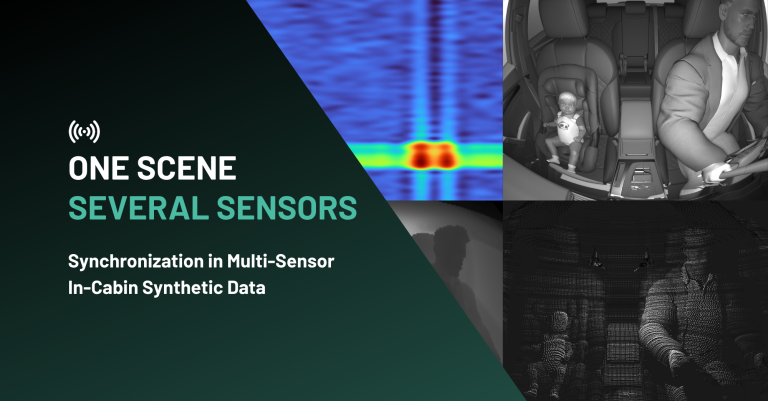
While Anyverse remains a premier partner for the Automotive market, specializing in In-Cabin Monitoring systems and ADAS, its technology is increasingly adopted across Defence, Robotics, and Industry 4.0. Leveraging a proprietary physics-grounded engine, procedural synthetic data generation, and next-gen Generative AI, Anyverse produces datasets with unmatched realism and sensor-level accuracy (including RGB, NIR, Radar, LiDAR, and Thermal).

Its unified validation framework helps partners ensure compliance with specific regulations like Euro NCAP, as well as broader safety standards for autonomous systems. By bridging the gap between simulation and reality, Anyverse accelerates development, reduces costs, and ensures trustworthy perception for vehicles, robots, and intelligent machines.

Impairment Detection Validation: A Ground Truth Problem, Not an Algorithm Problem

NIR driver monitoring frame: inferred impairment for impairment detection validation
SHARE

Table of Contents

Accurate against what?

Consider a routine question in impairment detection validation: what is the detection rate for a driver at 0.5 g/L blood alcohol (0.05% BAC), 40 minutes into a night drive, observed by a NIR driver monitoring camera? Answering it requires a dataset that records which drivers were at 0.5 g/L, when they reached it, and which drivers were not impaired at all. The driver and values are illustrative; the requirement is general.

A common explanation is that impairment detection models are not accurate enough yet. The reading is reasonable, since a low score looks like a weak model. But accuracy is a measurement against a reference, meaning an independently verified record of the state each sample shows. Where the reference is missing or bounded, “not accurate enough” is an untested claim.

Impairment detection is constrained by the limited availability of valid ground truth, not by model capability. This is a data validity problem.

Take the driver above. A detector can be scored against a label inferred from the footage, but the score then measures agreement with the label’s assumptions as much as the detector’s performance.

The sections that follow define impairment and explain how Euro NCAP credits its detection. They set out what valid ground truth requires, show why naturalistic footage cannot supply it and why controlled studies supply it only within bounds, and describe how synthetic data can, including where its own validity comes from.

What counts as impairment in driver monitoring

Impairment is a reduction in the driver’s capacity to perform the driving task, caused by a substance or an acute medical event. It persists until the cause resolves, and the driver cannot correct it by redirecting attention. Driver impairment detection, as used here, means identifying that state from in-cabin sensing.

Two neighboring states already have dedicated warning systems. Distraction is attention directed away from the road, with driving capacity intact and the state transient; advanced driver distraction warning (ADDW) addresses it. Drowsiness is declining arousal that develops over time; driver drowsiness and attention warning (DDAW) addresses it.

The scope here is intoxication (alcohol and drugs) and sudden incapacitation, meaning unresponsiveness. Euro NCAP’s 2026 Driver Engagement protocol uses “impairment” more broadly, to include drowsiness. The two states in scope here correspond to two separate items in that protocol, covered in the next section. Emotional and cognitive states such as stress or panic fall outside this scope, and the protocol does not score them.

The boundary with drowsiness needs care, because the categories can overlap in one driver. Severe drowsiness can converge on unresponsiveness, and a fatigued driver can also be intoxicated; the illustrative driver above is both. The same decline in arousal counts as drowsiness when sleep pressure and time on task cause it, and as impairment when a sedating substance does. The categories therefore differ by cause and dynamics, not necessarily by what the camera sees, which is why cause has to be part of the record.

Impairment detection is rated, not mandated

The General Safety Regulation (GSR), Regulation (EU) 2019/2144, mandates two driver-state warning systems for categories M and N. DDAW applies to new vehicle types from 6 July 2022 and to all new vehicles from 7 July 2024; ADDW applies to new types from 7 July 2024 and to all new vehicles from 7 July 2026. Their technical rules are set in Delegated Regulations 2021/1341 and 2023/2590.

GSR does not mandate impairment detection. The only alcohol-related system Article 6(1) lists is alcohol interlock installation facilitation, a standardized interface for fitting aftermarket interlock devices.

Impairment enters through Euro NCAP, a voluntary rating program. Its 2026 Driver Engagement protocol awards 2 of its 25 Driver Monitoring points for a warning and intervention when the system detects impairment unrelated to fatigue, such as from alcohol or drugs, and and 2 more when an emergency function brings an unresponsive driver’s vehicle to a safe stop or below 10 km/h. Interlock interfaces are excluded from the impairment credit.

Credit is awarded on the basis of a manufacturer dossier, with spot checks by the test laboratory. The dossier reports a true positive rate and false alerts per hour, measured on datasets the dossier describes. In the dossier guidance (SD-201, version 1.1), the true positive datasets for non-transient states have no defined subject count, and non-fatigue impairment is the one non-transient state without an indicative true positive rate. The guidance labels its indicative values as not pass criteria.

GSR mandates. Euro NCAP rates.
Impairment detection appears only in the rating.
GSR, Regulation (EU) 2019/2144
Mandates systems for type approval
6 Jul 2022
DDAW, new vehicle types
7 Jul 2024
DDAW, all new vehicles
ADDW, new vehicle types
7 Jul 2026
ADDW, all new vehicles
Impairment detection is not mandated. The only alcohol-related system it lists is interlock installation facilitation, a standardized interface for fitting aftermarket devices.
Euro NCAP 2026, Driver Engagement protocol
Awards points in a voluntary rating
Driver Monitoring: 25 points
Transient states Non-transient states
15
2
2
2
2
2
Non-fatigue impairment2 points: warning 0.5, intervention 1.5
Unresponsive driver2 points: emergency function brings the vehicle to a safe stop or below 10 km/h
Drowsiness, microsleep, and sleep: 2 points each
SD-201 dossier guidance (v1.1): non-transient true positive datasets have no defined subject count, and non-fatigue impairment has no indicative true positive rate.
Sources: Regulation (EU) 2019/2144; Euro NCAP Safe Driving, Driver Engagement protocol v1.2 (July 2026); Euro NCAP Technical Bulletin SD-201 v1.1.

For OEMs and Tier-1s, the consequence is direct: credit for impairment depends on evidence of how a system performs across impairment states, and that evidence can be no stronger than the ground truth it was measured against. Synthetic data provides parameterized evidence that can support a validation argument; the OEM constructs and owns that argument.

What valid ground truth requires

Ground truth for driver monitoring is an independently verified record of the state a sample represents, established when the sample is captured or generated, not inferred from the sample afterward. For impairment, that record has five components:

  • Cause or causes, including co-occurring states such as fatigue.
  • Severity, measured on a defined scale such as blood alcohol in g/L, not rated by an observer.
  • Onset and trajectory, needed to measure time to detection.
  • Verified negatives, including look-alikes such as a fatigued but sober driver, squinting into glare, eyewear, and age-related eyelid changes, needed to measure the false-positive rate.
  • Reproducibility: the same state can be produced again under the same conditions, so a result can be re-run.

Not every driver state is equally hard to document. Whether the eyes are open or closed is in the frame, and a labeler can verify it. Drowsiness is not in the frame, so DDAW validation measures participants on the Karolinska Sleepiness Scale (KSS). Alternatives such as EEG, PERCLOS, and expert video rating are allowed, but each must be shown equivalent to the KSS threshold (Delegated Regulation 2021/1341). 

The Euro NCAP protocol likewise refers to a KSS level or an equivalent metric for drowsiness; for impairment unrelated to fatigue, it names none. Where an intervention ends because the impaired state has passed, the protocol asks the manufacturer to substantiate how the vehicle determines that, which is a verified-negative question in all but name.

Where the reference lives
The camera is the same in each case. What changes is where the reference sits, and whether one is named.
Checkable from the frameNo named reference
Eyes open or closed
Reference
In the frame
Validation uses
A labeler verifies it directly
Verifiable
Drowsiness
Reference
Outside the frame
Validation uses
KSS self-report, or an alternative shown equivalent to it
DDAW, Delegated Regulation (EU) 2021/1341
Proxy reference
Non-fatigue impairment
Reference
Outside the frame
Validation uses
No reference named in the rating protocol
Euro NCAP names KSS or an equivalent for drowsiness, none for this state
No named reference
Valid ground truth records cause, severity, onset and trajectory, verified negatives, and reproducibility.
Sources: Commission Delegated Regulation (EU) 2021/1341; Euro NCAP Safe Driving, Driver Engagement protocol v1.2 (July 2026).

Ground truth for impairment is also temporal. A per-frame “impaired” label cannot express onset or trajectory, so it cannot support the metrics validation depends on. Trajectory is also a variable in alcohol research: a study of acute tolerance compares effects at the same blood alcohol level on the rising and falling limbs of the curve.

The illustrative driver shows what this demands. Valid ground truth means the blood alcohol value, when it was reached, whether it was rising or falling at minute 40, the co-occurring fatigue state on a defined scale, and a matched sober sequence. The next section applies these five components to real-world footage.

Three ways real-world footage falls short

Naturalistic footage and controlled studies meet the five components very differently. Three limits keep each short of the ground truth that validation needs, though not equally: the third applies to naturalistic footage only. 

Ethical limits on induction

Controlled induction exists, and it produces measured ground truth. One peer-reviewed study tested 20 volunteers sober and at blood alcohol levels titrated to 0.5 and 0.9 g/L, in a simulator and on a closed track. A camera dataset recorded 60 participants in three breath-measured alcohol bands (sober, 0.5 to 0.7 g/L, and 0.8 g/L and above) with RGB, infrared, and 3D facial video, and a separate simulator study used driver monitoring cameras with 30 participants. Drug studies exist as well, such as one in which 16 drivers received a benzodiazepine in real-world and simulated driving.

These datasets are also bounded. The camera dataset is simulator-based, and its authors note that studying people who drive under the influence is impractical for legal reasons. A 2025 clinical study tested four drugs (oxycodone, lorazepam, lisdexamphetamine, and cannabis) in 48 healthy volunteers, 12 per drug, staying within therapeutic doses, and its authors state that abuse-level doses cannot be tested safely in healthy volunteers. Sudden incapacitation is different in kind. Euro NCAP classifies a driver as unresponsive by observable criteria, such as eyes closed for six seconds or more, and an actor can perform those. The real event cannot be induced: a participant cannot be made unresponsive at the wheel, so the way an actual collapse presents is missing from collected data, and footage of a real event does not by itself record its cause.

No shared signature

At a matched blood alcohol level, people still differ. The camera dataset’s authors cite drinking habit and age among the factors reported to change the response, and they normalize each participant against that person’s own sober baseline. Causes can also point in opposite directions: in the same clinical study, oxycodone constricted pupils and lisdexamphetamine dilated them. 

Severity is continuous, but the camera dataset labels it in three bands set with reference to legal limits, and assigns one band to each 10-minute drive, so the label cannot show how blood alcohol changed within it. In real footage of the illustrative driver, the two causes arrive together, and the frames carry no measured split between them.

Labels without a reference

In naturalistic footage, labelers infer an internal state from external cues. Inter-annotator agreement measures how consistent labelers are with each other, not whether they are right. This limit applies to naturalistic footage; in controlled studies, cause and severity are measured. Euro NCAP’s dossier guidance describes false alerts per hour as measured on naturalistic recordings in which detections are reviewed; it does not describe a measured record of the driver’s state. 

Collecting more naturalistic footage multiplies unverified labels. The barrier is validity, not volume.

The table compares what each source can verify. Its last row is the one criterion where real recordings win: they capture the native sensor domain, which synthetic data has to model.

Criterion

Naturalistic footage

Controlled studies

Synthetic data

Cause known (incl. co-occurring states)

Not by default

Yes; co-occurring states only if measured

Yes (specified)

Severity measured

Not by default

Yes, within the dosed range

Any specified value

Onset and trajectory

Not by default

Partly (dosing time, set test points)

Yes (specified)

Verified negatives

Not by default

Yes (sober sessions)

Yes (specified)

Reproducibility

No

Partly

Yes (specified)

Same subject, only severity varied

No

Partly (separate sessions)

Yes

Native sensor domain

Yes

Depends on rig

Modeled; residual sim-to-real gap 

Specifying impairment instead of inferring it

A common framing treats synthetic data for driver monitoring as a patch for gaps in real-world datasets, mostly rare scenarios. For impairment, that framing understates the role. Outside the bounds described above, there is no measured dataset to patch.

Parameters, not labels

In synthetic generation, the state is an input. Cause, severity, onset, and trajectory are specified before any frame is rendered, so the label is the specification. The parameter space has four axes:

  • State: cause class, severity value, onset time, trajectory, and co-occurring states such as fatigue level.
  • Behavioral manifestation: eyelid closure dynamics and PERCLOS, blink duration and frequency, gaze dispersion and saccade behavior, pupil diameter, head-pose sway, postural change, response latency.
  • Subject: age, sex, stature, skin complexion, eyelid aperture, facial morphology, eyewear, facial hair.
  • Cabin and sensor: ambient light, NIR wavelength and illuminator placement, camera position and field of view, occlusions such as masks, hats, and hand position.

Euro NCAP’s protocol lists several of these axes, with ranges, as noise variables, among them Fitzpatrick skin types 1 to 6, eyelid aperture from 6.0 to 12.0 mm, and ambient light from 1 to 100,000 lux. The axes come from the problem itself: a system scores Driver Monitoring points only if it covers the full range of each listed variable.

Counterfactual pairs

A counterfactual pair holds the subject, cabin, and illumination fixed and changes one variable. A sweep of the illustrative driver runs the same subject at 0.0, 0.3, 0.5, 0.8, and 1.2 g/L, with the co-occurring fatigue state held at one specified level, which makes the detection threshold measurable. The same logic isolates trajectory, with 0.5 g/L reached on a rising and on a falling course. Hard negatives follow from the same mechanism: the sober driver after 40 minutes of night driving, the driver squinting into low sun, the driver in heavy eyewear.

Holding illumination fixed, or sweeping it explicitly, matters. The authors of the 2025 clinical study note that a sober pupil is large in dim light, which makes dilation harder to detect, and small in bright light, which makes constriction harder to detect. 

Traceability

Every sample links to the parameters that defined it. A detection failure then traces to a parameter region, such as missed detections concentrated at low severity under one illumination condition, instead of to an unexplained label. Real-world labels have no equivalent trace unless the state was independently recorded, as in controlled studies. Auditable here means a reviewer can see what each sample represents, and why.

For the parts of the space that collection cannot reach, synthetic data is the only path to auditable ground truth: causes and doses that cannot be administered, states such as sudden incapacitation that cannot be induced, and comparisons in which a single variable changes while everything else stays fixed. Controlled studies provide it within their bounds.

Where synthetic ground truth gets its validity

The strongest objection to synthetic ground truth is that a synthetic label is only as valid as the model of how impairment looks. If the behavioral model is wrong, every label it produces is wrong with full confidence. The answer has three parts.

  • Assumptions can be made explicit. Each behavioral parameter can map to a declared source in published physiological and clinical findings. Real-world labels rest on similar assumptions, but those sit inside annotator judgment, where no one can review them.
  • The sensor side is modeled physically. Here “physics-based” refers to the sensing chain, not to motion or dynamics: the image is computed from modeled light transport, material reflectance, and sensor response, not from visual plausibility. A NIR camera does not record an RGB image. Its output depends on skin and eye reflectance at the illuminator’s wavelength, the illuminator’s placement and pattern, the lens, the image signal processor, and low-light noise, and the Euro NCAP protocol itself ties sunglasses transmittance to the wavelength the camera operates at. Spectral rendering with a sensor model addresses that axis of the sim-to-real gap.
  • Real data changes role. Controlled-study recordings at measured blood alcohol, like those described above, check the behavioral model instead of supplying its labels: parameter distributions such as blink duration, PERCLOS, and gaze dispersion are compared at matched severity. A mismatch then points to a specific parameter to revise.

What remains is the behavioral model, which is the residual sim-to-real gap. Where matched recordings exist, the model can be checked against them; where they do not, as with sudden incapacitation, it rests on published findings alone. Because the assumptions are declared, they can be updated, and the data regenerated as the evidence grows.

For the illustrative driver, every assumption behind a sequence can be written down and attributed to a source, from the blink-duration shift to the gaze dispersion to the fatigue contribution. For a real-world clip labeled “possibly impaired,” the label records none of them. Auditable does not mean correct. It means checkable: a reviewer can find the error and fix it.

What to ask before comparing detection rates

The opening question asked for the detection rate of a model for the illustrative driver, 40 minutes into a night drive at 0.5 g/L. Answering it takes a reference that records that state, and the sections above set out what such a reference contains. The constraint in impairment detection is the availability of valid ground truth, not the model.

That changes how two results should be compared. Before comparing impairment detection validation results, ask the questions that map to the five components of valid ground truth: which cause or causes the sequences represent, which severity range was measured, how onset and trajectory were defined, which negatives were verified, and whether the result can be re-run. A detection rate without that record has no stated reference, so comparing two of them says little about either model.

Anyverse INCABIN generates physics-based synthetic in-cabin sequences in which each sample carries the parameters that defined it. An impairment model is only as credible as the record of what it was tested against.

Enjoyed this article?

Tap to add us as a Preferred Source on Google to see more content like this.

About Anyverse

With over 25 years of heritage in physics-based simulation and a 2008 Academy Technical Achievement Award, Anyverse is a leading provider of high-fidelity synthetic data and validation tools for advanced Perception AI.

While Anyverse remains a premier partner for the Automotive market, specializing in In-Cabin Monitoring systems and ADAS, its technology is increasingly adopted across Defence, Robotics, and Industry 4.0. Leveraging a proprietary physics-grounded engine, procedural synthetic data generation, and next-gen Generative AI, Anyverse produces datasets with unmatched realism and sensor-level accuracy (including RGB, NIR, Radar, LiDAR, and Thermal).

Its unified validation framework helps partners ensure compliance with specific regulations like Euro NCAP, as well as broader safety standards for autonomous systems. By bridging the gap between simulation and reality, Anyverse accelerates development, reduces costs, and ensures trustworthy perception for vehicles, robots, and intelligent machines.