
Table of Contents
Table of Contents
Executive Summary
In-cabin monitoring systems (ICMS) have crossed a regulatory inflection point. What was once a differentiating safety feature is now a non-negotiable requirement for vehicle homologation, advanced automation, and top safety ratings across all major automotive markets.
By 2026, global regulatory frameworks, from the EU’s General Safety Regulation (GSR) and Euro NCAP protocols to China’s C-NCAP 2024, Japan’s Road Transport Vehicle Act, India’s AIS-184, and UNECE Regulation No. 171, have converged on a shared principle: preventing accidents caused by driver distraction, fatigue, and automation complacency requires continuous, vision-based driver monitoring.
Consumer assessment programs have accelerated this transition even faster than legislation. Achieving a five-star safety rating in Europe, China, Japan, or Australia is now mathematically impossible without a robust DMS capable of detecting gaze, posture, alertness, and availability under real-world conditions.
For OEMs and Tier-1 suppliers, the challenge is no longer whether to deploy in-cabin monitoring, but how to design systems that meet stringent detection accuracy, privacy-by-design requirements, and future-proof scalability for L2+ and L3 automation. Compliance, safety performance, and customer trust are now inseparable, and in-cabin intelligence sits at the center of all three.
Global In-Cabin Monitoring System (ICMS) Regulations: Mandates and Compliance Through 2026
The automotive industry is approaching a major transformation in traffic safety matters. In recent years, with human error being a significant contributor to road accidents, Driver Monitoring Systems (DMS) have increasingly become a critical safety feature for car manufacturers designing their latest models. For their part, governments around the globe have recognized the need for an in-cabin monitoring system’s regulation to enhance traffic safety.
Many countries have already implemented, or are in the process of developing, regulations to enforce the use of these interior monitoring systems. These regulations are often based on shared safety principles or designed in collaboration with international bodies.
The European Union is leading the way. By 2026, all 18 million vehicles introduced to the European market must be equipped to effectively detect driver drowsiness and distraction. The production of cars lacking driver monitoring systems will come to an abrupt halt, enforced by the European Union (EU) itself. But Europe is not going down this path alone, countries like the United States and China are also working on their legislation.
After previously covering the basics and the top benefits of Driver Monitoring Systems (DMS) in this blog series, now let’s take a look at the In-cabin monitoring systems regulation around the globe. For the sake of this article, we will divide the article into two blocks, Governmental Legislation (legally binding) and Vehicle Assessment Programs and Consumer Tests (not legally binding, but valuable for customer trust, homologation, and legal issues).
Worldwide guidelines of automotive in-cabin monitoring safety technology:
What does each regional framework mandates?
In-Cabin Monitoring Systems (ICMS) have transitioned from voluntary safety enhancements to mandatory global requirements, anchored by the EU’s General Safety Regulation (GSR) and upcoming 2026 Euro NCAP protocols. For OEMs and Tier-1 suppliers, compliance is now a critical prerequisite for vehicle type approval and top-tier safety ratings. As regulatory frameworks converge across Europe, China, and North America, mastering these evolving standards is the only way to ensure market access and long-term roadmap stability.

European Union DMS Regulations: The 2026 GSR Deadline & Euro NCAP’s "Driver Engagement" Protocols
Effective July 7, 2024, the European Union’s General Safety Regulation (GSR) mandates that all new vehicle types must include advanced Driver Monitoring Systems (DMS) to detect drowsiness and distraction. This legislation creates a non-negotiable standard for the automotive market: by 2026, the mandate extends to all newly registered vehicles, affecting approximately 18 million cars annually. The regulation specifically requires the integration of three core technologies: Driver Drowsiness and Attention Warning (DDAW), Advanced Driver Distraction Warning (ADDW), and Driver Availability Monitoring Systems (DAMS).
Europe has set clear mandates for vision-based Driver Monitoring Systems (DMS). The European Parliament’s General Safety Regulation (GSR), and its latest update effective from July 7, 2024, requires all new vehicles to have technology detecting driver drowsiness and distraction:
- Driver Drowsiness and Attention Warning (DDAW): A system that evaluates the driver’s alertness using vehicle systems analysis and warns the driver when necessary. It automatically activates at speeds above 70 km/h.
- Advanced Driver Distraction Warning (ADDW): This system observes eye movements to assist the driver in maintaining attention to the traffic situation and issues a warning when the driver becomes distracted. The warning is triggered when the driver’s gaze deviates from designated areas within a set time frame.
- Driver Availability Monitoring System (DAMS): DAMS is designed to evaluate – and ensure – if the driver can assume control of an automated vehicle in specific situations, when necessary.

Euro NCAP 2026 In-Cabin Monitoring: OEM Guidelines to Readiness
United States In-Cabin Mandates: The NHTSA Impairment Mandate (Section 24220) & The End of Voluntary Adoption
In the United States, the regulatory framework for in-cabin monitoring is established by the Bipartisan Infrastructure Law (IIJA), specifically Section 24220 (impaired driving prevention) and Section 24222 (child safety). While the NHTSA continues to refine the technical standards for impairment detection following the November 2024 statutory deadline, the industry has proactively standardized child presence detection. As of Model Year 2025, nearly all new passenger vehicles are equipped with rear-seat reminder systems, fulfilling the voluntary commitment led by the Alliance for Automotive Innovation ahead of the final federal rule.
In the United States, regulatory pressure for in-cabin monitoring is primarily driven by the Bipartisan Infrastructure Law (IIJA), enacted in 2021. This legislation absorbed earlier proposals like the SAFE Act and Hot Cars Act, turning them into federal mandates. While strict deadlines were set, the regulatory landscape is currently split between active rulemaking by the NHTSA and voluntary industry adoption.
Impaired Driving Prevention & Passive Alcohol Detection (Section 24220)
Originally stemming from the SAFE Act, Section 24220 of the IIJA mandates that all new passenger vehicles be equipped with “advanced drunk and impaired driving prevention technology.”
The Mandate: The system must passively monitor the driver’s performance or blood alcohol concentration to prevent operation if impairment is detected.
Current Status: The statutory deadline for the NHTSA to issue a final rule was November 15, 2024. This deadline passed without a final regulation. However, the process is active: the NHTSA issued an Advance Notice of Proposed Rulemaking (ANPRM) in January 2024 to gather technical data on sensor reliability and privacy. A final standard is now expected to follow the review of these public comments.
Child Presence Detection (Section 24222)
Incorporating the goals of the Hot Cars Act, Section 24222 focuses on preventing pediatric heatstroke deaths.
The Mandate: It requires the NHTSA to issue a final rule for rear-seat reminder systems.
Industry Adoption: Unlike the impaired driving rule, the industry has moved faster than federal regulators. Under a voluntary commitment led by the Alliance for Automotive Innovation, nearly all major automakers committed to installing rear-seat reminder systems (audio and visual alerts) as standard equipment by Model Year 2025. As a result, basic compliance is effectively market-standard today, even as the NHTSA finalizes the specific federal performance requirements.
ADAS Safety: Combatting Driver Distraction & Automation Complacency
Beyond specific mandates for alcohol and children, the IIJA directs research into modernizing standards for driver distraction and disengagement, particularly regarding Advanced Driver Assistance Systems (ADAS).
The focus has shifted toward preventing “automation complacency,” ensuring drivers remain engaged when using Level 2+ systems (like lane centering or adaptive cruise control).
Future regulations are expected to align closely with the AV STEP (Autonomous Vehicle Support for Transporting Everyone Safely) proposals, which emphasize robust driver monitoring as a prerequisite for deploying automated driving features on public roads.
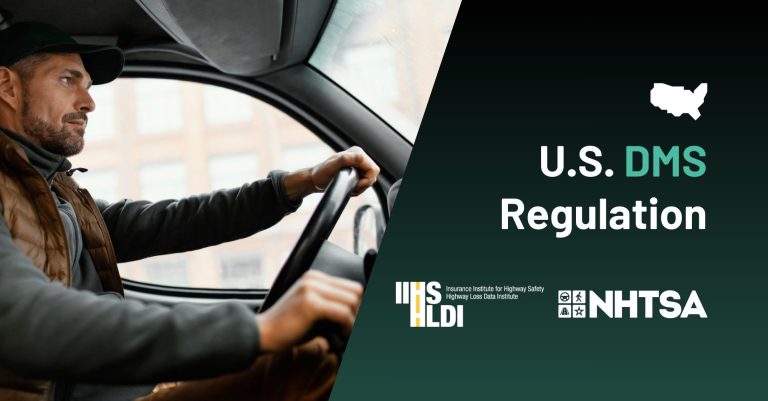
U.S. In-Cabin Monitoring Regulations: What OEMs and Tier-1s Must Know
China: C-NCAP Protocols & The Push for Mandatory L2+ Monitoring
China is rapidly transitioning from voluntary guidelines to strict enforcement, driven by the Ministry of Industry and Information Technology (MIIT). While the national standard GB/T 41797-2022 established the technical baseline for “Driver Attention Monitoring,” the regulatory landscape shifted significantly in July 2024 with the implementation of the new C-NCAP Management Regulation (2024 Edition). Furthermore, the MIIT has drafted mandatory safety standards specifically for vehicles equipped with “Combined Driving Assistance Systems” (Level 2+), making driver monitoring a prerequisite for advanced automation features to prevent automation complacency.
C-NCAP 2024: Active Safety & DMS Scoring
Under the C-NCAP 2024 protocol, Driver Monitoring Systems (DMS) are no longer just a “bonus” feature but a core component of the Active Safety score.
Direct Scoring: DMS performance now contributes 2 points directly to the vehicle’s safety rating.
Testing Criteria: The protocol evaluates two specific categories:
Driver Fitness Monitoring (DFM): Detection of physiological fatigue (e.g., prolonged eye closure, yawning).
Driver Attention Monitoring (DAM): Detection of distraction behaviors, specifically abnormal head pose, smartphone usage, and smoking.
Performance Threshold: To achieve full points, systems often require a detection accuracy rate of ≥90% across varied lighting conditions.
GB/T 41797-2022: The Technical Standard
While C-NCAP sets the consumer rating, the national standard GB/T 41797-2022 (“Performance Requirements and Test Methods for Driver Attention Monitoring System”) remains the technical reference for compliance. It defines the specific detection parameters for:
Eye-closing time (duration thresholds).
Head deflection angles (yaw/pitch/roll).
Distraction behaviors (calling, smoking, yawning).
Data Privacy (PIPL) & L3 Automation
As China accelerates toward approving Level 3 (Conditional Automation) vehicles by 2026, two additional factors have become critical for in-cabin systems:
PIPL Compliance: All in-cabin monitoring data must comply with China’s Personal Information Protection Law (PIPL). This requires automakers to process biometric data (face/eye tracking) locally on the vehicle (“edge processing”) rather than uploading raw images to the cloud.
Mode Awareness: For L2+ and L3 vehicles, regulations now emphasize Driver Availability Monitoring—ensuring the driver is ready to retake control when the automated system reaches its operational limit.

Japan: In-Cabin Monitoring Mandates & JNCAP "Preventive Safety"
In Japan, the regulatory framework for in-cabin monitoring is designed to support the nation’s “Level 4 Mobility” goals. The Ministry of Land, Infrastructure, Transport and Tourism (MLIT) enforces strict driver availability requirements for automated vehicles under the Road Transport Vehicle Act, while the National Agency for Automotive Safety & Victims’ Aid (NASVA) drives mass-market adoption through J-NCAP safety scores. By 2026, the Japanese market has effectively standardized Emergency Driving Stop Systems (EDSS), making driver monitoring a de facto requirement for any vehicle targeting a “Five Star” rating.
MLIT & The Road Transport Vehicle Act (Level 3/4)
Japan was the first country to legally approve Level 3 autonomous driving (Honda Legend, 2021), and the regulations have since evolved to support Level 4 services. The revised Road Transport Vehicle Act mandates specific monitoring capabilities based on the automation level:
Level 3 (Conditional Automation): The vehicle must feature a Driver Monitoring System (DMS) capable of verifying “Driver Availability.” If the system requests a takeover, the DMS must confirm the driver is ready to intervene. If the driver is unresponsive (e.g., sleeping or looking away for too long), the system must initiate a Minimum Risk Maneuver (MRM).
Level 4 (Driverless Services): For mobility services (like the ZEN drive Pilot), the mandate shifts to Remote Monitoring. Operators must have visual access to the cabin to ensure passenger safety, though the “driver” is no longer in the seat.
JNCAP: The "EDSS" Incentive
For standard passenger vehicles (Level 0-2), adoption is driven by the JNCAP Preventive Safety Performance assessment. The critical factor here is the Emergency Driving Stop System (EDSS).
Deadman’s Switch Logic: JNCAP awards high points for vehicles that can detect an unresponsive driver (due to heart attack, stroke, or sleep).
The DMS Role: To score maximum points, the EDSS cannot rely solely on steering torque (hands-off); it must use an active in-cabin camera to detect “posture collapse” or prolonged eye closure.
Market Impact: As of 2026, major domestic OEMs (Toyota, Nissan, Honda) have integrated camera-based DMS into their standard safety suites (e.g., Toyota Safety Sense) specifically to unlock these EDSS safety ratings.
Hands-Off Driving (ProPILOT & Teammate)
Japan is a global leader in “Hands-Off” Level 2+ driving on expressways. Systems like Nissan ProPILOT 2.0 and Toyota Teammate are legal and popular, but they operate under a strict regulatory condition:
Gaze Detection: The driver is legally permitted to remove their hands from the wheel only if a DMS camera confirms their eyes are on the road.
Strict Enforcement: If the camera detects the driver looking at a smartphone or closing their eyes, the system is required by MLIT certification rules to issue an immediate warning and disengage the hands-off feature.
India In-Cabin Monitoring Regulations: The AIS-184 Mandate & Bharat NCAP 2.0
In India, the push for in-cabin monitoring is bifurcated between a strict government mandate for heavy commercial vehicles and a safety-rating incentive for private cars. The regulatory anchor is AIS-184, the automotive industry standard for Driver Drowsiness and Attention Warning (DDAW). While originally proposed for earlier adoption, the Ministry of Road Transport and Highways (MoRTH) issued a decisive Gazette notification in November 2025, finalizing the mandatory implementation of DDAW for buses and trucks starting in October 2027. Meanwhile, the Bharat NCAP (BNCAP) has introduced voluntary incentives for passenger cars under its new “Safe Driving” protocol.
AIS-184: The Commercial Vehicle Mandate
Following the November 2025 notification, the timeline for mandatory compliance is now set. This regulation targets the vehicle categories with the highest accident risk—heavy transport.
Affected Categories: The mandate applies to M2 & M3 (buses/passenger transport with 8+ seats) and N2 & N3 (heavy goods vehicles/trucks).
The Deadline: All new models introduced after October 1, 2027, must be equipped with a DDAW system compliant with AIS-184. Existing models must be updated to comply by January 1, 2028.
Technical Requirement: The system must use vision-based monitoring (cameras) or steering-pattern analysis to detect drowsiness levels equivalent to Level 7 on the KSS (Karolinska Sleepiness Scale).
Bharat NCAP 2.0: "Safe Driving" Incentives
For the private passenger car market (M1 category), adoption is driven by consumer safety ratings rather than legal force. The Bharat NCAP 2.0, drafted in late 2025, aligns India’s safety protocols closer to global standards like Euro NCAP.
New Scoring Vertical: The updated protocol introduces a “Safe Driving” category which holds 10% weight of the total score.
DMS Points: To achieve a full 5-star rating under the 2.0 protocol, vehicles must demonstrate active Driver Monitoring capabilities. The test protocols reward systems that can detect both fatigue (eye closure) and distraction (phone usage).
Impact: This has spurred domestic OEMs (like Tata Motors and Mahindra) to integrate camera-based DMS into their flagship SUVs to future-proof their safety ratings ahead of the protocol’s full enforcement.
Fleet Market DMS Adoption
Independent of government timelines, the Indian commercial fleet sector has seen rapid voluntary adoption of aftermarket DMS solutions (from providers like Netradyne and KPIT).
Insurance Drivers: Fleet operators are installing these systems today to reduce insurance premiums and prevent accidents on hazardous routes.
The “Human” Factor: Unlike the passive warnings mandated by AIS-184, these advanced aftermarket systems often include active driver coaching (audio alerts) that correct behavior in real-time, effectively creating a “safety culture” that exceeds the minimum regulatory standard.

UNECE Framework: Global Harmonization & Regulation No. 171 (DCAS)
The United Nations Economic Commission for Europe (UNECE) acts as the global harmonization body, creating the “model regulations” that countries like Japan, South Korea, Australia, and EU member states adopt into national law. By 2026, the UNECE has effectively standardized in-cabin monitoring through two primary vehicles: the new Regulation No. 171 for automated assistance and the global harmonization of DDAW/ADDW protocols.
Regulation No. 171: The "DCAS" Standard
Entered into force in September 2024, UN Regulation No. 171 governs Driver Control Assistance Systems (DCAS). This is the global standard for what the industry calls “Level 2+” or “hands-off” driving features.
The Monitoring Mandate: Unlike older regulations that allowed simple steering torque sensors (hands-on detection), R171 explicitly requires visual driver monitoring.
Engagement Verification: To activate a DCAS feature (e.g., automated lane changing or hands-free highway assist), the vehicle must verify the driver’s “Engagement” via eye gaze or head posture analysis.
Anti-Complacency: The regulation mandates strategies to prevent “mode confusion.” If the camera detects the driver is disengaged (e.g., using a phone) while the system is active, R171 requires the vehicle to escalate warnings and eventually terminate the assistance.
Globalizing the "GSR" (ADDW & DDAW)
While the EU led the way with its General Safety Regulation (GSR), the UNECE has moved to harmonize these requirements globally to prevent market fragmentation.
Harmonized Drafts (2025): In late 2025, the WP.29 World Forum advanced proposals to create unified UN Regulations for Advanced Driver Distraction Warning (ADDW) that mirror the EU’s requirements.
The Goal: This creates a “one-certification-fits-all” pathway. A vehicle certified for distraction monitoring under the UN regulation in Germany can be sold with the same certification in Australia or Japan without re-testing.
Privacy by Design (The "No-ID" Rule)
A critical component of all UNECE in-cabin regulations is the strict separation of Monitoring from Identification.
The Requirement: The regulations explicitly state that systems must detect impairment (drowsiness/distraction) without identifying who the driver is.
Data Handling: To comply with UN privacy standards, data must be processed in a “closed loop” on the vehicle—meaning the video feed is analyzed to trigger a warning and then immediately discarded, never stored or transmitted.

Image 1: In-cabin monitoring system legislation around the world
| Region | Primary Regulation | Key Mandate Status (2026) | Core Technology Requirement |
|---|---|---|---|
| Europe (EU) | GSR (General Safety Regulation) | Mandatory for all new vehicles | DDAW (Drowsiness) & ADDW (Distraction) |
| United States | IIJA (Sec. 24220 / 24222) | Voluntary (Child Safety) / Pending Rule (Impairment) | Rear-Seat Reminder (Standard); Alcohol Detection (Draft) |
| China | C-NCAP 2024 / MIIT | Mandatory for L2+ Vehicles | Gaze-Off Detection (L2+); Active Safety Scoring |
| Japan | Road Transport Act / J-NCAP | Mandatory for L3/L4; EDSS Incentive | Driver Availability (L3); Posture Collapse (EDSS) |
| India | AIS-184 | Mandatory for Commercial (Bus/Truck) by 2027 | DDAW (Camera/Steering) for heavy vehicles |
| Global (UN) | UN Reg No. 171 (DCAS) | Mandatory for "Hands-Off" Features | Visual Engagement Monitoring (Eye/Head Tracking) |

How Do Consumer Ratings (Euro NCAP & IIHS) Enforce In-Cabin Monitoring Standards?
Consumer Safety Ratings: The "Five-Star" Requirement for DMS
While government regulations set the minimum legal baseline, consumer testing programs (NCAPs) effectively define the market standard. As of 2026, obtaining a top safety rating (5-Star or “Top Safety Pick”) is mathematically impossible without a high-performance In-Cabin Monitoring System. These voluntary programs have moved faster than legislation, penalizing automakers that rely on outdated “steering torque” sensors instead of direct vision.
Euro NCAP's "Safe Driving" In-Cabin Monitoring Protocols
Since DMS and in-cabin monitoring systems are assessed in the test protocols, the European New Car Assessment Programme (Euro NCAP) mandates the inclusion of DMS for a five-star safety rating. The European Union aims to cut road fatalities by 50% by 2030, and ultimately achieve zero fatalities by 2050.
The Euro NCAP evaluates interior monitoring systems at different points, focusing on active safety, passive safety, and autonomous driving.
- Active Safety – Addresses driver inattention and drowsiness:
- Driver impairment: Evaluates the system’s ability to detect drivers’ condition in their driving tasks and performance.
- Child Presence Detection (CPD): Aiming to avoid heatstroke fatalities in children left in cars, Euro NCAP assesses the system’s capacity to detect the presence of living beings, particularly children, and alert those responsible.
- Passive safety – Addressess occupant classification: In order to improve the effectiveness of safety functions, the system’s ability to detect and classify vehicle occupants will be evaluated.
- Airbag parameters
- Seat belt force limiters
- Posture monitoring to enhance utilization of seat belts and headrests
- Advanced airbag deactivation
- Information on vehicle occupancy
- Autonomous driving – Seeking further progress in autonomous driving capabilities, Euro NCAP proposes:
- Creation of best practice recommendations for safety assessment
- Improve transparency by drafting public requirements for autonomous vehicles, based on which voluntary safety assessments (VSA) can be conducted

ANCAP Standards for Driver Monitoring
The Australian New Car Assessment Program (ANCAP) aligns with Euro NCAP standards, focusing on safe driving, crash avoidance, crash protection, and post-crash safety, including in-cabin monitoring.
As Euro NCAP, ANCAP formulates its efforts in:
- Driver monitoring
- Occupant monitoring and classification
- Child presence detection
IIHS-HLDI for Driver Monitoring
The Insurance Institute for Highway Safety (IIHS) has introduced a new evaluation program to assess the effectiveness of safety features in semi-automated driving systems. The systems under review focus on monitoring key driver indicators such as gaze, head orientation, and hand placement to ensure drivers remain engaged and attentive while driving.
C-NCAP Active Safety & DMS Scoring
In January 2024, China unveiled an updated draft of the China New Car Assessment Program (C-NCAP), replacing the 2021 guidelines. Aiming for zero fatalities, injuries, and accidents, the C-NCAP 2024 protocol emphasizes active safety, incorporating advanced driver assistance systems (ADAS), driver monitoring systems (DMS), and road feature recognition (RFR).

Image 2: Vehicle Assessment Programs and Consumer Tests featuring In-cabin Monitoring
Global In-Cabin Monitoring Outlook: Compliance, Safety, and the Road to 2030
The regulatory landscape for In-Cabin Monitoring Systems (ICMS) has shifted decisively from “voluntary innovation” to “mandatory compliance.” As we navigate through 2026, the global automotive industry has effectively converged on a single truth: active Driver Monitoring Systems (DMS) are no longer optional add-ons, but fundamental safety components required to sell vehicles in major markets.
Whether driven by hard laws like the EU’s General Safety Regulation (GSR), aggressive consumer mandates like Euro NCAP’s “Safe Driving” protocols, or the L2+ requirements in China and the US, the goal is unified: Vision Zero. Governments and safety bodies have identified human distraction and fatigue as the primary targets for the next decade of road safety improvements.
So, what comes next? As these deadlines pass and the technology matures, we are already seeing the conversation shift from simple “policing” to genuine “cabin intelligence.” The next challenge for automakers isn’t just ticking a regulatory box, it’s building systems that keep drivers safe without making them feel watched or annoyed. We are entering an era where our cars don’t just transport us, they actively understand us; finding the balance between strict safety and seamless comfort is exactly what will define the market leaders of the next decade.
FAQ: Global In-Cabin Monitoring Regulations
Are in-cabin monitoring regulations converging globally or fragmenting by region?
Despite regional differences in legal language and enforcement timelines, technical requirements are converging, not fragmenting. Europe (GSR), China (C-NCAP / MIIT), Japan (MLIT), India (AIS-184), and UNECE (R171) all independently arrive at the same conclusion:
Driver state must be continuously monitored
Monitoring must be vision-based
Systems must function reliably under automation (L2+)
The convergence is happening at the functional level, even when certification paths differ. For OEMs, this enables a single global DMS architecture with market-specific tuning rather than region-specific redesigns.
What are the biggest causes of DMS failure during homologation or NCAP testing?
The most common failure modes include:
Over-sensitivity causing false warnings
Under-detection in short distraction intervals
Poor performance across demographics or eyewear
Inconsistent behavior across lighting conditions
Latency that violates takeover timing requirements
These are not algorithmic issues alone. They are data coverage problems.
What technical capabilities are now mandatory for DMS compliance across major markets?
Across Europe, China, Japan, and UNECE-aligned regions, compliant Driver Monitoring Systems must reliably support:
Drowsiness detection (eye closure duration, blink frequency, yawning)
Distraction detection (gaze-off-road time, head pose, phone usage)
Driver availability monitoring (for L2+/L3 takeover readiness)
Visual-based sensing (camera systems are explicitly favored or required)
Steering-wheel torque alone is no longer sufficient for regulatory compliance or safety scoring. Vision-based monitoring has become the global baseline.
How do Euro NCAP and UNECE regulations differ in their DMS requirements?
They serve complementary roles:
Euro NCAP
A consumer safety rating program
Penalizes poor DMS performance via reduced star ratings
Expands scope beyond drivers to include child presence detection (CPD) and occupant classification
UNECE Regulations (e.g., R171)
Legally binding once adopted into national law
Define minimum performance requirements for hands-off and L2+ systems
Explicitly mandate visual engagement verification and anti-complacency strategies
In practice, OEMs must design systems that satisfy UNECE legality and NCAP competitiveness simultaneously.
Why is synthetic data becoming critical for regulatory DMS validation?
Regulatory test protocols demand:
≥90% detection accuracy across lighting, ethnicity, eyewear, posture, and occlusion
Rare but safety-critical scenarios (microsleep, partial occlusions, edge-case distractions)
Validation at scale without violating privacy laws
Real-world data alone cannot cover this combinatorial space efficiently or ethically. Scenario-based synthetic data generation has emerged as the only scalable way to:
Systematically cover regulatory edge cases
Accelerate validation cycles
De-risk homologation and NCAP testing
As regulations tighten, synthetic data is increasingly viewed not as an accelerator—but as a compliance enabler.
How is DMS evolving beyond compliance toward “cabin intelligence”?
Once regulatory baselines are met, OEMs are extending DMS into:
Personalized alert strategies (without identification)
Context-aware warnings tied to driving complexity
Integration with occupant monitoring and CPD
Seamless transitions between manual, assisted, and automated modes
The strategic shift is from rule-based monitoring to behavioral understanding, where safety interventions feel supportive rather than punitive—an evolution regulators are beginning to quietly encourage.