
Table of Contents
Table of Contents
Executive Summary
In-cabin monitoring systems are now safety-critical technologies governed by Euro NCAP protocols, privacy regulations, and emerging AI legislation. Yet the industry still relies on real biometric data to validate these systems, creating a fundamental contradiction between safety validation and privacy compliance.
This article explains why real personal data has become a structural liability for Driver Monitoring System (DMS) and Occupant Monitoring System (OMS) validation, why anonymization and governance alone cannot solve the problem, and how synthetic data enables a new, privacy-immune validation paradigm.
By reframing synthetic data as a verifiable, traceable, and audit-ready validation foundation, rather than merely a data augmentation tool, OEMs and Tier-1 suppliers can:
- Eliminate consent and provenance risk from validation pipelines
- Achieve reproducible, regulator-ready validation results
- Accelerate Euro NCAP readiness
- And build in-cabin AI systems that are safe, compliant, and trustworthy by design
Ultimately, the future of in-cabin monitoring belongs to organizations that understand that validation, not data collection, is the real bottleneck, and that synthetic data is the only way to remove it.


The Liability Trap: Common in-cabin monitoring scenarios that expose OEMs to privacy risks.
The Privacy Bottleneck: Why is Personal Data a Liability for In-Cabin Monitoring?
The privacy bottleneck in in-cabin monitoring validation stems from a fundamental conflict: modern AI requires massive datasets of human behaviors to be safe, yet privacy laws like GDPR strictly limit the collection and use of this sensitive biometric data. As OEMs race to meet Euro NCAP safety mandates, engineering teams find their validation pipelines choked by legal restrictions that treat essential training data as a liability rather than an asset.
Driver Monitoring Systems (DMS) and Occupant Monitoring Systems (OMS) are rapidly becoming standard components of modern vehicle architectures. Driven by tightening Euro NCAP protocols, regulatory pressure, and a clear safety mandate, in-cabin AI now plays a critical role in detecting driver distraction, fatigue, misuse, and occupant-related risks. From camera-based gaze tracking to facial analysis and biometric inference, these systems promise measurable improvements in road safety.
Yet this technological progress comes with a growing tension.
In-cabin monitoring systems operate in one of the most sensitive data environments imaginable: the private interior of a vehicle. Facial features, eye movements, posture, and physiological signals are not just technical inputs. They are deeply personal biometric data. As OEMs scale deployment across global fleets, the question is no longer whether these systems improve safety, but how they can be deployed responsibly, legally, and sustainably.
This is not merely a social or ethical debate. It is a core business and governance issue.
Poorly managed biometric data can expose OEMs and Tier-1 suppliers to regulatory penalties under GDPR and emerging AI regulations, create downstream liability across complex supplier ecosystems, and erode consumer trust at a time when brand differentiation increasingly depends on transparency and responsibility. In the worst cases, in-cabin AI risks becoming a liability time bomb—technically impressive, but legally fragile and reputationally damaging.
OEMs now face a fundamental dilemma: How do you deploy life-saving in-cabin monitoring AI without creating unacceptable privacy risks or regulatory exposure? The answer lies not in choosing between safety and privacy, but in immunizing the data pipeline itself. By rethinking how we validate and train these systems, we can move from a “risk mitigation” strategy to a “risk elimination” strategy.

Data Governance and the Cost of Compliance: How Does Personal Data Slow Down In-Cabin Monitoring Development
Real-world data slows down In-Cabin Monitoring development because compliance is no longer just a final legal checkpoint, but an operational drag that forces engineering teams to wait for consent management, anonymization, and legal clearance before they can test a single model iteration. In a traditional pipeline, the simple act of validating a new “drowsiness detection” feature can trigger weeks of data cleaning and privacy reviews, creating a latency that makes agile development impossible.
Ethical DMS AI cannot exist without rigorous data governance. For OEMs and Tier-1 suppliers, governance is the framework that defines how data is collected, processed, stored, and shared throughout the AI lifecycle. In the context of driver and occupant monitoring, this includes sensor data, derived biometric features, training datasets, model validation results, and post-deployment updates.
Regulatory and Standards Landscape
Driver and occupant monitoring data fall under some of the most stringent regulatory regimes:
- GDPR: Classifies biometric data used for identification as special-category personal data, requiring strict consent, purpose limitation, and accountability measures.
- ePrivacy: Extends protection to electronic and sensor-based data, including communications and in-vehicle monitoring.
- ISO/SAE standards: Increasingly mandate traceability, risk assessment, and auditability for AI-driven, safety-critical systems.
Weak governance creates multiple operational and strategic risks:
- Compliance failures can delay homologation or Euro NCAP certification.
- Unclear data lineage complicates audits, incident investigations, and regulatory reporting.
- Poor governance exposes OEMs to reputational risk, particularly as public scrutiny of in-cabin AI grows.
Effective governance, by contrast, provides traceability, accountability, and control, enabling safe deployment at scale. It also forces a critical question: can current practices reliably support ethical facial and biometric monitoring? These governance frameworks define the rules of the road, but they cannot resolve the deeper ethical dilemmas inherent in capturing the human face and form.
For in-cabin monitoring, data governance is not just a compliance function. It directly determines whether AI systems can be validated fast enough, often enough, and with sufficient statistical confidence to meet Euro NCAP and internal safety requirements. In practice, data governance does not fail in policy. It fails in validation throughput. Every consent check, anonymization pass, and legal review delays model iteration, creating a structural validation bottleneck.

The "Dirty Data" Risk: Is Real Driver and Occupant Data GDPR Compliant?
The “dirty data” problem refers to the inherent legal toxicity of real-world datasets in Driver Monitoring Systems (DMS), where every frame captures highly sensitive biometric identifiers, facial geometry, iris patterns, and gaze behavior that are strictly regulated under GDPR and the EU AI Act. Unlike external vehicle cameras that capture public streets, in-cabin sensors record a private space, meaning that any dataset containing real faces carries a permanent risk of consent revocation and regulatory fines.
Even with strong governance in place, in-cabin monitoring systems introduce ethical complexity that extends beyond compliance. OEMs and Tier-1 suppliers must address these challenges at the system design and operational levels to maintain safety, regulatory adherence, and consumer trust.
Bias and Fairness
Driver Monitoring AI models trained on real human data can exhibit biases that compromise both safety and equity:
- Performance may vary across skin tones, age groups, gender, and facial characteristics.
- Edge cases, such as children, elderly passengers, or passengers in non-standard seating positions, can be underrepresented.
- Such disparities not only undermine system reliability but also expose organizations to regulatory scrutiny and public criticism.
Such disparities not only undermine system reliability but also expose organizations to regulatory scrutiny and public criticism.
Consent, Transparency, and Passenger Trust
Vehicles are shared, multi-user environments, creating a unique consent challenge:
- Drivers, passengers, and occasional users may be unaware of monitoring systems.
- Children or ride-share passengers cannot provide informed consent.
Even when formal consent is obtained, perceived surveillance can erode trust and impact adoption of safety systems.


High-Risk Data: driving scenarios involving minors and passengers create immediate GDPR liability.
Data Minimization and Retention
Ethical AI extends beyond technical safeguards to how much driver and occupant data is collected and retained:
- Collecting raw biometric data “just in case” increases exposure without improving model performance.
- Retaining only derived features or aggregated metrics limits risk and aligns AI use with its stated safety purpose.
The Consent Paradox and Data Provenance
Two interrelated challenges illustrate why real biometric data is inherently risky:
- Consent Paradox: Passengers cannot meaningfully opt out of safety-critical systems, creating ethical and legal gray zones.
- Data Provenance: Biometric data flows through multiple entities – collectors, labelers, Tier-1 suppliers, cloud services, and OEMs. If lineage, usage rights, or consent conditions are unclear, the data becomes ethically and legally fragile. “Dirty” data can compromise compliance and model integrity at scale.
The challenge is not simply managing sensitive interior monitoring data responsibly, but whether relying on real human data is a sustainable foundation for ethical, large-scale in-cabin AI. The problem is not that real-world data is not “good”, it is that it is legally and statistically unstable as a validation foundation. Any dataset whose consent can be revoked, provenance questioned, or demographic coverage disputed cannot serve as a stable validation reference for safety-critical AI.
Given these structural ethical constraints, the practical challenge for engineers becomes clear: how to build robust in-cabin monitoring systems within these new boundaries?

The Validation Gap: Why Anonymization Isn't Enough for Safety-Critical In-Cabin Monitoring AI
Anonymization is often insufficient for safety-critical Interior Monitoring AI because effective Monitoring Systems require high-fidelity analysis of the exact features, eyes, mouth, and head pose that standard anonymization techniques blur or destroy to protect identity. You cannot validate a gaze-tracking algorithm if you have blurred the eyes to satisfy privacy rules; this creates a dangerous “validation gap” where the data legally available to engineers is not precise enough to prove safety performance.
The governance challenges described above do not just create legal risk; they create engineering bottlenecks. For validation teams, the requirement to anonymize, secure, and obtain consent for every frame of video creates massive friction. Validating a new model iteration can take weeks of data cleaning and legal review. The question is not just “is this legal?”, but “can we validate fast enough to meet production deadlines when we aren’t allowed to freely use the data?”
Safety Impact and Demonstrated Benefits
Driver monitoring systems have demonstrably improved road safety in real-world deployments. Advanced gaze tracking, head pose estimation, and physiological signal analysis can detect driver fatigue, distraction, or impairment, enabling timely interventions that reduce accidents. Euro NCAP increasingly incorporates these measures into its safety assessments, making them not just desirable but a practical compliance requirement for new vehicle models.
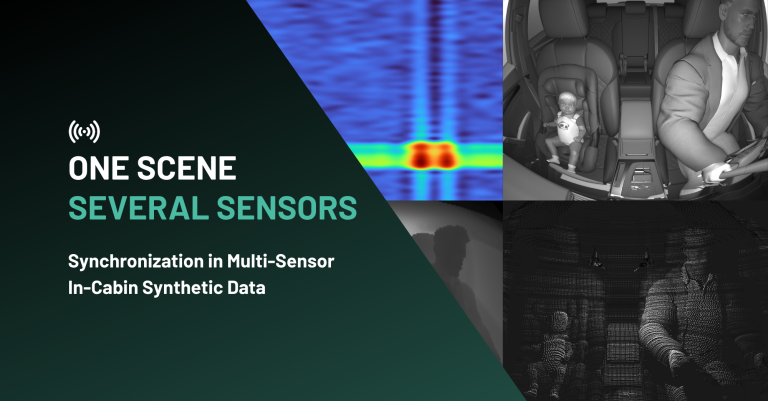
These tests validate whether each modality meets baseline functional expectations before entering the fusion pipeline. Synthetic data is particularly valuable here because ground truth is always complete and modality-aligned.
Trade-offs Between Accuracy and Privacy
The tension between accuracy and privacy is often overstated. While raw biometric data can provide high-resolution insights, regulatory and ethical constraints necessitate a careful design approach. Effective solutions balance these objectives through:
- Edge AI processing: Performing inference locally on the vehicle ECU limits the need to transmit sensitive data to the cloud, reducing exposure and latency.
- Anonymization and feature extraction: Systems can retain only derived features (e.g., blink rate, gaze vector) without storing identifiable facial imagery.
- Encryption and secure storage: Robust cryptographic measures protect data at rest and in transit, ensuring compliance with GDPR, ePrivacy, and ISO/SAE standards.
These strategies demonstrate that high-performance in-cabin AI and robust privacy protection are not mutually exclusive, but require deliberate architectural and procedural design.
Operational Implications for OEMs and Tier-1s
Implementing privacy-conscious systems has downstream impacts across the supply chain:
- Supplier alignment: Tier-1s and AI vendors must adhere to consistent data governance protocols.
- Auditability: Transparent logging and traceable workflows are essential for regulatory readiness and incident investigations.
- System validation: Safety testing, such as Euro NCAP driver monitoring assessments, must reflect privacy-preserving data pipelines to ensure both compliance and credibility.
Effectively, privacy becomes a design constraint integrated into system architecture, rather than an afterthought, influencing sensor placement, data flow, and model training strategy.
While these technical strategies reduce risk, they still operate within the paradigm of real people’s data and its inherent flaws. To fundamentally break this constraint, the industry is turning to a new paradigm: synthetic data for in-cabin monitoring validation.

Immunizing the Pipeline: How Does Synthetic Data Solve Privacy in DMS Validation?
Synthetic data enables privacy-risk-free validation by decoupling the testing process from physical data collection, allowing engineers to generate physics-based, photorealistic cabin scenarios that offer pixel-perfect ground truth without ever recording a real human subject. By using computer-generated imagery (CGI) that mimics the optical properties of cabin cameras, teams can validate the full Operational Design Domain (ODD), from routine driving to extreme edge cases, while remaining completely immune to privacy laws.
What Synthetic Data Brings to In-Cabin Monitoring AI
Synthetic data is engineered, photorealistic, and statistically representative, created to mimic real-world in-cabin scenarios without relying on identifiable human subjects. Its advantages for driver and occupant monitoring systems include:
- Provenance clarity: Every dataset has a known, documented origin.
- Consent elimination: No personal biometric data is involved.
- Perfect Ground Truth for Validation: unlike real-world datasets, which relies on prone-to-error manual labeling, synthetic data provides pixel-perfect ground truth (e.g., exact gaze vectors). This “immunizes” the validation process against human labeling errors, ensuring that if a test fails, it is a model failure, not a data failure.
- Reproducibility: Training and validation conditions can be repeated exactly across model iterations.
- Audit readiness: Dataset composition, scenario logic, and distributions can be fully documented.
- Bias mitigation: Diverse synthetic datasets can cover demographics, rare behaviors, and edge cases often underrepresented in real-world data.
- Robust model development: Enables controlled scenario generation, stress-testing, and accelerated validation aligned with Euro NCAP requirements.
In-Cabin Monitoring Validation Without Liability: A Technical Advantage
In a traditional pipeline, validating even standard behaviors, like checking a side mirror or adjusting the radio, requires collecting massive datasets involving thousands of real subjects to statistically prove demographic and environmental robustness. This creates a massive “surface area” for privacy risks and consent management.
Synthetic data immunizes this entire process by decoupling validation from physical data collection. It allows engineers to validate the full Operational Design Domain (ODD), from routine driving tasks to critical safety interventions, without processing a single pixel of real biometric data. Teams can mathematically prove model robustness across millions of variations (lighting, ethnicity, cabin geometry, and occlusion), ensuring the system is validated against Euro NCAP standards without a single privacy waiver ever being signed.
Strategic Implications for OEMs and Tier-1s
Synthetic data allows organizations to train, validate, and benchmark AI systems while maintaining regulatory and ethical compliance. It also reduces reliance on complex supplier chains for collecting real-world datasets, lowering operational risk and improving traceability. To support this, platforms like Anyverse InCabin allow engineering teams to generate physics-based, privacy-compliant datasets on demand. This shifts the workflow from hunting for compliant data to generating it, effectively immunizing the validation phase against the legal bottlenecks of real-world data acquisition.
With synthetic data as a tool, OEMs can operationalize a governance framework that ensures ethical, privacy-first in-cabin AI at scale.

Zero-Liability Framework: How Do You Implement a Synthetic-First Validation Loop for In-Cabin Monitoring?
Building a zero-liability validation framework requires shifting from a reactive “compliance-check” approach to a proactive “synthetic-first” strategy, where the bulk of system training and testing occurs in a privacy-free virtual environment before any real-world data is touched. This framework prioritizes generated data for all regression testing and initial model training, ensuring that real human data is used only sparingly for final “gold standard” verification, thereby minimizing the surface area for legal risk.
Implementing privacy-conscious, ethical in-cabin AI requires more than policy statements. It requires a structured, operational framework. The following checklist provides actionable steps that OEMs and Tier-1 suppliers can adopt to integrate privacy, ethics, and regulatory compliance into every stage of AI development and deployment.
1) Adopt Privacy-by-Design
The Action:
- Integrate privacy principles into system architecture from the outset.
- Minimize collection of identifiable biometric data; retain only features required for AI inference.
- Leverage edge AI and on-device processing to reduce data exposure.
- Design data flows and storage protocols to ensure compliance with GDPR, ePrivacy, and ISO/SAE standards.
The Immunization: Privacy becomes a core design constraint rather than a reactive afterthought.
2) Immunize the Validation Loop
The Action
- Use synthetic data as the primary dataset for regression testing and system validation.
- Reserve real-world data only for final confirmation when strictly necessary.
- Automate validation pipelines using pre-compliant synthetic datasets.
- Maintain explicit metadata on scenario logic, distributions, and generation parameters.
- Treat synthetic data as a verifiable, traceable, regulation-ready validation foundation, not an edge-case supplement.
The Immunization
Validation becomes continuous, auditable, and legally risk-free by design.

DMS Sensor Fusion + Synthetic Data to Ensure In-Cabin Safety
3) Establish Ethics Review Boards
The Action
- Form cross-functional governance teams including AI engineers, safety engineers, legal, and compliance.
- Review in-cabin AI initiatives for fairness, bias, consent implications, and ethical risk.
- Monitor post-deployment behavior and validation evidence continuously.
The Immunization
Ethical accountability becomes institutionalized rather than discretionary.
4) Ensure Partner Alignment
The Action
- Require Tier-1s, AI vendors, and cloud providers to follow identical governance and privacy standards.
- Define contractual obligations for data provenance, handling, and retention.
- Conduct regular governance and validation audits across the supply chain.
The Immunization
Privacy and compliance risk is not outsourced to weaker links in the ecosystem.

5) Maintain Traceability and Auditability
The Action
- Document full data lineage for all datasets—synthetic and real.
- Track model versions, training sources, and validation scenarios with reproducible references.
- Use synthetic datasets as baseline reference corpora for regression and re-certification.
The Immunization
Validation evidence becomes reproducible, defensible, and regulator-ready.
6) Monitor, Measure, and Iterate
The Action
- Continuously evaluate performance across demographics, scenarios, and safety conditions.
- Track privacy exposure, bias indicators, and validation coverage.
- Adapt governance policies as standards evolve (e.g., EU AI Act, Euro NCAP updates).
- Refine synthetic scenario generation to reflect new operational risks.
The Immunization
Governance remains adaptive, not obsolete.
Implementing this six-step framework empowers OEMs and Tier-1s to translate ethical principles into operational reality. It provides a clear pathway to deploy robust, safety-critical In-Cabin Monitoring AI while systematically managing risk, ensuring compliance, and preserving trust. Beyond immediate deployment, this structured approach builds the organizational agility needed to adapt to evolving regulations, integrate new privacy-preserving technologies, and secure a durable competitive advantage through trustworthy innovation.
Future-Proofing In-Cabin Monitoring Systems: Beyond GDPR and Euro NCAP
Future-proofing in-cabin monitoring systems requires looking beyond current GDPR and Euro NCAP standards to anticipate stricter regulations like the upcoming EU AI Act, which will demand rigorous auditability and bias mitigation that only fully controllable data sources can guarantee. As regulators move from asking “is this data private?” to “is this data unbiased and explainable?”, reliance on unexplainable “black box” real-world datasets will become a strategic vulnerability.
The regulatory and technical landscape for in-cabin AI is rapidly evolving. OEMs and Tier-1 suppliers should anticipate several key trends:
Regulatory Evolution
- EU AI Act: Expected to classify biometric and high-risk AI systems under stringent transparency, fairness, and accountability requirements.
- Global harmonization: Regulators increasingly reference GDPR, ISO, and SAE frameworks, raising the bar for international deployment.
Technical Innovations
- Federated learning: Allows AI models to improve across fleets without centralizing sensitive data, further reducing privacy exposure.
- Edge AI and on-device inference: Improves latency and security while minimizing data transfer.
- Advanced privacy-preserving analytics: Techniques such as differential privacy, anonymization, and synthetic augmentation are gaining adoption.
Strategic Imperatives
Organizations that integrate privacy-conscious in-cabin AI into product development can differentiate themselves through trust, Euro NCAP compliance, and reduced legal risk. Ethical AI is becoming not just a regulatory requirement, but a competitive advantage in automotive safety and customer perception.

Achieving 100% In-Cabin Monitoring Compliance Without Compromising Performance
Achieving 100% compliance without compromising performance is possible only when OEMs and Tier-1s treat data privacy not as a restriction, but as a design parameter solved through the strategic adoption of synthetic data. By immunizing the in-cabin monitoring validation pipeline against legal risk, companies can finally align their engineering goals with their ethical obligations, delivering driver and occupant monitoring systems that are as safe for the user’s data as they are for the user’s life.
In-cabin AI offers transformative potential for automotive safety, but it also raises profound ethical and regulatory challenges. OEMs and Tier-1 suppliers face a dual mandate: deliver effective driver monitoring systems while protecting privacy, ensuring fairness, and maintaining compliance across complex global operations.
The future of automotive leadership belongs to organizations that recognize safety and privacy are two sides of the same coin: trust. By building in-cabin monitoring AI on a foundation of ethical data governance and privacy-preserving technologies like synthetic data, OEMs can protect passengers, their brands, and their market position, delivering both safer roads and sustainable innovation.
FAQ: Deploying In-Cabin Monitoring Without Private Data
How does synthetic data solve privacy issues in Driver Monitoring Systems (DMS)?
Synthetic data is generated entirely through computer graphics rather than by recording real people. Because no real biometric identifiers exist, the data falls outside GDPR, the EU AI Act, and similar regulations. This removes consent, retention, and liability constraints from the validation pipeline while preserving full visual fidelity and ground-truth accuracy.
Is synthetic data accepted for Euro NCAP validation?
Yes. Synthetic data is increasingly used to support Euro NCAP validation of Driver and Occupant Monitoring systems. It allows OEMs to demonstrate robustness across demographics, cabin configurations, and safety-critical scenarios that are impractical or unethical to reproduce with real occupants.
What is the difference between anonymized data and synthetic data?
Anonymized data is real footage that has been altered to conceal identity, often compromising features necessary for gaze or facial analysis. Synthetic data is artificial from the start: it is anonymous by design, retains pixel-level clarity, and includes exact ground-truth labels, making it better suited for safety-critical validation.
Why is real-world data a bottleneck for in-cabin AI development?
Real data requires consent management, legal review, anonymization, and manual labeling, significantly slowing validation cycles. Synthetic data removes this friction by providing compliant, pre-labeled datasets on demand, enabling faster and more repeatable system validation.
Does synthetic data replace real data completely?
No. Real data can still be used for final confirmation. However, synthetic data should serve as the primary validation and regression foundation, providing verifiable, traceable, and regulation-ready evidence of system performance.
Why is synthetic data important for future regulations?
Future regulations will require transparency, bias traceability, and reproducible validation. Synthetic data enables controlled dataset composition, documented scenario logic, and repeatable testing capabilities, which are difficult to guarantee with real-world biometric datasets.