
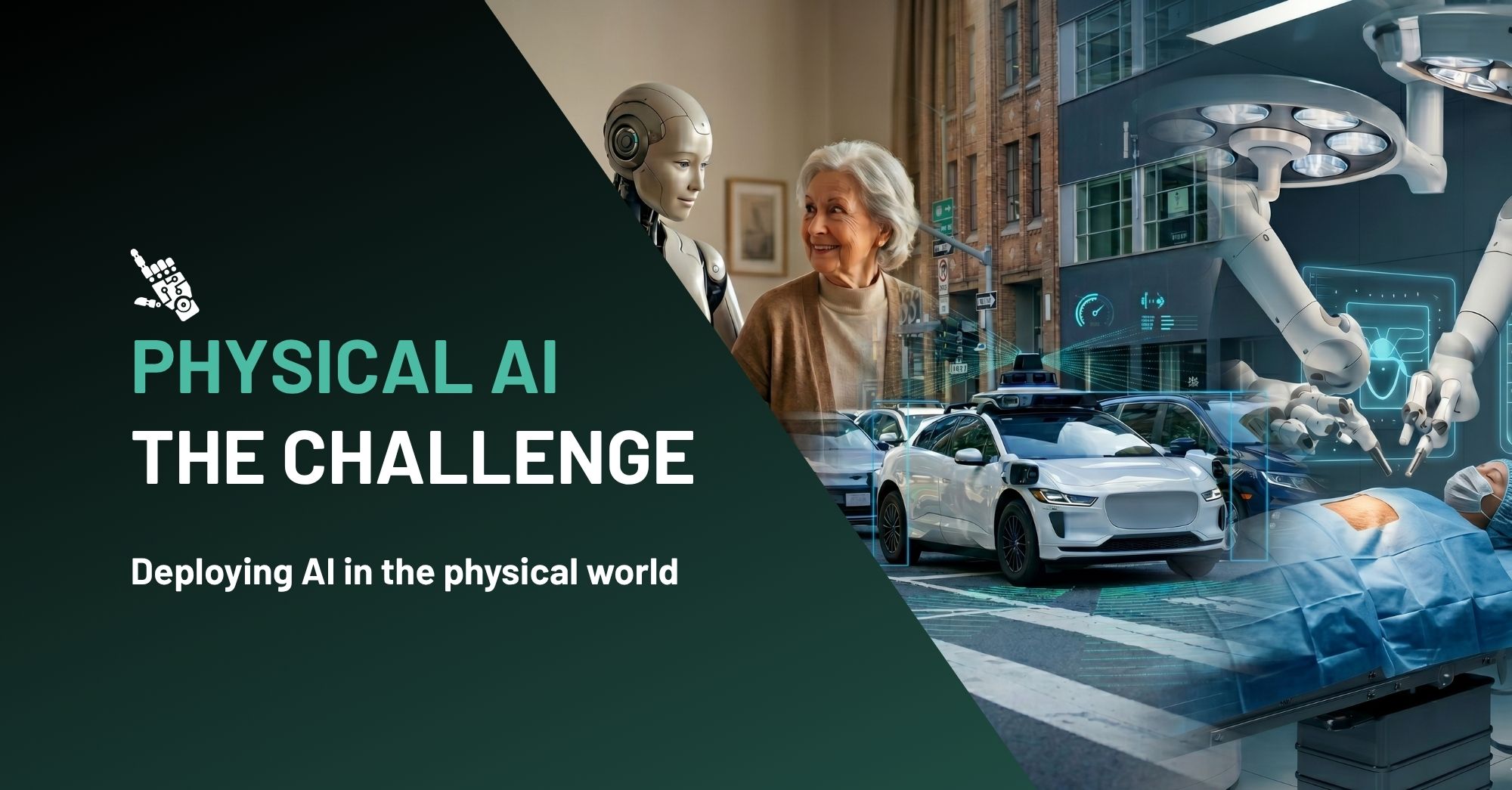
Is Physical AI the Next Great Engineering Challenge? What Deploying AI in the Physical World Requires
Is Physical AI the Next Great Engineering Challenge - Anyverse Building trust in physical AI with synthetic data
SHARE

Table of Contents

Table of Contents

The Test Was Perfect, the Deployment Wasn't: When Physical AI Meets the Real World

Somewhere in a test log from a January morning in the Pacific Northwest, there is a 340-millisecond gap that nobody outside the engineering team ever heard about.

The system had been performing flawlessly for months. Thousands of highway miles. Hundreds of correct decisions. Then it encountered a pedestrian at an intersection partially occluded by a utility pole, wearing a high-visibility jacket that, in low-angle winter sun breaking through overcast at 8 degrees elevation, registered differently in that sensor array than any vest in the training data had.

It hesitated. In a scenario where the margin for hesitation was zero.

No hardware failure. No software bug. Just a gap between the world the system had been trained on and the world it had just met, invisible to everyone except the people watching the logs.

It’s a gap every team building Physical AI knows. The question is how you close it before it closes in on you.
Is Physical AI the Next Great Engineering Challenge What Deploying AI in the Physical World Requires

From Software AI to Physical AI: The Day AI Stopped Living in the Cloud

AI spent decades getting very good at a particular kind of problem. Pattern matching. Prediction. Generation. All of it happening inside controlled digital environments, where inputs arrive cleanly, errors are recoverable, and the cost of being wrong is low.

Then it left the server. And everything changed.

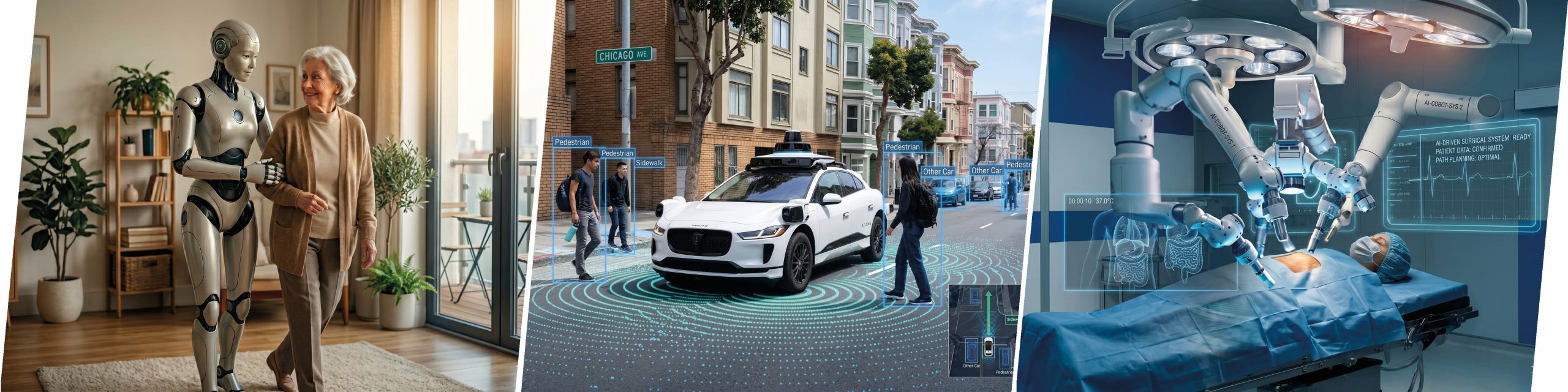
Physical AI, also called Embodied AI, is what happens when neural networks stop processing the world and start operating in it. Driving vehicles. When a system is making real-time decisions in a vehicle, a drone, or a robot working alongside humans, the cost of being wrong is measured in consequences, not logs. As Nishant Bhanot, a senior systems engineer at Waymo, put it in a recent piece on HackerNoon: Physical AI leaves the clean world of software and enters physics, time pressure, and real-world risk.

Software AI lives in a forgiving environment. A wrong answer gets corrected. A bad model gets retrained. Nothing breaks physically. Physical AI doesn’t get that luxury. 

Reality Has No API

Shipping a Physical AI system has a way of teaching you things that no benchmark prepared you for. Three things change when AI enters the physical world, and each one is harder than it looks.

The first is coverage. The physical world doesn’t document its edge cases. A driver monitoring system that handles controlled test conditions with ease will eventually meet a driver in low winter sun, wearing polarised glasses, in a cabin geometry the training data never included. Not an exotic failure. Just the normal variation of the real world, arriving on a Tuesday morning. No dataset fully captures it. That’s not a collection problem, it’s a fundamental property of deploying in open environments.

The second is about time. In Physical AI, being right and being right on time are not the same thing. A DMS operating with a 200ms decision budget has no margin for uncertainty. Identify drowsiness late, and the intervention comes after the lane departure, not before. Latency isn’t a performance footnote in safety-critical systems. It is a hard constraint, and it shapes every architectural decision from sensor selection to inference pipeline design.

The third is the most humbling. In software, you can afford to learn in production. Deploy, observe, fix, redeploy. In Physical AI, that cycle breaks down. The cost of a wrong decision — in a vehicle, on a factory floor, in an autonomous drone — is not a bug report. It is a physical event. You don’t iterate on a system that has already caused harm. The burden of getting it right sits entirely on the pre-deployment side, which means validation isn’t a final step. It’s the whole game.

Why 99% Reliability Is a Disaster in Physical AI — And What the Long Tail Actually Costs

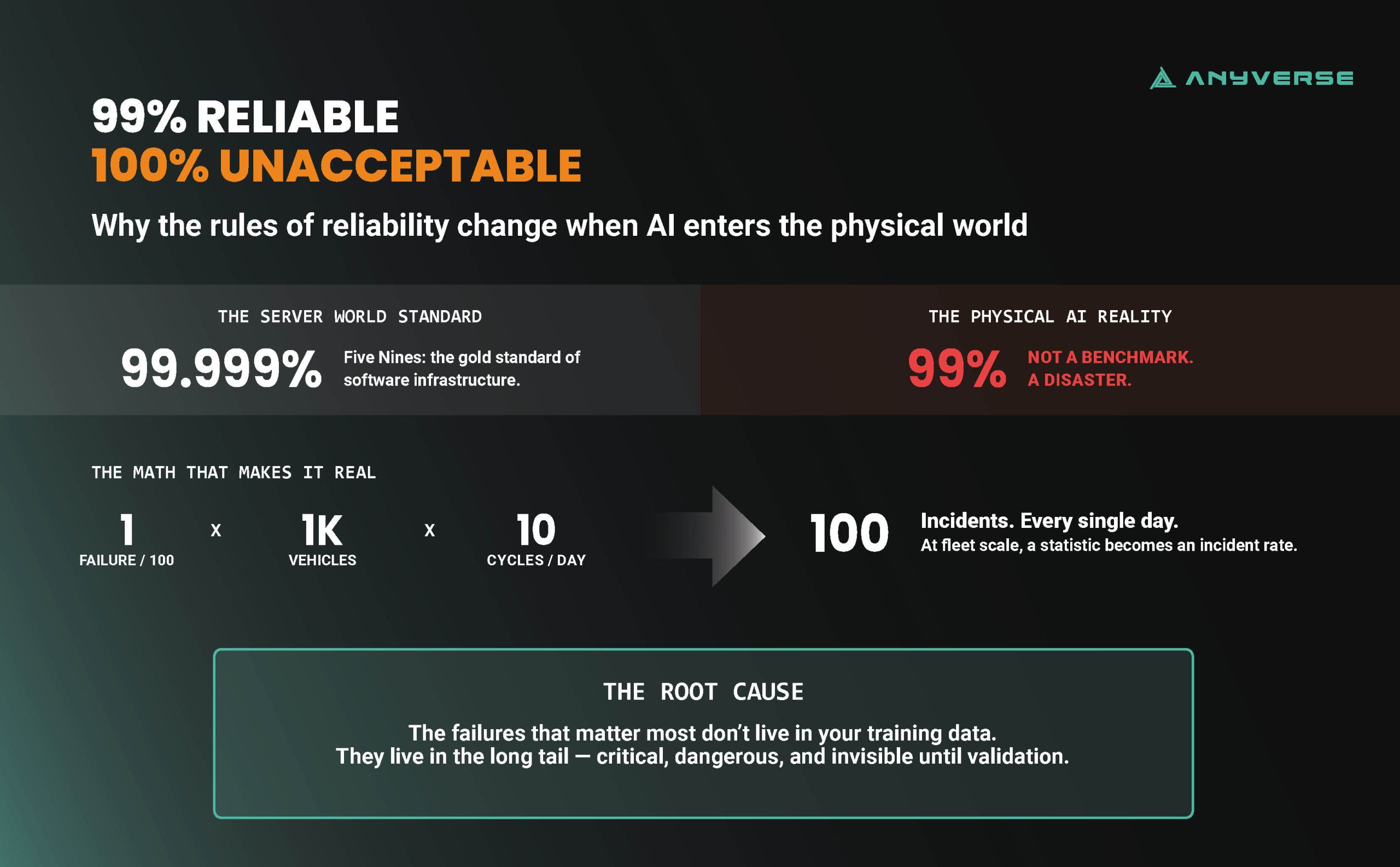
In server infrastructure, Five Nines — 99.999% uptime — is the gold standard. It’s celebrated because it’s hard to achieve.

Now apply that thinking to a Physical AI system. As Bhanot noted, in Physical AI, 99% reliability is a disaster. One failure in a hundred interactions, across a fleet running thousands of daily monitoring cycles, that’s not a statistic, it’s an incident rate.

The failures that matter most are rarely the common ones. They live in the long tail: scenarios too rare to surface in a data collection campaign, too dangerous to stage, too geographically specific to anticipate. A DMS that performs well across ten thousand logged drives may never have encountered the precise combination of driver fatigue, cabin temperature, and IR washout that occurs on a cold January morning with the heating on full.
Is Physical AI the Next Great Engineering Challenge What Deploying AI in the Physical World Requires

This is where simulation becomes relevant, not as a silver bullet, but as the most practical way to reach the scenarios that real-world collection misses systematically. A UAV team preparing for maritime operations can generate sea haze, salt spray, and low-angle sun at scale rather than waiting for the right conditions over open water. The gaps get found in the lab, not in the field.

The sim-to-real gap is real, a simulation is only as useful as the fidelity of its sensor models and environmental physics. But used with rigour, it moves validation from reactive to deliberate. From driver monitoring systems in vehicle cabins to perception pipelines on autonomous drones, different domains, same long tail.

That UAV team didn’t just solve a data problem. They changed how they thought about validation entirely. And that shift — from volume to coverage — is what separates Physical AI programmes that hold up in deployment from the ones that don’t.

Is Synthetic Data the Answer to Physical AI's Coverage Problem?

The teams getting this right aren’t just running more simulation. They’ve changed the question they’re asking. The old question was: do we have enough data? The new question is: have we covered the scenarios that will actually matter? Those two questions have different answers and they produce completely different validation programmes.

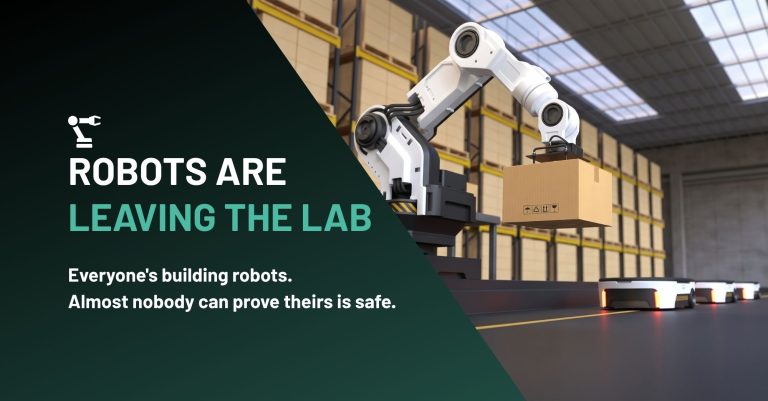
Coverage-first thinking means building synthetic datasets not as a supplement to real-world collection, but as a structured answer to a specific question: which scenarios can we not safely or reliably encounter in the field? For a driver monitoring system, that’s the rare but critical combinations, extreme IR washout, reflective eyewear, non-standard head positions, that a real-world collection campaign may log once in ten thousand drives. For a UAV perception stack — like the maritime deployment example from earlier — it’s the sea haze gradients and low-angle sun conditions that no field test campaign can reliably replicate at scale. For an industrial robot entering a new production environment, it’s the object variations, surface textures, and spatial configurations that only exist once the system is already deployed, too late to be useful as training data.

This is where platforms like Anyverse become relevant, not as a shortcut, but as infrastructure for deliberate, coverage-driven validation across automotive, defence, drones, and robotics. The ability to generate sensor-accurate synthetic scenarios at scale gives teams a practical path to the conditions real-world collection leaves uncovered.

The goal was never more data. It was always the right coverage.

Accuracy Gets You to the Benchmark. Validation Gets You Trust

Go back to that January morning in the Pacific Northwest. The system wasn’t broken. It was doing exactly what it had been trained to do. It had just never encountered that precise combination of light, occlusion, and sensor response, and in the 340 milliseconds it hesitated, the margin that separated a correct decision from a catastrophic one was gone.

That gap has a name now. And the field has a clearer sense than ever of what it takes to close it.

Physical AI is not a harder version of software AI. It is a different discipline, one where the cost of failure is physical, the margin for error is narrow, and the scenarios that matter most are precisely the ones that standard development pipelines are least likely to surface. Capability matters. But capability without validation is just trust, and in Physical AI, trust without evidence is a risk nobody can afford.

The systems that earn lasting trust in this field won’t necessarily be the most sophisticated ones. They will be the ones that can demonstrate, through rigorous coverage and honest validation, that they hold up in the moments that actually matter. Not just in the lab. Not just on the benchmark. On a January morning, in a light condition nobody thought to include in the training data, in the 340 milliseconds where everything is decided.

That’s the work. And it’s only getting more important.
Enjoyed this article?

Add us as a Preferred Source on Google to see more content like this in Discover and Top Stories.

About Anyverse

With over 25 years of heritage in physics-based simulation and a 2008 Academy Technical Achievement Award, Anyverse is a leading provider of high-fidelity synthetic data and validation tools for advanced Perception AI.

While Anyverse remains a premier partner for the Automotive market, specializing in In-Cabin Monitoring systems and ADAS, its technology is increasingly adopted across Defence, Robotics, and Industry 4.0. Leveraging a proprietary physics-grounded engine, procedural synthetic data generation, and next-gen Generative AI, Anyverse produces datasets with unmatched realism and sensor-level accuracy (including RGB, NIR, Radar, LiDAR, and Thermal).

Its unified validation framework helps partners ensure compliance with specific regulations like Euro NCAP, as well as broader safety standards for autonomous systems. By bridging the gap between simulation and reality, Anyverse accelerates development, reduces costs, and ensures trustworthy perception for vehicles, robots, and intelligent machines.

Is Physical AI the Next Great Engineering Challenge? What Deploying AI in the Physical World Requires

Is Physical AI the Next Great Engineering Challenge - Anyverse Building trust in physical AI with synthetic data
SHARE

Table of Contents

Table of Contents

The Test Was Perfect, the Deployment Wasn't: When Physical AI Meets the Real World

Somewhere in a test log from a January morning in the Pacific Northwest, there is a 340-millisecond gap that nobody outside the engineering team ever heard about.

The system had been performing flawlessly for months. Thousands of highway miles. Hundreds of correct decisions. Then it encountered a pedestrian at an intersection partially occluded by a utility pole, wearing a high-visibility jacket that, in low-angle winter sun breaking through overcast at 8 degrees elevation, registered differently in that sensor array than any vest in the training data had.

It hesitated. In a scenario where the margin for hesitation was zero.

No hardware failure. No software bug. Just a gap between the world the system had been trained on and the world it had just met, invisible to everyone except the people watching the logs.

It’s a gap every team building Physical AI knows. The question is how you close it before it closes in on you.

Is Physical AI the Next Great Engineering Challenge What Deploying AI in the Physical World Requires

From Software AI to Physical AI: The Day AI Stopped Living in the Cloud

AI spent decades getting very good at a particular kind of problem. Pattern matching. Prediction. Generation. All of it happening inside controlled digital environments, where inputs arrive cleanly, errors are recoverable, and the cost of being wrong is low.

Then it left the server. And everything changed.

Physical AI, also called Embodied AI, is what happens when neural networks stop processing the world and start operating in it. Driving vehicles. When a system is making real-time decisions in a vehicle, a drone, or a robot working alongside humans, the cost of being wrong is measured in consequences, not logs. As Nishant Bhanot, a senior systems engineer at Waymo, put it in a recent piece on HackerNoon: Physical AI leaves the clean world of software and enters physics, time pressure, and real-world risk.

Software AI lives in a forgiving environment. A wrong answer gets corrected. A bad model gets retrained. Nothing breaks physically. Physical AI doesn’t get that luxury. 

Reality Has No API

Shipping a Physical AI system has a way of teaching you things that no benchmark prepared you for. Three things change when AI enters the physical world, and each one is harder than it looks.

The first is coverage. The physical world doesn’t document its edge cases. A driver monitoring system that handles controlled test conditions with ease will eventually meet a driver in low winter sun, wearing polarised glasses, in a cabin geometry the training data never included. Not an exotic failure. Just the normal variation of the real world, arriving on a Tuesday morning. No dataset fully captures it. That’s not a collection problem, it’s a fundamental property of deploying in open environments.

The second is about time. In Physical AI, being right and being right on time are not the same thing. A DMS operating with a 200ms decision budget has no margin for uncertainty. Identify drowsiness late, and the intervention comes after the lane departure, not before. Latency isn’t a performance footnote in safety-critical systems. It is a hard constraint, and it shapes every architectural decision from sensor selection to inference pipeline design.

The third is the most humbling. In software, you can afford to learn in production. Deploy, observe, fix, redeploy. In Physical AI, that cycle breaks down. The cost of a wrong decision — in a vehicle, on a factory floor, in an autonomous drone — is not a bug report. It is a physical event. You don’t iterate on a system that has already caused harm. The burden of getting it right sits entirely on the pre-deployment side, which means validation isn’t a final step. It’s the whole game.

Why 99% Reliability Is a Disaster in Physical AI — And What the Long Tail Actually Costs

In server infrastructure, Five Nines — 99.999% uptime — is the gold standard. It’s celebrated because it’s hard to achieve.

Now apply that thinking to a Physical AI system. As Bhanot noted, in Physical AI, 99% reliability is a disaster. One failure in a hundred interactions, across a fleet running thousands of daily monitoring cycles, that’s not a statistic, it’s an incident rate.

The failures that matter most are rarely the common ones. They live in the long tail: scenarios too rare to surface in a data collection campaign, too dangerous to stage, too geographically specific to anticipate. A DMS that performs well across ten thousand logged drives may never have encountered the precise combination of driver fatigue, cabin temperature, and IR washout that occurs on a cold January morning with the heating on full.

Is Physical AI the Next Great Engineering Challenge What Deploying AI in the Physical World Requires

This is where simulation becomes relevant, not as a silver bullet, but as the most practical way to reach the scenarios that real-world collection misses systematically. A UAV team preparing for maritime operations can generate sea haze, salt spray, and low-angle sun at scale rather than waiting for the right conditions over open water. The gaps get found in the lab, not in the field.

The sim-to-real gap is real, a simulation is only as useful as the fidelity of its sensor models and environmental physics. But used with rigour, it moves validation from reactive to deliberate. From driver monitoring systems in vehicle cabins to perception pipelines on autonomous drones, different domains, same long tail.

That UAV team didn’t just solve a data problem. They changed how they thought about validation entirely. And that shift — from volume to coverage — is what separates Physical AI programmes that hold up in deployment from the ones that don’t.

Is Synthetic Data the Answer to Physical AI's Coverage Problem?

The teams getting this right aren’t just running more simulation. They’ve changed the question they’re asking. The old question was: do we have enough data? The new question is: have we covered the scenarios that will actually matter? Those two questions have different answers and they produce completely different validation programmes.

Coverage-first thinking means building synthetic datasets not as a supplement to real-world collection, but as a structured answer to a specific question: which scenarios can we not safely or reliably encounter in the field? For a driver monitoring system, that’s the rare but critical combinations, extreme IR washout, reflective eyewear, non-standard head positions, that a real-world collection campaign may log once in ten thousand drives. For a UAV perception stack — like the maritime deployment example from earlier — it’s the sea haze gradients and low-angle sun conditions that no field test campaign can reliably replicate at scale. For an industrial robot entering a new production environment, it’s the object variations, surface textures, and spatial configurations that only exist once the system is already deployed, too late to be useful as training data.

This is where platforms like Anyverse become relevant, not as a shortcut, but as infrastructure for deliberate, coverage-driven validation across automotive, defence, drones, and robotics. The ability to generate sensor-accurate synthetic scenarios at scale gives teams a practical path to the conditions real-world collection leaves uncovered.

The goal was never more data. It was always the right coverage.

Accuracy Gets You to the Benchmark. Validation Gets You Trust

Go back to that January morning in the Pacific Northwest. The system wasn’t broken. It was doing exactly what it had been trained to do. It had just never encountered that precise combination of light, occlusion, and sensor response, and in the 340 milliseconds it hesitated, the margin that separated a correct decision from a catastrophic one was gone.

That gap has a name now. And the field has a clearer sense than ever of what it takes to close it.

Physical AI is not a harder version of software AI. It is a different discipline, one where the cost of failure is physical, the margin for error is narrow, and the scenarios that matter most are precisely the ones that standard development pipelines are least likely to surface. Capability matters. But capability without validation is just trust, and in Physical AI, trust without evidence is a risk nobody can afford.

The systems that earn lasting trust in this field won’t necessarily be the most sophisticated ones. They will be the ones that can demonstrate, through rigorous coverage and honest validation, that they hold up in the moments that actually matter. Not just in the lab. Not just on the benchmark. On a January morning, in a light condition nobody thought to include in the training data, in the 340 milliseconds where everything is decided.

That’s the work. And it’s only getting more important.
Enjoyed this article?

Tap to add us as a Preferred Source on Google to see more content like this.

About Anyverse

With over 25 years of heritage in physics-based simulation and a 2008 Academy Technical Achievement Award, Anyverse is a leading provider of high-fidelity synthetic data and validation tools for advanced Perception AI.

While Anyverse remains a premier partner for the Automotive market, specializing in In-Cabin Monitoring systems and ADAS, its technology is increasingly adopted across Defence, Robotics, and Industry 4.0. Leveraging a proprietary physics-grounded engine, procedural synthetic data generation, and next-gen Generative AI, Anyverse produces datasets with unmatched realism and sensor-level accuracy (including RGB, NIR, Radar, LiDAR, and Thermal).

Its unified validation framework helps partners ensure compliance with specific regulations like Euro NCAP, as well as broader safety standards for autonomous systems. By bridging the gap between simulation and reality, Anyverse accelerates development, reduces costs, and ensures trustworthy perception for vehicles, robots, and intelligent machines.