
Table of Contents
Table of Contents
In modern vehicles, privacy-first in-cabin AI systems are becoming essential for monitoring driver attention, detecting occupant presence, and preventing safety-critical events such as drowsiness, distraction, or unattended children. These systems underpin Driver Monitoring Systems (DMS), Occupant Monitoring Systems (OMS), and Child Presence Detection (CPD), directly influencing road safety outcomes.
However, designing these systems introduces a critical challenge: how to maintain high-performance AI while protecting occupant privacy. Collecting and processing real-world in-cabin data (including video, audio, and biometric signals) can expose sensitive personal information, especially faces and the behavior of minors, creating both ethical and legal risks.
Synthetic data offers a powerful solution for this problem. By generating fully controllable, privacy-preserving in-cabin scenarios, engineers can train AI models that meet regulatory standards (GDPR, CCPA, UN R155, Euro NCAP) without relying on sensitive real-world data.
In this article, we explore practical, engineering-focused strategies for building privacy-preserving in-cabin AI systems, covering:
Synthetic Data Pipelines: Creating realistic, annotated datasets that avoid personally identifiable information (PII) while modeling rare and high-risk scenarios.
Privacy-First Sensor Design: Selecting sensor modalities that minimize identity exposure without compromising system performance.
Sensor Fusion Architectures: Combining multiple sensor streams to achieve robust monitoring while maintaining anonymity.
Regulatory Compliance Mapping: Aligning system design with global standards to ensure both legal and market readiness.
Whether you are training a DMS model, designing a CPD system, or architecting multi-sensor in-cabin AI, this guide provides practical, technically grounded strategies to develop compliant, high-performance monitoring systems without compromising privacy.
Understanding Privacy Challenges in In-Cabin AI
The vehicle cabin is traditionally considered a private space, yet modern safety systems increasingly rely on cameras, microphones, and other sensors inside it. For engineers, this introduces a dual challenge: capturing sufficient data for reliable DMS, OMS, or CPD performance, while avoiding exposure of PII.
Collecting real-world in-cabin data carries multiple legal, ethical, and technical risks:
Legal Compliance: Using facial images, biometric signals, or recordings of minors triggers strict regulations such as GDPR, CCPA, and UN R155. Failing to comply can result in penalties, product recalls, or litigation.
Ethical Responsibility: Occupants expect their privacy to be respected, and public perception of intrusive monitoring can impact adoption rates.
Technical Limitations: Capturing rare events (e.g., a child left unattended, driver seizures) in real vehicles is logistically difficult, costly, and potentially unsafe.
Example: A DMS system that requires high-resolution video of drivers may inadvertently store facial identifiers, creating GDPR and CCPA risks. Engineers must design pipelines that either remove or avoid PII entirely.
This tension between performance and privacy has historically forced teams to trade off system accuracy for regulatory safety. However, modern solutions, such as synthetic data and privacy-first sensor design, allow engineers to eliminate this trade-off, achieving both compliance and high performance.
In the next section, we will define what privacy-preserving in-cabin AI entails, and how engineering architectures can be designed to meet regulatory and ethical standards while maintaining robust monitoring capabilities.

Defining Privacy-Preserving In-Cabin AI: Engineering Principles and Strategies
Building privacy-preserving in-cabin AI systems requires more than anonymizing video or audio streams; it demands an end-to-end design approach that considers data acquisition, model training, inference, and sensor selection. Engineers can achieve compliance and high performance by applying the following strategies:
Avoid Collecting Personally Identifiable Information (PII)
Systems should be architected to prevent storage or transmission of facial features, biometric identifiers, or other sensitive data. Techniques include on-device inference, low-resolution or abstracted sensor streams, and avoiding raw video storage.Leverage Synthetic Data for Model Training
Synthetic data pipelines generate fully annotated, privacy-safe datasets that simulate realistic in-cabin scenarios. These include variations in occupant type, seating positions, lighting conditions, and edge-case scenarios such as drowsiness or unattended children. Because no real individuals are captured, PII risk is eliminated, and regulatory compliance is built-in.Prioritize Non-Identifying Sensor Modalities
Selecting sensors that inherently minimize identity exposure, such as radar, thermal, or near-infrared (NIR), reduces both technical and legal complexity. For example:Radar: Detects movement, respiration, and presence without imaging facial features.
Thermal: Captures heat signatures for presence and posture detection.
NIR: Enables eye-gaze and head-pose estimation under low-light conditions without recording identifiable faces.
Design On-Device Inference Pipelines
Performing model inference locally on embedded AI modules or vehicle ECUs ensures that sensitive raw data never leaves the cabin, reducing cybersecurity and privacy risk while meeting automotive-grade hardware constraints. Combined with privacy-first sensors and synthetic training data, on-device AI allows full functionality without transmitting or storing PII externally.Align System Design with Regulatory Frameworks
Architectures must integrate GDPR, CCPA, UN R155, and Euro NCAP principles from the outset. Using synthetic data and non-identifying sensors makes compliance systematic rather than reactive, mitigating legal and market risks.
In essence, privacy-preserving in-cabin AI shifts the development paradigm: models focus on behavior and state recognition, not identity. Engineers can achieve high accuracy in monitoring and safety-critical tasks without ever exposing personal information.

Challenges of Using Real-World In-Cabin Data for AI Training
While real-world data has traditionally powered AI development, using it for in-cabin monitoring presents significant technical, legal, and ethical challenges. These limitations highlight why synthetic data has emerged as a practical alternative for privacy-preserving model training.
Below are the key issues engineers face when collecting and using real in-cabin footage:
| Challenge | Impact on AI Development | Why It Matters for Compliance & Safety |
|---|---|---|
| Privacy Violations | Faces, behaviors, and biometric signals are hard to anonymize reliably | Storing identifiable data of drivers or passengers, especially minors, risks GDPR and CCPA violations |
| Consent Complexity | Legal constraints for data collection, storage, and usage | Obtaining informed consent from all occupants can be logistically impractical, particularly for rare edge-case scenarios |
| Edge Case Scarcity | Dangerous or rare events (e.g., seizures, unattended children) are difficult or unsafe to capture | Models may fail to recognize critical safety events without sufficient data diversity |
| Representation Bias | Datasets often underrepresent demographic diversity or unusual cabin configurations | Biased models may underperform across different driver populations or seating arrangements |
| High Cost and Low Scalability | Manual data collection, annotation, and storage are time-consuming | Slows iteration, increases development cost, and limits coverage of rare or extreme scenarios |
Example Use Case: Child Presence Detection
Training AI to detect unattended children in vehicles is a high-stakes task. Capturing such events with real children is ethically and legally restricted, making conventional data collection impractical.
Engineering Insight: Each of these challenges can be mitigated with synthetic data pipelines, which generate fully annotated, privacy-safe scenarios across diverse cabin configurations, lighting conditions, and occupant behaviors. This approach enables engineers to train high-accuracy DMS and CPD models without risking privacy violations or legal non-compliance.
By understanding these limitations, development teams can make informed decisions on data strategy, shifting away from real-world dependency and toward synthetic datasets designed for privacy-first, regulation-aligned AI.

Synthetic Data for DMS & CPD: Compliant, Scalable, and Privacy-First
Synthetic data provides a technical alternative to real-world collection, enabling engineers to train Driver Monitoring Systems (DMS), Occupant Monitoring Systems (OMS), and Child Presence Detection (CPD) models without capturing PII or exposing minors. By simulating in-cabin environments, synthetic data allows full control over lighting, posture, demographics, edge-case behaviors, and sensor modalities.
Key In-Cabin Scenarios Modeled with Synthetic Data:
Drowsiness and micro-sleep events
Infants or pets left unattended
Driver distraction (e.g., using a phone or infotainment)
Aggressive occupant behavior or sudden illness
Improper seatbelt use or rear-seat monitoring
Advantages of Synthetic Data for In-Cabin AI
| Benefit | Technical Impact |
|---|---|
| Infinite Variation | Generate unlimited combinations of occupant type, seating position, and lighting conditions to cover rare or dangerous scenarios |
| Zero Privacy Risk | No real individuals are recorded; avoids PII and consent issues entirely |
| Full Parameter Control | Adjust lighting, clothing, posture, emotion, and sensor perspectives for controlled experiments |
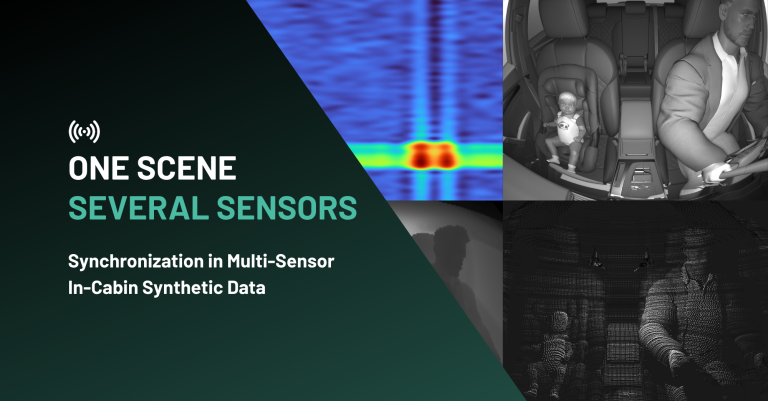
| Multimodal Sensor Support | Simulate RGB, NIR, thermal, radar, and LiDAR streams for training multimodal models |
| Built-in Annotation | Ground-truth labels automatically included for every frame, eliminating costly manual annotation |
| Regulation-Ready | Synthetic pipelines can be designed to comply with GDPR, CCPA, UN R155, and Euro NCAP standards |
Engineering Insight: Synthetic data allows teams to train models on edge cases that are unsafe, rare, or impossible to collect in real vehicles. For example, unattended child detection or seizure events can be fully simulated and annotated without any ethical or legal risk.
By incorporating synthetic datasets into DMS and CPD pipelines, engineers can accelerate development, improve model robustness, and maintain compliance—all while eliminating the privacy barriers inherent in real-world data collection.

Sensors and Sensor Fusion for Privacy-Preserving In-Cabin AI
Privacy-First Sensor Selection for In-Cabin Monitoring
While synthetic data provides privacy-safe training scenarios, sensor choice determines how these models perform in real vehicles, balancing signal fidelity, edge-case coverage, and anonymity. The choice of sensors directly affects both system performance and privacy compliance. Selecting modalities that minimize personally identifiable information (PII) reduces regulatory risk while maintaining high-fidelity signals for model inference.
Common Privacy-Respecting Sensor Modalities:
| Sensor Type | Captured Data | Privacy Rating | Ideal Use Case |
|---|---|---|---|
| Radar | Movement, respiration, heart rate | ⭐⭐⭐⭐⭐ | Child Presence Detection (CPD), vital sign monitoring |
| Thermal | Heat signatures, occupancy detection | ⭐⭐⭐⭐ | Night-time occupant detection, posture recognition |
| NIR (Near-Infrared) | Eye gaze, head pose (low-light) | ⭐⭐⭐⭐ | Driver Monitoring Systems (DMS) without facial ID |
| RGB | Full facial detail, colors | ⭐ | Requires strict safeguards, typically avoided or anonymized |
⭐ = low privacy protection (captures identifiable information), ⭐⭐⭐⭐⭐ = high privacy protection (identity-free signals)
Engineering Insight: Radar and thermal sensors provide identity-free measurements suitable for CPD and general occupancy monitoring. NIR enables head-pose and gaze detection without revealing facial identity, making it an excellent compromise for DMS. RGB cameras should be used sparingly or in conjunction with anonymization and on-device processing.

DMS Sensor Fusion + Synthetic Data to Ensure In-Cabin Safety
Sensor Fusion Architectures for Robust and Privacy-Conscious Monitoring
Sensor fusion combines multiple modalities to improve inference accuracy while minimizing privacy exposure. By strategically combining privacy-first sensors, engineers can maintain high model performance without storing or transmitting sensitive visual information.
Example Fusion Architectures:
Radar + Thermal: Identity-free occupancy detection for CPD and rear-seat monitoring.
NIR + Multi-Angle NIR: Eye-gaze and head-pose estimation without capturing full facial features.
RGB (low-resolution) + NIR: Low-light driver monitoring with anonymized facial cues.
Engineering Insight: Sensor fusion can be implemented at different stages:
Early Fusion: Raw sensor signals combined before feature extraction.
Feature-Level Fusion: Features from each modality are merged prior to model input.
Late Fusion: Independent model outputs are combined for final prediction.
When combined with synthetic data pipelines, these fusion strategies enable engineers to simulate, train, and validate multi-sensor systems without ever capturing PII. This ensures regulatory compliance and accelerates development of DMS and CPD systems.

Regulatory Requirements for Privacy-Preserving In-Cabin AI
Compliance is no longer optional for in-cabin AI systems. Regulatory frameworks now treat privacy and data protection as integral product requirements, influencing sensor selection, data pipelines, and model design. Engineers must consider both legal constraints and functional safety standards when developing DMS, OMS, or CPD systems.
Key Regulations and Their Implications:
| Regulation | Relevance for In-Cabin AI | Design Implications |
|---|---|---|
| Euro NCAP 2026 Roadmap | Requires evaluation of DMS and CPD systems for vehicle safety ratings | Sensor and model design must capture critical events (drowsiness, unattended children) without violating privacy |
| UN Regulation No. 155 (UN R155) | Covers cybersecurity and data protection for vehicle software | On-device processing, secure storage, and encrypted communications are mandatory; synthetic datasets reduce exposure to sensitive real-world data |
| GDPR (EU) & CCPA (US) | Enforce data minimization, purpose limitation, and user consent | Avoid storing identifiable faces or biometric data; use anonymized or synthetic datasets; implement explainable AI practices |
Practical Engineering Mapping:
Synthetic Data: Eliminates real PII, ensuring GDPR/CCPA compliance by design.
Privacy-First Sensors (Radar, Thermal, NIR): Reduce exposure to biometric identifiers, lowering legal risk.
On-Device Inference: Keeps sensitive data within the vehicle, supporting UN R155 compliance.
Edge Case Simulation: Rare events (child left unattended, micro-sleep) can be trained safely, satisfying Euro NCAP evaluation requirements without collecting real-world high-risk data.
Engineering Insight: By integrating synthetic data pipelines and privacy-focused sensor architectures, engineers can design DMS and CPD systems that are regulation-ready from day one, rather than retrofitting compliance after model development.
Real-World Example:
Tesla faced scrutiny in the Netherlands when internal cabin footage was reportedly shared, demonstrating the risk of regulatory and public backlash from non-compliant data handling. This highlights why privacy-first engineering practices are essential, not optional.

Euro NCAP 2026 In-Cabin Monitoring: OEM Guidelines to Readiness
OEM Adoption: Privacy-First In-Cabin AI in Practice
Automotive OEMs are increasingly recognizing that privacy-preserving AI is both a regulatory necessity and a competitive advantage. Early adopters are implementing synthetic data pipelines, privacy-first sensors, and on-device inference to comply with regulations while maintaining high-performance in-cabin monitoring.
Industry Examples and Technical Approaches:
| OEM | Technical Implementation | Focus Area |
|---|---|---|
| BMW | On-device DMS inference with anonymized sensor streams | Driver Monitoring System accuracy without storing PII |
| Volvo | Low-resolution NIR and thermal sensors for occupancy detection | CPD and rear-seat monitoring without capturing facial identity |
| Toyota Research Institute | Synthetic data pipelines simulating diverse in-cabin scenarios | DMS & CPD model training across edge cases |
| Ford | Behavioral-signal-based DMS instead of facial recognition | Driver state monitoring while preserving occupant privacy |
Engineering Insight: These implementations demonstrate that privacy-first architectures do not compromise functionality. Combining synthetic data with privacy-conscious sensors and on-device processing allows OEMs to meet regulatory standards, safely monitor occupants, and accelerate AI model iteration.
Takeaway for Engineers:
OEM adoption trends confirm that engineering for privacy from the ground up is now an industry best practice. Synthetic datasets, sensor fusion, and compliant inference architectures are becoming standard components of modern in-cabin AI development pipelines.

Design for Privacy, Deliver on Performance: Engineering Takeaways
Developing in-cabin AI systems requires engineers to balance safety, performance, and privacy, all within a complex regulatory landscape. The transition to privacy-first architectures, powered by synthetic data, privacy-conscious sensors, and on-device inference, enables teams to achieve this balance without compromise.
Key Takeaways for Engineers:
Synthetic Data as a Compliance-First Solution
Generates fully annotated, privacy-safe scenarios.
Covers rare and high-risk edge cases that are unsafe or impractical to collect in real vehicles.
Reduces reliance on real-world occupant data, mitigating GDPR/CCPA/UN R155 risks.
Privacy-First Sensor Selection
Radar, thermal, and NIR sensors capture essential signals while minimizing PII.
RGB cameras should be anonymized or limited to non-identifying usage.
Proper sensor choice reduces regulatory exposure and accelerates validation.
Sensor Fusion for Robustness
Combines multiple sensor streams to improve inference accuracy.
Feature-level or late fusion approaches allow engineers to balance signal fidelity and privacy.
Works seamlessly with synthetic data pipelines for model training and testing.
On-Device Inference and Architecture Design
Keeps sensitive raw data within the vehicle.
Supports cybersecurity requirements and compliance with UN R155 and Euro NCAP.
Regulatory Alignment from Day One
Embedding privacy-first principles early ensures GDPR, CCPA, and Euro NCAP compliance.
Eliminates costly retrofits or redesigns for legal alignment.
Engineering Insight: Privacy-preserving design is not a compromise, it is an enabler for high-performance, compliant in-cabin AI. Teams that adopt synthetic data pipelines, carefully selected sensors, and robust fusion architectures can accelerate development, improve model reliability, and confidently deploy systems at scale.
By integrating these practices, engineers can build DMS, CPD, and OMS systems that are safe, regulation-ready, and privacy-conscious, establishing a foundation for the next generation of in-cabin AI.