
Table of Contents
Table of Contents
TL;DR: A robust in-cabin AI dataset requires five characteristics: demographic coverage, photometric coverage, scenario coverage, temporal coverage, and annotation precision. Real-world data collection struggles to deliver all five simultaneously and at scale. Parametric synthetic data is engineered to meet all five as a matter of design, not exception.
You Don't Have a Data Volume Problem
Ask any ML engineer or data lead working on driver monitoring systems (DMS), occupant monitoring systems (OMS), or child presence detection (CPD) — the three in-cabin monitoring functions Euro NCAP assesses — what stands between their current model and Euro NCAP-ready performance, and the answer is almost always the same: more data. It’s become the default diagnosis for every underperforming validation run, every demographic bias flagged in testing, every edge case that slipped through.
It’s also, on its own, the wrong target. Volume and coverage aren’t the same thing. A dataset can run into millions of frames and still fail validation because it’s imbalanced, incomplete in the conditions that matter, or imprecisely labeled. Teams chasing volume without a clear definition of “enough” tend to discover the gap only when a model fails in exactly the scenario nobody thought to collect for.
So the real question isn’t how much data a team needs but rather what characteristics that data has to have. This article defines five of them, argues that real-world collection struggles to deliver all five at once, and shows how parametric synthetic data closes that gap systematically using Anyverse INCABIN as the working example. That includes the fair question synthetic data invites on its own: does it hold up outside the simulation? We’ll address that once we look at how Anyverse INCABIN handles it.

The Five Characteristics of a Robust In-Cabin AI Dataset
If more data isn’t the answer on its own, then what does “enough” actually mean? In practice, it comes down to five characteristics. A dataset missing any one of them, regardless of size, will leave gaps in DMS, OMS, or CPD validation that surface later, usually in the field, usually at the worst possible time.
1. Demographic Coverage
What it means: Representation across skin tones (full Fitzpatrick scale), ages, genders, and body types, from petite to large-frame.
Why it matters:
- Camera exposure and reflectance vary across skin tones — most pronounced in RGB, where higher melanin content absorbs more visible light and reduces captured detail. NIR imaging reduces this effect, since melanin absorbs less at NIR wavelengths, but it doesn’t eliminate it: exposure and gain compensation still differ across skin tones, and gaze and landmark estimation can still degrade under NIR.
- Eye morphology varies enough across demographic groups to shift landmark detection reliability
- Seatbelt and pose detection models trained on a narrow body-type range degrade sharply outside it
- Euro NCAP‘s own Driver Monitoring dossier guidance requires manufacturers to demonstrate that a system “covers a wide variety of the driver population and is robust” — meaning a training gap in demographic coverage risks becoming a compliance gap as these protocols mature.
- The Fitzpatrick scale itself is an imperfect proxy for this — inherited from dermatology, not built for computer vision. Still, it remains the industry’s shared vocabulary for describing skin tone coverage, and parametric generation isn’t limited to its six categories when finer distinctions are needed.


2. Photometric Coverage
What it means: Coverage across lighting conditions — bright daylight, full darkness, tunnel flicker, direct low-sun glare, NIR-only illumination at night — and across sensor modalities the system actually uses, typically RGB and NIR.
Why it matters:
- Each lighting condition interacts differently with each sensor modality; a dataset needs coverage across all combinations, not just the easy ones
- Photometric edge cases are disproportionately where DMS/OMS models fail in the field — precisely because they’re the hardest conditions to capture consistently and at volume during real-world collection
- In-cabin dynamic range is extreme by camera standards: direct sunlight through a windshield and deep shadow under a visor can appear in the same frame, and a dataset needs enough range coverage to train exposure handling for both extremes at once, not just each in isolation
- Sensor modalities fail differently, not just less: RGB degrades in low light, NIR illumination can be washed out by strong ambient infrared in direct sunlight, and thermal trades spatial resolution for lighting independence — a dataset needs each modality’s specific failure conditions covered, not generic “low light” or “bright light” categories
- Transition moments — entering or exiting a tunnel, a sudden shift from shade to direct glare — are where auto-exposure and auto-gain systems are still adjusting, and are disproportionately represented in real-world failure reports relative to how rarely they’re captured in typical collection
3. Scenario Coverage — The Combinatorial Problem
What it means: DMS events (drowsiness, distraction, phone use), OMS events (seatbelt status, occupant classification), and CPD events (child presence detection), each represented across the full range of demographic and photometric conditions, and not in isolation.
Why it matters:
A dataset doesn’t need drowsiness coverage, or low-light coverage, or coverage of a specific demographic on their own. It needs all three simultaneously — a drowsy driver at dusk, a distracted driver from an underrepresented demographic under tunnel lighting, a child obscured under a blanket in NIR glare at night.
That multiplicative requirement — scenario × demographic × lighting — is exactly why volume alone can’t solve scenario coverage. Doubling a dataset’s size doesn’t double its coverage of these combinations; it just adds more of whatever was already easy to collect.

4. Temporal Coverage
What it means: Full behavioral sequences, not isolated frames — microsleep progression, gradual gaze drift, slow postural change.
Why it matters:
- Metrics like PERCLOS— the proportion of a time window in which the eyes are closed beyond a set threshold — are temporal by definition
- A dataset built entirely from single-frame captures — however diverse in every other respect — cannot validate a model’s ability to track sequence-dependent behavior
5. Annotation Precision
What it means: Ground truth accurate enough for safety-critical decisions — pixel-level facial landmarks, precise gaze vectors, and consistent eye-state labeling (open, closing, closed) across every frame.
Why it matters:
- Human annotation introduces variability: different annotators labeling the same borderline eye-state differently, or landmark placement drifting across a large labeling team.
- A few degrees of gaze vector error can be the difference between a correct and incorrect drowsiness classification — inconsistency here isn’t a minor quality issue; it’s a validation risk. Annotation error is systematic, not random: a labeling convention applied inconsistently by a team biases the dataset in a consistent direction, so it doesn’t average out as the dataset grows.
Taken together, these five characteristics define what “robust” actually means for a DMS/OMS validation dataset — not a volume target, but a coverage-and-precision standard a dataset either meets or doesn’t. The next question is whether real-world data collection can realistically meet it, and if not, what can.

What Parametric Synthetic Data Changes — The Engineering Case
Here’s how parametric synthetic data meets that standard — mechanism by mechanism, not as a patch but as a matter of design.
1. Demographic Coverage, Solved Parametrically
Parametric human models let demographic distributions be specified directly and generated on demand — an exact percentage split across Fitzpatrick skin types, age brackets, and body types — rather than sourced from whatever happens to be available.
That removes two of the biggest constraints on real-world collection at once: no dependency on recruiting underrepresented demographics in sufficient volume, and no waiting for a rare combination to occur naturally in a collection fleet.
2. Photometric Coverage, Solved Through Physical Simulation
Physically-based rendering models real light transport and sensor-specific response across RGB and NIR, rather than approximating it after the fact.
Why this differs fundamentally from HDR-augmenting real footage:
- Post-processing real footage to simulate different lighting only adjusts pixel values within the limits of what the original sensor already captured
- Physical simulation models how light actually behaves and how each sensor modality actually responds to it — producing lighting conditions and sensor artifacts that were never in the source footage to begin with
- It also makes conditions that are dangerous, rare, or impractical to stage physically no harder to produce than common ones — the same physics apply either way, so an edge case costs nothing extra to generate

3. Scenario Coverage, Solved by Specifying Instead of Waiting
Rather than capturing each variable separately and hoping the combination occurs naturally, parametric generation specifies the combination directly — turning “wait and hope” into “specify and generate.”
Why this is the direct answer to the combinatorial problem:
The combinatorial problem wasn’t about any single characteristic — it was about needing all of them at once. Real-world collection has to wait for that exact combination to occur. Parametric generation simply specifies it.
That shift — from waiting for a combination to specifying one — is what turns scenario × demographic × lighting from an open-ended sourcing problem into a defined generation task.
4. Temporal Coverage, Solved Through Sequence Generation
Full behavioral sequences — a microsleep progression, a gradual gaze drift — are generated frame by frame across a controlled time window, deterministically and repeatably, at whatever duration and progression rate is needed, rather than sampled as isolated moments.
That’s what makes it possible to validate temporal metrics like PERCLOS in the first place, which single-frame datasets structurally can’t support no matter how large they are.
5. Annotation Precision, Solved by Construction
Ground truth — facial landmarks, gaze vectors, eye-state labels — is generated natively from the 3D scene itself, because those values are known exactly as scene parameters rather than inferred afterward by a human annotator. That removes the annotation risk described earlier at its source:
- No interpretation step — landmark position and eye state are defined at generation time, not judged after the fact
- No inter-annotator variance, because there’s no annotator making a borderline call
- Precision is a property of how the data was created, not a downstream quality-control process applied to it
At a Glance: Real-World Constraints vs. Parametric Synthetic Capability
Characteristic | Real-World Constraint | Parametric Synthetic Capability |
Demographic Coverage | Depends on who can be recruited and in what numbers | Exact distributions specified and generated on demand |
Photometric Coverage | Limited to conditions physically staged or naturally encountered | Full lighting/sensor combinations generated through physical simulation |
Scenario Coverage | Rare combinations must occur naturally and be captured | Any combination of variables specified and generated in one pass |
Temporal Coverage | Sequences must be captured in full as they naturally occur | Full sequences generated deterministically, frame by frame |
Annotation Precision | Ground truth inferred by human annotators, with variability | Ground truth generated natively from scene parameters |
That’s the mechanism behind each characteristic — the how. What’s still unresolved is whether any of it holds up outside the simulation.

Anyverse INCABIN — Five Characteristics, One System
This section makes that engineering case concrete — starting with how it comes together as a single system.
One Pipeline, Not Five Point Solutions
It would be easy to read the five characteristics as five separate capabilities — one for demographics, one for lighting, one for scenarios, and so on. That’s not how Anyverse INCABIN is architected.
Five independent solutions wouldn’t compose. A system that generates demographically accurate faces, a separate system that simulates lighting physics, and a separate system that scripts scenarios could each work perfectly on its own and still produce nothing that satisfies all three at once — nothing guarantees the outputs align. Anyverse INCABIN controls demographic, photometric, scenario, and temporal parameters together, in the same scene generation pass, specifically so that composition isn’t left to chance.
Annotation precision follows from this for free. Because facial landmarks, gaze vectors, and eye-state labels are already known as parameters of that same scene, they don’t need a separate labeling step afterward — they’re a byproduct of generation, not a downstream process bolted on.
Coverage, in other words, isn’t five wins stacked side by side. It’s a property of one system, not a tally of five separate ones.
Closing the Sim-to-Real Gap
Does synthetic data actually generalize to real-world DMS/OMS performance? The short answer: it depends entirely on how the data is generated — and the mechanism matters more than the word “synthetic” itself.
Why physically-based rendering is the deciding factor:
- Generic synthetic data — the kind produced by game engines adapted for automotive use — approximates how a scene looks. It’s built for visual plausibility, not sensor accuracy.
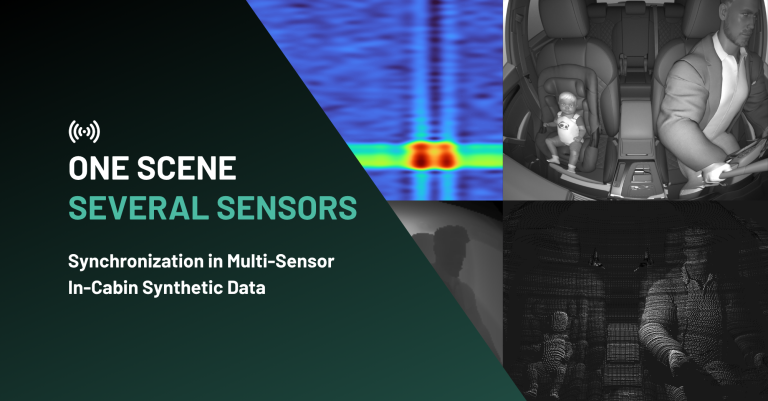
- Physically-based rendering models instead models the physics: light transport through the cabin, material reflectance (skin, fabric, plastic, glass), and sensor response modeled for RGB, NIR, and thermal (LWIR).
- The output isn’t a rendering that looks like an RGB or NIR. It’s a simulation of what that specific sensor, with its specific spectral response and noise characteristics, would actually capture in that specific scene.
What this means practically: a model trained or validated on this kind of synthetic data isn’t learning to recognize a stylized approximation of drowsiness or occlusion — it’s learning against sensor-accurate signal, which is what transfers to real-world deployment. The gap between synthetic and real narrows to the degree that the underlying physics are modeled correctly, not to the degree that the images are cosmetically convincing.
Worked Example 1: Drowsiness Detection on an Underrepresented Face in Low Light
A concrete illustration of the simultaneous parametric control argument — demographic, photometric, and scenario variables specified together, in one generation pass.
Parametric inputs:
Parameter | Value |
Demographic | Fitzpatrick skin type V, female, age 62, smaller-frame body type |
Scenario | Microsleep event — progressive eyelid, generated within a continuous 60-second sequence |
Lighting | Tunnel-exit transition — low-light to direct sun backlight |
Sensor | NIR |
Ground truth generated alongside it:
- Facial landmarks
- Gaze vector
- Eye-state label
- Eyelid aperture
- Head pose
No recruitment, no waiting for this exact combination to occur in a collection fleet, no separate annotation pass — the demographic, the lighting transition, and the drowsiness event were specified together, and the ground truth came out of the same generation pass.
Worked Example 2: Child Presence Detection Under Night-Time NIR Glare
A second example, deliberately chosen to reinforce that this isn’t a one-off capability — different failure mode, same underlying mechanism.
Parametric inputs:
Parameter | Value |
Occupant | Rear-facing infant seat, age band 0–1 year |
Occlusion | 40% blanket coverage |
Lighting | Near-zero ambient lux, NIR illuminator active |
Condition | Glare reflecting off seat fabric |
Ground truth generated alongside it:
- Occupancy classification per seat
- Segmentation mask: generated under partial occlusion
- 3D bounding box: exact depth (distance from sensor to occupant), known directly from scene geometry rather than estimated
This is precisely the kind of scenario we previously identified as structurally difficult to collect: rare, safety-sensitive, and involving a child — a combination that’s not just hard to source in volume, but ethically and practically constrained to source at all.
Fitting Into an Existing ML Pipeline
None of this is useful if it doesn’t integrate into how teams actually build and validate models. Two things matter in practice:
If you can give me the actual supported annotation formats, add a third bullet naming them — it’s a real question ML leads ask, and we currently don’t answer it.
- Supplementing, not replacing — synthetic data is generally most effective combined with existing real-world data, filling the specific coverage gaps identified earlier rather than replacing a real-world dataset wholesale.
- Workflow integration — datasets are generated on demand against a specification, which fits naturally into iterative model development: identify a coverage gap, generate data against it, retrain or fine-tune, validate, repeat.
Supporting Euro NCAP Validation Readiness
Euro NCAP sets the assessment criteria for in-cabin monitoring systems. Anyverse INCABIN‘s scenario library is aligned with Euro NCAP’s DMS, OMS, and CPD test protocols, giving teams a way to validate against the same categories of conditions Euro NCAP assessments cover before physical testing begins.
That alignment now has a formal structure behind it: Anyverse manages the Virtual Assessment Implementation Program (VAIP), an industry program that prepares OEMs and suppliers for Euro NCAP’s move toward virtual assessment, following the Euro NCAP‘s virtual testing working group as that framework is defined.
The Standard — and How to Test Your Own Dataset Against It
A robust in-cabin AI dataset isn’t defined by size — it’s defined by five characteristics: demographic coverage, photometric coverage, scenario coverage, temporal coverage, and annotation precision, delivered together, not one at a time. Most real-world pipelines were never built to solve all five simultaneously.
That’s the standard. Here’s how to test your own dataset against it:
The Dataset Readiness Checklist
# | Question |
1 | Does your dataset represent the full range of skin tones, ages, and body types your system needs to handle — in the proportions that actually matter, not just as isolated examples? |
2 | Does your dataset cover the full range of lighting conditions and sensor modalities your system will actually face, not just the easiest ones to capture? |
3 | Does your dataset include the specific combinations of scenario, demographic, and lighting that matter most — not just broad coverage of each variable in isolation? |
4 | Does your dataset include behavioral sequences long enough to validate temporal metrics like PERCLOS? |
5 | Is your ground truth consistent and precise enough for safety-critical validation — accurate landmarks, gaze vectors, and eye-state labels — across the entire dataset? |
If the honest answer to any of these is no, that’s not a data volume problem. It’s a coverage gap, and no amount of additional collection closes it on its own.
Parametric synthetic data isn’t a patch for what real-world collection couldn’t capture. It’s the systematic way to guarantee all five characteristics at once, by design rather than by exception. If you want to see how your own dataset compares to this standard, Anyverse INCABIN is built to show you.

FAQs: What a Robust In-Cabin AI Validation Dataset Actually Looks Like
What's the difference between "owl" and "lizard" gaze strategies in DMS?
Researchers use these terms to describe how drivers shift gaze: “owl” drivers move their head a lot and their eyes little; “lizard” drivers keep the head still and move only their eyes. This matters because DMS systems relying primarily on head pose can miss lizard glances entirely — the eyes have moved off-road, but the head hasn’t, so head-pose-only systems read it as still attentive.
Why do most in-cabin NIR sensors use 940nm instead of 850nm?
850nm gives better sensor sensitivity and range, but the illuminator emits a faint visible red glow. 940nm is fully invisible to occupants, at some cost to sensitivity — though modern CMOS sensors are closing that gap. For in-cabin use, where an occupant would otherwise be staring directly at the emitter, invisibility usually wins.
How does domain randomization differ from physically-based parametric generation?
Domain randomization deliberately injects wide, often low-fidelity variation into scene properties so a model treats reality as just another variation it’s seen. Physically-based generation instead aims for high-fidelity accuracy grounded in real sensor physics. They’re not mutually exclusive — some pipelines combine both.