
Stop Calling It Synthetic Data: AI vs. Physics-Based Data in Computer Vision
Stop Calling It Synthetic Data AI vs. Physics-Based Data in Computer Vision - Anyverse
SHARE

As generative AI reshapes the landscape of data in computer vision, it’s tempting to rely solely on AI-generated datasets to train machine learning models. The appeal is understandable—fast, scalable, and visually realistic outputs make them look like a silver bullet. But when it comes to building safety-critical autonomous systems, that reliance is not just risky—it can be outright unaffordable.

For applications like driver monitoring systems (DMS), child presence detection (CPD), or advanced driver assistance systems (ADAS), accuracy, consistency, and realism are non-negotiable. Training models on data that lacks a foundation in physical principles opens the door to failures that can compromise not just product performance, but human safety.

This article explores the differences between AI-generated and physics-based synthetic data and why physical realism remains the gold standard in safety-critical machine learning environments.

What Is AI-Generated Synthetic Data?

AI-generated data is created using generative models like GANs or diffusion models. These systems are trained on real-world datasets and then used to produce new data samples that mimic the training distribution. It’s fast, scalable, and increasingly realistic.

Pros:

  • Rapid generation of high volumes of data
  • Ideal for aesthetic or style transfer tasks
  • Useful for domain adaptation or data augmentation

Cons:

  • Lack of physical accuracy: Generative models do not understand or enforce physics.
  • Hallucinations and artifacts: Studies have shown that ML models trained on AI-generated data can suffer from “hallucinations”—predicting features that don’t exist in the real world. This happens after multiple iterations from the same source data, leading to significant deviations from reality.
  • Untraceable scene parameters: You can’t go back and tweak lighting, geometry, or sensor configuration because the data isn’t based on a structured, simulated environment.
  • Limited ability to generate accurate metadata or arbitrary output variables (AOVs): Unlike physics-based synthetic data, AI-generated content typically lacks the underlying structure needed to produce the rich metadata (like depth, segmentation masks, or sensor outputs) required for training ML models.

Several academic papers and other courses have highlighted how AI-generated data can compromise model robustness, especially when used beyond visual augmentation. The absence of physical principles introduces inconsistencies that are invisible to the eye but impactful for ML systems.

What Is Physics-Based Synthetic Data?

Physics-based synthetic data is generated through simulation engines or specific synthetic data generation platforms like Anyverse. Every image is produced with strict control over physical parameters: lighting, material properties, camera optics, object dynamics, and even sensor noise.

This makes it the preferred choice for use cases where models need to understand real-world variability, such as driver state monitoring systems that track head pose and gaze under varying lighting, or self-driving applications that require accurate sensor fusion from camera and LiDAR data.

Pros:

  • High fidelity and realism based on real-world physics
  • Perfectly labeled ground truth for every pixel, object, and sensor output
  • Traceability to all scene and sensor parameters
  • Essential for replicating sensor behavior, especially in multimodal systems (e.g., LiDAR, radar, RGB)
  • Ideal for testing and validation of ML models in safety-critical systems

Cons:

  • Requires more computational resources
  • More complex to set up and manage

Companies like Anyverse specialize in providing high-accuracy, physics-based synthetic datasets tailored to automotive needs, ensuring physical consistency and trustworthiness for both training and validation.

Why This Distinction Matters in Automotive AI

When you’re training ML models for automotive systems, your data must reflect real-world scenarios with a high degree of fidelity.

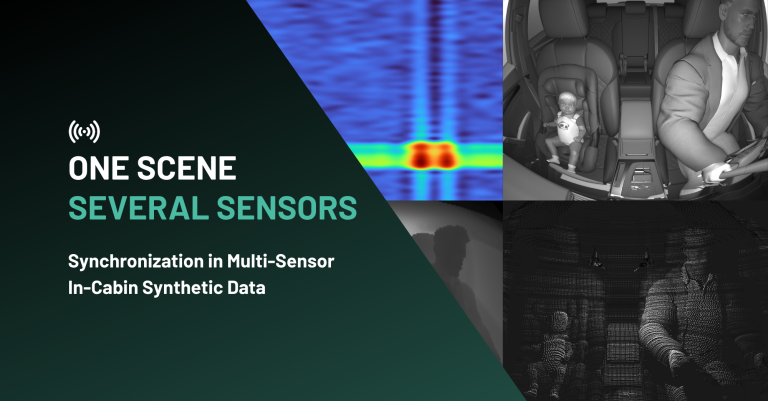
For example, occupant monitoring systems rely on precise pose, occlusion, and lighting variation modeling, something AI-generated data often fails to capture reliably. In child presence detection systems, thermal and depth sensors need accurate multimodal data, which only physics-based simulation can offer.

ADAS and autonomous driving models require the highest standard of sensor realism. AI-generated images might replicate a scene visually but fail to reflect physical behavior in traffic, sensor response to adverse weather, or detailed vehicle dynamics.

Use Case

AI-Generated Data

Physics-Based Synthetic Data

Driver/Occupant Monitoring

❌ Often lacks sensor realism

✅ Accurate eye-gaze, lighting, head pose, occlusions

Child Presence Detection

❌ Can’t simulate thermal or depth data reliably

✅ Simulates multi-modal sensor input accurately

ADAS Perception

❌ Inconsistent scene dynamics

✅ Simulates traffic, weather, sensor artifacts

Sensor Fusion (Camera + LiDAR)

❌ Not feasible

✅ Full sensor modeling possible

In short, AI-generated data can enhance style diversity, but physics-based data ensures model reliability—a must-have in safety-critical automotive environments.

The Future: Hybrid Approaches?

Some researchers are exploring hybrid workflows—using physics-based simulations as a base and applying AI-generated domain adaptation to match real-world conditions. While promising, this approach still relies on the physical grounding of the base simulation.

Conclusion: Choose Physics When Safety Matters

Generative AI is a powerful tool, especially for augmenting existing datasets. But when it comes to training and validating models for life-critical systems like autonomous driving and in-cabin monitoring, trust and accuracy outweigh speed and scale.

Physics-based synthetic data remains the gold standard for machine learning in automotive applications. It offers the realism, traceability, and control required to build and validate models that you can trust—especially when lives are on the line.

Looking to build robust ML pipelines for your automotive systems? Start with simulation-grade data that respects the laws of physics.
Enjoyed this article?

Add us as a Preferred Source on Google to see more content like this in Discover and Top Stories.

About Anyverse

With over 25 years of heritage in physics-based simulation and a 2008 Academy Technical Achievement Award, Anyverse is a leading provider of high-fidelity synthetic data and validation tools for advanced Perception AI.

While Anyverse remains a premier partner for the Automotive market, specializing in In-Cabin Monitoring systems and ADAS, its technology is increasingly adopted across Defence, Robotics, and Industry 4.0. Leveraging a proprietary physics-grounded engine, procedural synthetic data generation, and next-gen Generative AI, Anyverse produces datasets with unmatched realism and sensor-level accuracy (including RGB, NIR, Radar, LiDAR, and Thermal).

Its unified validation framework helps partners ensure compliance with specific regulations like Euro NCAP, as well as broader safety standards for autonomous systems. By bridging the gap between simulation and reality, Anyverse accelerates development, reduces costs, and ensures trustworthy perception for vehicles, robots, and intelligent machines.

Stop Calling It Synthetic Data: AI vs. Physics-Based Data in Computer Vision

Stop Calling It Synthetic Data AI vs. Physics-Based Data in Computer Vision - Anyverse
SHARE

As generative AI reshapes the landscape of data in computer vision, it’s tempting to rely solely on AI-generated datasets to train machine learning models. The appeal is understandable—fast, scalable, and visually realistic outputs make them look like a silver bullet. But when it comes to building safety-critical autonomous systems, that reliance is not just risky—it can be outright unaffordable.

For applications like driver monitoring systems (DMS), child presence detection (CPD), or advanced driver assistance systems (ADAS), accuracy, consistency, and realism are non-negotiable. Training models on data that lacks a foundation in physical principles opens the door to failures that can compromise not just product performance, but human safety.

This article explores the differences between AI-generated and physics-based synthetic data and why physical realism remains the gold standard in safety-critical machine learning environments.

What Is AI-Generated Synthetic Data?

AI-generated data is created using generative models like GANs or diffusion models. These systems are trained on real-world datasets and then used to produce new data samples that mimic the training distribution. It’s fast, scalable, and increasingly realistic.

Pros:

  • Rapid generation of high volumes of data
  • Ideal for aesthetic or style transfer tasks
  • Useful for domain adaptation or data augmentation

Cons:

  • Lack of physical accuracy: Generative models do not understand or enforce physics.
  • Hallucinations and artifacts: Studies have shown that ML models trained on AI-generated data can suffer from “hallucinations”—predicting features that don’t exist in the real world. This happens after multiple iterations from the same source data, leading to significant deviations from reality.
  • Untraceable scene parameters: You can’t go back and tweak lighting, geometry, or sensor configuration because the data isn’t based on a structured, simulated environment.
  • Limited ability to generate accurate metadata or arbitrary output variables (AOVs): Unlike physics-based synthetic data, AI-generated content typically lacks the underlying structure needed to produce the rich metadata (like depth, segmentation masks, or sensor outputs) required for training ML models.

Several academic papers and other courses have highlighted how AI-generated data can compromise model robustness, especially when used beyond visual augmentation. The absence of physical principles introduces inconsistencies that are invisible to the eye but impactful for ML systems.

What Is Physics-Based Synthetic Data?

Physics-based synthetic data is generated through simulation engines or specific synthetic data generation platforms like Anyverse. Every image is produced with strict control over physical parameters: lighting, material properties, camera optics, object dynamics, and even sensor noise.

This makes it the preferred choice for use cases where models need to understand real-world variability, such as driver state monitoring systems that track head pose and gaze under varying lighting, or self-driving applications that require accurate sensor fusion from camera and LiDAR data.

Pros:

  • High fidelity and realism based on real-world physics
  • Perfectly labeled ground truth for every pixel, object, and sensor output
  • Traceability to all scene and sensor parameters
  • Essential for replicating sensor behavior, especially in multimodal systems (e.g., LiDAR, radar, RGB)
  • Ideal for testing and validation of ML models in safety-critical systems

Cons:

  • Requires more computational resources
  • More complex to set up and manage

Companies like Anyverse specialize in providing high-accuracy, physics-based synthetic datasets tailored to automotive needs, ensuring physical consistency and trustworthiness for both training and validation.

Why This Distinction Matters in Automotive AI

When you’re training ML models for automotive systems, your data must reflect real-world scenarios with a high degree of fidelity.

For example, occupant monitoring systems rely on precise pose, occlusion, and lighting variation modeling, something AI-generated data often fails to capture reliably. In child presence detection systems, thermal and depth sensors need accurate multimodal data, which only physics-based simulation can offer.

ADAS and autonomous driving models require the highest standard of sensor realism. AI-generated images might replicate a scene visually but fail to reflect physical behavior in traffic, sensor response to adverse weather, or detailed vehicle dynamics.

Use Case

AI-Generated Data

Physics-Based Synthetic Data

Driver/Occupant Monitoring

❌ Often lacks sensor realism

✅ Accurate eye-gaze, lighting, head pose, occlusions

Child Presence Detection

❌ Can’t simulate thermal or depth data reliably

✅ Simulates multi-modal sensor input accurately

ADAS Perception

❌ Inconsistent scene dynamics

✅ Simulates traffic, weather, sensor artifacts

Sensor Fusion (Camera + LiDAR)

❌ Not feasible

✅ Full sensor modeling possible

In short, AI-generated data can enhance style diversity, but physics-based data ensures model reliability—a must-have in safety-critical automotive environments.

The Future: Hybrid Approaches?

Some researchers are exploring hybrid workflows—using physics-based simulations as a base and applying AI-generated domain adaptation to match real-world conditions. While promising, this approach still relies on the physical grounding of the base simulation.

Conclusion: Choose Physics When Safety Matters

Generative AI is a powerful tool, especially for augmenting existing datasets. But when it comes to training and validating models for life-critical systems like autonomous driving and in-cabin monitoring, trust and accuracy outweigh speed and scale.

Physics-based synthetic data remains the gold standard for machine learning in automotive applications. It offers the realism, traceability, and control required to build and validate models that you can trust—especially when lives are on the line.

Looking to build robust ML pipelines for your automotive systems? Start with simulation-grade data that respects the laws of physics.

Enjoyed this article?

Tap to add us as a Preferred Source on Google to see more content like this.

About Anyverse

With over 25 years of heritage in physics-based simulation and a 2008 Academy Technical Achievement Award, Anyverse is a leading provider of high-fidelity synthetic data and validation tools for advanced Perception AI.

While Anyverse remains a premier partner for the Automotive market, specializing in In-Cabin Monitoring systems and ADAS, its technology is increasingly adopted across Defence, Robotics, and Industry 4.0. Leveraging a proprietary physics-grounded engine, procedural synthetic data generation, and next-gen Generative AI, Anyverse produces datasets with unmatched realism and sensor-level accuracy (including RGB, NIR, Radar, LiDAR, and Thermal).

Its unified validation framework helps partners ensure compliance with specific regulations like Euro NCAP, as well as broader safety standards for autonomous systems. By bridging the gap between simulation and reality, Anyverse accelerates development, reduces costs, and ensures trustworthy perception for vehicles, robots, and intelligent machines.