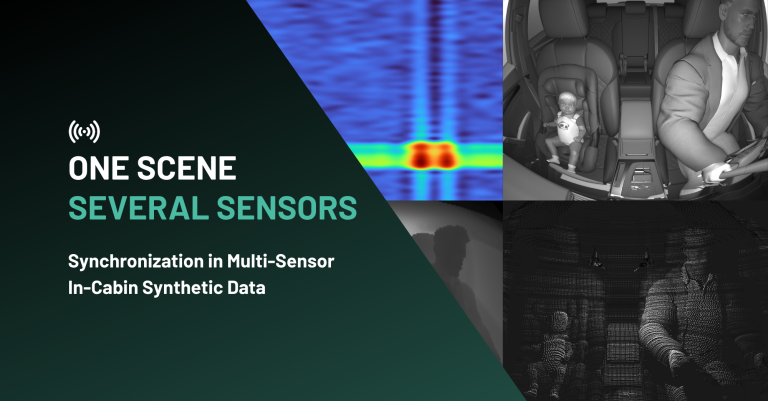

In-cabin monitoring systems (ICMS) have become pivotal for vehicle safety, especially as Euro NCAP and other global regulations increasingly mandate their use. These systems, which include Driver Monitoring Systems (DMS) and Occupant Monitoring Systems (OMS), require significant amounts of data for testing and validation. However, ensuring data diversity while protecting individual privacy—particularly children’s data—is a critical challenge. Here’s how synthetic data offers a transformative solution.
The privacy problem in data generation
Developing, testing, and validating in-cabin monitoring systems require a wide range of data coverage in various real-driving situations. Access to diverse, statistically balanced datasets that capture the full spectrum of human and driving variability is necessary. This includes images of people of various sexes, ethnic backgrounds, ages (including children, ranging from newborn babies to teenagers), and physical traits. These datasets must detail facial expressions, gestures, behaviors, and movements across a wide range of driving scenarios and vehicle types.
However, acquiring such comprehensive data is a monumental challenge. Gaining consent to film individuals, particularly minors, is not only ethically and legally complex but also incredibly time-consuming and costly. These barriers make it nearly impossible to rely solely on real-world data for system development, highlighting the need for innovative alternatives like synthetic data.
Moreover, real data often contains sensitive information, and even anonymized datasets can sometimes be de-anonymized, exposing individuals to potential breaches. For example:
- Facial recognition tools can match anonymized images to public social media profiles.
- Geolocation data—even when stripped of identifiable markers — can be cross-referenced with known travel patterns to pinpoint individuals.
These vulnerabilities are especially concerning for children’s data, where safeguarding privacy is paramount due to their inability to consent and the heightened sensitivity of personal information.
Regulatory restrictions
Regulatory frameworks like GDPR and COPPA restrict the use of children’s identifiable data, making it challenging for automotive OEMs and Tier 1 suppliers to access diverse and realistic datasets containing children’s data without violating privacy norms.
- GDPR (General Data Protection Regulation)
Under GDPR, children’s data is treated with extra care, requiring explicit parental consent for its collection and use. Additionally:- Data must be minimized, stored securely, and deleted after fulfilling its intended purpose.
- Special safeguards apply to sensitive information, such as biometrics used in monitoring systems.
- COPPA (Children’s Online Privacy Protection Act)
In the U.S., COPPA prohibits collecting personal information from children under 13 without verified parental consent. This law extends to online services and devices, including those in automotive systems.
How synthetic data resolves the privacy issue: benefits and applications
Synthetic data creates realistic, high-fidelity simulations of human behavior, eliminating the need for real-world data collection. It addresses privacy concerns in in-cabin monitoring testing by eliminating the need for real-world recordings of individuals, especially minors. Instead, it uses realistic simulations of people and behaviors tailored to the system’s needs. These datasets replicate diverse scenarios and demographics while ensuring no actual personal data is collected or used, maintaining privacy and enabling compliant, cost-effective validation.
Synthetic data provides numerous benefits for ICMS validation:
- Privacy compliance
- Avoids privacy risks entirely by being algorithmically generated without involving real individuals, including children.
- Ensures compliance with global privacy regulations like GDPR and COPPA.
- Bias reduction
- Facilitates the creation of diverse datasets representing different ages, ethnicities, and physical conditions.
- Simulates scenarios like children in various postures or ages in car seats, reducing bias in AI training.
- Cost and scalability
- Eliminates the need for costly, time-intensive traditional data collection processes involving actors and manual annotation.
- Generates large-scale datasets tailored to specific scenarios, like distracted driving or seatbelt use, at a fraction of the cost.
- Accelerated training processes
- Streamlines training material preparation by automating data generation for edge cases.
- Produces scenario-specific datasets rapidly, expediting model development and testing.
Here are a few of the key applications of synthetic data when privacy issues are at stake:
- Applications in children monitoring systems
- Enables systems to detect unattended children in vehicles or verify secure seating without using real footage of minors.
- Driver behavior analysis
- Simulates driver scenarios like drowsiness, texting while driving, or inattentiveness, enhancing safety while respecting privacy.
- Edge case testing
- Accurately replicates rare but critical scenarios, such as:
- Children left alone in vehicles under varying lighting, poses, and conditions.
- Occupants not wearing seatbelts or seated in non-standard postures.
- Obstructed driver views due to objects like toys or blankets on seats.
- Accurately replicates rare but critical scenarios, such as:
This capability to address complex challenges makes synthetic data a key enabler for advancing safer, more efficient, and privacy-compliant in-cabin monitoring systems.
Conclusion
As in-cabin monitoring systems (ICMS) become mandatory for modern vehicles, synthetic data emerges not as an alternative but as the only viable path forward. It eliminates privacy concerns, adheres to strict regulatory standards, and reduces the staggering costs and time associated with traditional data collection. By enabling manufacturers to simulate diverse, realistic scenarios—from children in car seats to distracted drivers—synthetic data ensures robust system validation without ethical or financial compromises. For those looking to innovate efficiently, meet deadlines, and stay within budget, synthetic data is the clear choice to drive the future of safer, smarter vehicles.