
The Tests You Can’t Fail: Inside Euro NCAP’s In-Cabin Monitoring Protocols
SHARE

Table of Contents

Table of Contents

Executive Summary

Euro NCAP safety ratings now hinge on in-cabin intelligence. Since 2023, Driver Status Monitoring (DSM) has been mandatory, and by 2026, expanded Occupant Monitoring System (OMS) and Child Presence Detection (CPD) tests will further raise requirements.

These protocols evaluate a vehicle’s ability to detect distraction, drowsiness, unresponsiveness, unbelted occupants, unsafe postures, and unattended children—under real-world conditions. Beyond perception accuracy, Euro NCAP scores response timing, alert escalation, and ADAS integration.

Passing these tests is ultimately a data challenge. Real-world data alone cannot scale across edge cases and controlled test conditions, making high-fidelity synthetic data essential for validating Euro NCAP–ready in-cabin AI systems.

This article outlines the current protocols, upcoming changes, and what OEMs and Tier-1 suppliers must do to secure a 5-star rating.

Introduction

The landscape of vehicle safety is rapidly evolving beyond traditional crash protection. Advanced driver assistance systems (ADAS) and in-cabin monitoring are now essential components of modern vehicle design and critical to securing top Euro NCAP safety ratings.

Starting in 2023 and accelerating through 2026, Euro NCAP has introduced a new wave of in-cabin monitoring tests. These protocols assess how effectively vehicles detect and respond to driver distraction, drowsiness, unbelted occupants, and the presence of unattended children. For OEMs and Tier 1s, passing these tests is no longer optional. They are a prerequisite for 5-star ratings and market credibility.

But meeting these standards is not straightforward.

  • Do development teams fully understand the scope of these new tests?
  • How are they validating AI models for Driver Monitoring Systems (DMS), Occupant Monitoring Systems (OMS), and Child Presence Detection (CPD)?
  • And perhaps most critically: where are they sourcing the diverse, high-quality data needed to train robust in-cabin AI systems?

Anyverse InCabin is purpose-built to solve this challenge. Our synthetic data solution generates photorealistic, sensor-accurate datasets tailored to Euro NCAP’s testing scenarios, enabling automotive innovators to train, test, and validate AI systems with the precision and scale required to pass.

In this article, we break down Euro NCAP’s current and upcoming in-cabin monitoring protocols and what it takes to meet them.

Breaking Down Euro NCAP’s In-Cabin Monitoring Requirements

Euro NCAP’s in-cabin monitoring protocols comprise a structured set of evaluations designed to assess how effectively a vehicle monitors its occupants and takes preemptive actions to mitigate risk. These tests mark a strategic shift from passive crash survival toward proactive accident prevention, making in-cabin monitoring systems a key driver of future safety ratings.

One of the foundational elements is the Seatbelt Reminder (SBR) system. This function detects whether front and rear occupants are properly buckled and, if not, issues persistent visual and audible alerts. While SBR has been part of Euro NCAP assessments for years, it remains a baseline safety requirement that all vehicles must meet.

As of 2023, Euro NCAP made Driver Status Monitoring (DSM) mandatory—a significant escalation in system complexity. DSM evaluates the vehicle’s ability to detect:

  • Driver distraction – Is the driver looking away from the road (e.g., at a phone or infotainment system)?
  • Fatigue indicators – Are the driver’s eyes closed or blinking abnormally slowly
  • Unresponsiveness – Is the driver failing to respond to system prompts or maintain control?

These challenges go beyond basic detection. DSM systems must generalize across diverse driver profiles (e.g., skin tone, eyewear, age) and perform reliably in variable real-world conditions such as nighttime driving, sunlight glare, or partial occlusion. Achieving this level of robustness depends heavily on the breadth and quality of the training data used to build and validate these AI models.

For a full breakdown of Euro NCAP’s DSM protocol, refer to the official guidelines and our analysis of the 2023 in-cabin requirements.

How Euro NCAP Evaluates Driver Status Monitoring Systems (DSM)

Driver Status Monitoring (DSM) is now a core component of Euro NCAP’s in-cabin safety protocols. These tests are designed to verify how effectively a vehicle detects unsafe driver behavior and how quickly it responds.

DSM systems are evaluated on their ability to:

  • Detect driver distraction — such as glancing away from the road for more than three seconds or interacting with a mobile device
  • Identify fatigue indicators — including prolonged eye closure, blink rate anomalies, and yawning
  • Recognize unresponsiveness — when the driver ignores repeated warnings or fails to maintain control

To pass, a system must demonstrate:

  • High-accuracy gaze tracking and attention analysis during simulated driving
  • Timely and appropriate alerting via visual and auditory warnings
  • Correct ADAS escalation, such as lane keeping or emergency braking, if the driver fails to react

By March 2025, Euro NCAP will formalize these DSM assessments with detailed test procedures, including:

  • Standardized video input captured at 25 Hz
  • Simulated driving scenarios that reflect real-world distraction and fatigue
  • Precise logging of warning triggers and driver response timing

These tests place significant demands on perception and AI systems—not only to detect subtle cues like eye closure or gaze deviation, but also to do so consistently across demographics and environmental conditions.

👉 See the official DSM test protocol (PDF) for full technical details.

What’s Coming in 2026: Euro NCAP’s Occupant Monitoring System (OMS) and CPD Tests

Starting in 2026, Euro NCAP will significantly expand its in-cabin monitoring protocols to cover full Occupant Monitoring Systems (OMS) and adaptive safety features. These new evaluations go beyond the driver to include all occupants—introducing new technical challenges for perception, classification, and real-time adaptation.

Vehicles will be assessed on their ability to:

  • Verify seatbelt usage for all passengers, including those in the rear
  • Detect child presence (CPD) to prevent hot-car incidents and ensure child safety
  • Classify occupants (adult, child, infant) to adjust restraint systems accordingly
  • Identify out-of-position (OOP) occupants, such as a slouched adult or a child leaning against a door, which could increase injury risk during deployment of safety systems

These evaluations test the system’s accuracy under varying lighting conditions, seating arrangements, and real-world distractions. The goal is not just detection—but correct, context-aware response. For example, if an occupant is detected in an unsafe posture, airbags may need to be suppressed or dynamically adjusted.

This places new demands on AI models:

  • Precision in 3D pose estimation, body segmentation, and classification
  • Robustness across skin tones, clothing types, and vehicle interiors
  • Extensive validation under edge cases (e.g., low light, partially occluded views, child in car seat)

Euro NCAP’s roadmap for these tests is outlined in the Safety Assist protocol updates. Automotive teams should prepare now to train and validate models that can pass these high-stakes OMS and CPD evaluations.

Post-Crash Occupant Detection Test

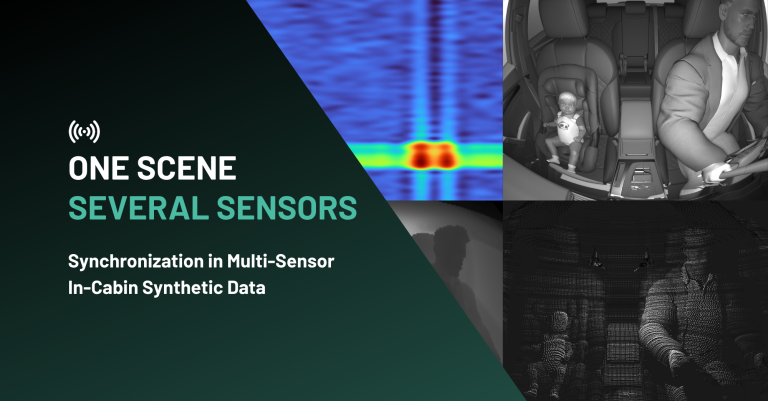
Millimeter-wave (mmWave) radar is already being integrated into production vehicles for passive vital sign monitoring, transforming passenger safety by enabling continuous, contactless observation.

At Anyverse, we simulate radar signals using advanced Shooting and Bouncing Ray (SBR) methods. Our simulation incorporates realistic parameters such as chirp design, MIMO antenna configurations, and generates detailed range-Doppler-angle point clouds. This enables developers to train AI models on rich, sensor-accurate radar data, achieving perception capabilities beyond what camera-only systems can offer.

For a deeper dive, check out our blog post on radar-based in-cabin sensing.

Beyond the Basics: Euro NCAP’s Real-World Testing Conditions for In-Cabin Monitoring Systems

To earn top Euro NCAP safety ratings, in-cabin monitoring systems must prove they work not just in ideal lab conditions, but in the messy, unpredictable reality of real-world driving. This is where many perception systems are most vulnerable.

Here are the key testing dimensions that Euro NCAP and industry experts use to assess system robustness, inclusivity, and reliability:

1. Variable Lighting Conditions

In-cabin monitoring must remain accurate across a wide lighting spectrum, from bright sunlight to tunnels, low-light urban environments, or night driving.
Euro NCAP’s protocols emphasize photometric robustness, meaning systems must be trained and validated with diverse lighting variations, glare angles, and shadow patterns.

2. Occlusions and Visual Obstructions

Real-world occupants wear sunglasses, masks, hats, or even rest their heads on a hand.
Systems must maintain gaze, eye, and head pose detection despite these occlusions. Research from institutions like Chalmers University highlights occlusion as a leading cause of fairness gaps and false negatives in DMS systems.

3. Demographic Fairness

AI models must generalize across all users, regardless of skin tone, age, gender, or facial morphology.
This means datasets must be demographically diverse and unbiased to ensure inclusive performance. Euro NCAP and partners like SBD Automotive are actively tracking how DMS developers address these fairness challenges.

4. Distinguishing Normal vs. Risky Behavior

Drivers glance at mirrors, talk, snack, or use infotainment systems. Systems must differentiate between natural driving actions and true distractions, like texting or prolonged gaze deviation. Euro NCAP evaluates performance across this behavioral spectrum during simulated test drives.

5. Posture Shifts and Micro-Movements

Small actions—like blinking, yawning, or shifting posture—can be subtle indicators of fatigue or inattention.
In-cabin AI must detect these signals reliably and adjust its alerts or ADAS triggers accordingly. This requires fine-grained annotation and temporal model accuracy.

6. Driver Readiness in Assisted Driving

For vehicles with Level 2+ automation, Euro NCAP assesses whether the driver is alert and able to resume control when prompted.
This is increasingly important as automation expands. Euro NCAP’s roadmap, discussed at AB Dynamics and other forums, outlines upcoming metrics for monitoring takeover readiness.

7. Response Timing and Escalation

Detection isn’t enough—response latency matters. Euro NCAP benchmarks how quickly systems issue alerts and trigger ADAS interventions like lane keeping or emergency braking.
Systems are tested using synchronized video and sensor data to evaluate end-to-end latency.

8. Edge Cases in Child Presence Detection (CPD)

Children may be hidden under blankets, toys, or safety seats. Future CPD tests will target these hard-to-detect scenarios, making robust training data and model generalization essential for OEMs.

9. Seatbelt Detection Across All Seats

Seatbelt status must be monitored for every occupant, front and rear. This includes detecting partial or improper usage—a basic, yet critical, requirement for full Euro NCAP compliance.

10. Post-Crash Occupant Status

New protocols are emerging to assess post-collision occupant detection—whether a person remains in the vehicle, their posture, and signs of consciousness.
This data can support automated emergency response, and is expected to be a focus in future safety assist protocols.

Why These Tests Are Critical for OEMs and Tier-1 Suppliers

The previous section made one thing clear: passing Euro NCAP in-cabin monitoring tests requires more than basic functionality. Systems must perform under real-world complexity, edge cases, and diverse user conditions. For OEMs and Tier-1 suppliers, this raises the stakes.

In fact, meeting Euro NCAP requirements is not optional—it directly influences:

  • Vehicle safety ratings: In-cabin monitoring performance contributes to the Euro NCAP star rating, which impacts vehicle marketability, especially in safety-conscious regions like Europe.
  • Regulatory alignment: Euro NCAP is aligned with growing legislative trends across the EU, US, and Asia. Compliance now helps future-proof your system against upcoming mandates.
  • Brand trust: Consumers expect vehicles to protect drivers and passengers proactively. Monitoring systems that detect distraction, fatigue, or unbelted occupants are fast becoming a safety standard.

But this is more than a checklist—it’s about building adaptive safety systems that:

  • Prevent accidents before they happen by detecting driver distraction or drowsiness
  • Adjust airbags and restraints in real time based on occupant posture and classification
  • Integrate seamlessly with ADAS and automated driving features to ensure human-machine coordination

For more context on how Euro NCAP fits into the global landscape, see our guide to international in-cabin monitoring regulations.

The Data Challenge Behind Euro NCAP In-Cabin Monitoring Compliance

Designing AI systems to meet Euro NCAP’s in-cabin protocols isn’t just a software engineering task — it’s a data problem at its core.

To perform reliably under the strict testing conditions outlined by Euro NCAP, these systems must be trained and validated on highly diverse, precisely labeled datasets that reflect real-world complexity, including:

  • Lighting variability — from daylight to nighttime, tunnels, glare, and backlighting
  • Demographic diversity — spanning a wide range of skin tones, facial features, ages, and accessories like sunglasses, face masks, or hats
  • Behavioral nuance — including occlusions, head tilts, hand-to-face gestures, micro-expressions, and posture changes
  • Dynamic sequences — full temporal coverage at required frame rates (e.g., 25Hz) to evaluate gaze tracking, fatigue detection, and warning timing

Achieving this level of data coverage through real-world collection alone is:

  • Extremely costly, requiring fleets, sensors, actors, and annotation teams
  • Slow to scale, especially when targeting rare edge cases like child presence under occlusion
  • Difficult to control, making it hard to produce repeatable test conditions for benchmark validation

These constraints make it challenging for OEMs and Tier-1 suppliers to validate their models against formalized Euro NCAP test procedures in a scalable and efficient way.

How Anyverse Helps You Meet and Exceed Euro NCAP In-Cabin Monitoring Requirements

As Euro NCAP raises the bar for in-cabin monitoring systems, the ability to develop, test, and validate AI models under tightly controlled and diverse conditions becomes a strategic differentiator.

At Anyverse, we provide synthetic data built specifically for Driver Monitoring Systems (DMS), Occupant Monitoring Systems (OMS), and Child Presence Detection (CPD), enabling OEMs and Tier-1 suppliers to stay ahead of evolving test protocols.

Here’s how we support your Euro NCAP compliance efforts:

Validate against protocol-specific conditions
Generate sequences that match Euro NCAP test video standards (e.g., 25Hz), camera placement, and scene dynamics, ensuring seamless integration into your AI validation pipeline.

Cover demographic and behavioral diversity

Create rich, fully annotated datasets across skin tones, ages, body types, accessories, postures, and micro-behaviors — essential for fairness, inclusion, and robustness.

Accelerate iteration and reduce real-world costs
Access scalable, on-demand simulation environments to develop and test systems faster without the expense and limitations of physical data collection.

Train for edge cases with precision
Simulate rare but safety-critical scenarios: distracted driving, drowsiness, child occlusion, improper seatbelt use, out-of-position occupants, and more across all demographics and lighting environments.

In short, Anyverse InCabin is designed to help you build smarter, safer, and regulation-ready in-cabin monitoring systems, not just for today’s DSM protocols, but for tomorrow’s full OMS and CPD evaluations.

To dive deeper into our Euro NCAP alignment, explore our 2023 protocol analysis article.

The road to a 5-star Euro NCAP rating now runs directly through the cabin.

With new in-cabin monitoring protocols expanding every year, building smarter, more adaptable AI systems isn’t optional but rather a competitive necessity.

At Anyverse, we help OEMs and Tier-1 suppliers navigate this shift with confidence. Our synthetic data platform is purpose-built for Driver, Occupant, and Child Presence Monitoring, offering the coverage, diversity, and precision needed to meet the most rigorous safety benchmarks.

Let’s talk. Book a free demo to see how Anyverse InCabin can accelerate your development, reduce validation risk, and help you stay ahead of regulatory change.

FAQ: Euro NCAP Monitoring Protocols

Why is the 25 Hz video requirement important in Euro NCAP DSM tests?

Euro NCAP specifies 25 Hz video input to ensure DSM systems can capture subtle, time-dependent driver behaviors. Micro-events such as blinking, gaze shifts, or gradual eye closure occur over short time windows and may be missed at lower frame rates.

For OEMs, this requirement affects both system design and data strategy. Training and validation datasets must include temporally accurate sequences that allow AI models to learn not just static features, but behavior evolution and response timing under Euro NCAP test conditions.

What does Euro NCAP mean by “out-of-position” occupants?

An out-of-position (OOP) occupant is a passenger whose posture could increase injury risk during airbag or restraint deployment—for example, a slouched adult, a child leaning against a door, or an occupant sitting too close to the dashboard.

Euro NCAP’s upcoming OMS assessments will test whether systems can detect these postures accurately and respond appropriately, such as suppressing or adapting airbag deployment. This requires precise 3D pose estimation and robust performance across clothing types, body shapes, and seating configurations.

Why are lighting variation and occlusion critical in Euro NCAP in-cabin tests?

Euro NCAP explicitly evaluates in-cabin monitoring performance under non-ideal conditions, including night driving, glare, shadows, and visual occlusions like sunglasses, hats, or hands on the face.

These conditions are a leading cause of real-world system failure and fairness gaps. To pass Euro NCAP tests, AI models must maintain consistent accuracy across lighting extremes and partial visibility—making diverse, well-controlled training and validation data essential.

How does Euro NCAP evaluate response timing and alert escalation in DSM systems?

Euro NCAP assesses not only whether unsafe driver behavior is detected, but how quickly and appropriately the system responds. Tests measure the latency between detection, visual or auditory warnings, and subsequent ADAS escalation if the driver fails to react.

Systems that detect correctly but respond too slowly, or escalate incorrectly, may lose points. This end-to-end timing evaluation requires tightly synchronized perception, decision logic, and actuation pipelines.

What role does demographic diversity play in Euro NCAP in-cabin monitoring assessments?

Euro NCAP expects in-cabin monitoring systems to perform consistently across skin tones, ages, facial features, and accessories such as glasses or face coverings. While Euro NCAP does not prescribe specific demographic datasets, it evaluates outcomes that expose bias-related performance gaps.

Models trained on limited or imbalanced data risk failing under these fairness expectations, particularly in DSM gaze tracking and fatigue detection tasks.

Why is gaze tracking central to Euro NCAP DSM performance?

Gaze direction is one of the primary signals used to assess driver attention in Euro NCAP DSM tests. Systems must determine whether the driver is looking at the road, mirrors, or off-road objects—and for how long.

Euro NCAP evaluates both spatial accuracy (where the driver is looking) and temporal consistency (how long attention is diverted). This makes high-quality gaze annotation and temporal modeling critical for compliance.
Enjoyed this article?

Add us as a Preferred Source on Google to see more content like this in Discover and Top Stories.

About Anyverse

With over 25 years of heritage in physics-based simulation and a 2008 Academy Technical Achievement Award, Anyverse is a leading provider of high-fidelity synthetic data and validation tools for advanced Perception AI.

While Anyverse remains a premier partner for the Automotive market, specializing in In-Cabin Monitoring systems and ADAS, its technology is increasingly adopted across Defence, Robotics, and Industry 4.0. Leveraging a proprietary physics-grounded engine, procedural synthetic data generation, and next-gen Generative AI, Anyverse produces datasets with unmatched realism and sensor-level accuracy (including RGB, NIR, Radar, LiDAR, and Thermal).

Its unified validation framework helps partners ensure compliance with specific regulations like Euro NCAP, as well as broader safety standards for autonomous systems. By bridging the gap between simulation and reality, Anyverse accelerates development, reduces costs, and ensures trustworthy perception for vehicles, robots, and intelligent machines.

The Tests You Can’t Fail: Inside Euro NCAP’s In-Cabin Monitoring Protocols

SHARE

Table of Contents

Table of Contents

Executive Summary

Euro NCAP safety ratings now hinge on in-cabin intelligence. Since 2023, Driver Status Monitoring (DSM) has been mandatory, and by 2026, expanded Occupant Monitoring System (OMS) and Child Presence Detection (CPD) tests will further raise requirements.

These protocols evaluate a vehicle’s ability to detect distraction, drowsiness, unresponsiveness, unbelted occupants, unsafe postures, and unattended children—under real-world conditions. Beyond perception accuracy, Euro NCAP scores response timing, alert escalation, and ADAS integration.

Passing these tests is ultimately a data challenge. Real-world data alone cannot scale across edge cases and controlled test conditions, making high-fidelity synthetic data essential for validating Euro NCAP–ready in-cabin AI systems.

This article outlines the current protocols, upcoming changes, and what OEMs and Tier-1 suppliers must do to secure a 5-star rating.

Introduction

The landscape of vehicle safety is rapidly evolving beyond traditional crash protection. Advanced driver assistance systems (ADAS) and in-cabin monitoring are now essential components of modern vehicle design and critical to securing top Euro NCAP safety ratings.

Starting in 2023 and accelerating through 2026, Euro NCAP has introduced a new wave of in-cabin monitoring tests. These protocols assess how effectively vehicles detect and respond to driver distraction, drowsiness, unbelted occupants, and the presence of unattended children. For OEMs and Tier 1s, passing these tests is no longer optional. They are a prerequisite for 5-star ratings and market credibility.

But meeting these standards is not straightforward.

  • Do development teams fully understand the scope of these new tests?
  • How are they validating AI models for Driver Monitoring Systems (DMS), Occupant Monitoring Systems (OMS), and Child Presence Detection (CPD)?
  • And perhaps most critically: where are they sourcing the diverse, high-quality data needed to train robust in-cabin AI systems?

Anyverse InCabin is purpose-built to solve this challenge. Our synthetic data solution generates photorealistic, sensor-accurate datasets tailored to Euro NCAP’s testing scenarios, enabling automotive innovators to train, test, and validate AI systems with the precision and scale required to pass.

In this article, we break down Euro NCAP’s current and upcoming in-cabin monitoring protocols and what it takes to meet them.

Breaking Down Euro NCAP’s In-Cabin Monitoring Requirements

Euro NCAP’s in-cabin monitoring protocols comprise a structured set of evaluations designed to assess how effectively a vehicle monitors its occupants and takes preemptive actions to mitigate risk. These tests mark a strategic shift from passive crash survival toward proactive accident prevention, making in-cabin monitoring systems a key driver of future safety ratings.

One of the foundational elements is the Seatbelt Reminder (SBR) system. This function detects whether front and rear occupants are properly buckled and, if not, issues persistent visual and audible alerts. While SBR has been part of Euro NCAP assessments for years, it remains a baseline safety requirement that all vehicles must meet.

As of 2023, Euro NCAP made Driver Status Monitoring (DSM) mandatory—a significant escalation in system complexity. DSM evaluates the vehicle’s ability to detect:

  • Driver distraction – Is the driver looking away from the road (e.g., at a phone or infotainment system)?
  • Fatigue indicators – Are the driver’s eyes closed or blinking abnormally slowly
  • Unresponsiveness – Is the driver failing to respond to system prompts or maintain control?

These challenges go beyond basic detection. DSM systems must generalize across diverse driver profiles (e.g., skin tone, eyewear, age) and perform reliably in variable real-world conditions such as nighttime driving, sunlight glare, or partial occlusion. Achieving this level of robustness depends heavily on the breadth and quality of the training data used to build and validate these AI models.

For a full breakdown of Euro NCAP’s DSM protocol, refer to the official guidelines and our analysis of the 2023 in-cabin requirements.

How Euro NCAP Evaluates Driver Status Monitoring Systems (DSM)

Driver Status Monitoring (DSM) is now a core component of Euro NCAP’s in-cabin safety protocols. These tests are designed to verify how effectively a vehicle detects unsafe driver behavior and how quickly it responds.

DSM systems are evaluated on their ability to:

  • Detect driver distraction — such as glancing away from the road for more than three seconds or interacting with a mobile device
  • Identify fatigue indicators — including prolonged eye closure, blink rate anomalies, and yawning
  • Recognize unresponsiveness — when the driver ignores repeated warnings or fails to maintain control

To pass, a system must demonstrate:

  • High-accuracy gaze tracking and attention analysis during simulated driving
  • Timely and appropriate alerting via visual and auditory warnings
  • Correct ADAS escalation, such as lane keeping or emergency braking, if the driver fails to react

By March 2025, Euro NCAP will formalize these DSM assessments with detailed test procedures, including:

  • Standardized video input captured at 25 Hz
  • Simulated driving scenarios that reflect real-world distraction and fatigue
  • Precise logging of warning triggers and driver response timing

These tests place significant demands on perception and AI systems—not only to detect subtle cues like eye closure or gaze deviation, but also to do so consistently across demographics and environmental conditions.

👉 See the official DSM test protocol (PDF) for full technical details.

What’s Coming in 2026: Euro NCAP’s Occupant Monitoring System (OMS) and CPD Tests

Starting in 2026, Euro NCAP will significantly expand its in-cabin monitoring protocols to cover full Occupant Monitoring Systems (OMS) and adaptive safety features. These new evaluations go beyond the driver to include all occupants—introducing new technical challenges for perception, classification, and real-time adaptation.

Vehicles will be assessed on their ability to:

  • Verify seatbelt usage for all passengers, including those in the rear
  • Detect child presence (CPD) to prevent hot-car incidents and ensure child safety
  • Classify occupants (adult, child, infant) to adjust restraint systems accordingly
  • Identify out-of-position (OOP) occupants, such as a slouched adult or a child leaning against a door, which could increase injury risk during deployment of safety systems

These evaluations test the system’s accuracy under varying lighting conditions, seating arrangements, and real-world distractions. The goal is not just detection—but correct, context-aware response. For example, if an occupant is detected in an unsafe posture, airbags may need to be suppressed or dynamically adjusted.

This places new demands on AI models:

  • Precision in 3D pose estimation, body segmentation, and classification
  • Robustness across skin tones, clothing types, and vehicle interiors
  • Extensive validation under edge cases (e.g., low light, partially occluded views, child in car seat)

Euro NCAP’s roadmap for these tests is outlined in the Safety Assist protocol updates. Automotive teams should prepare now to train and validate models that can pass these high-stakes OMS and CPD evaluations.

Post-Crash Occupant Detection Test

Millimeter-wave (mmWave) radar is already being integrated into production vehicles for passive vital sign monitoring, transforming passenger safety by enabling continuous, contactless observation.

At Anyverse, we simulate radar signals using advanced Shooting and Bouncing Ray (SBR) methods. Our simulation incorporates realistic parameters such as chirp design, MIMO antenna configurations, and generates detailed range-Doppler-angle point clouds. This enables developers to train AI models on rich, sensor-accurate radar data, achieving perception capabilities beyond what camera-only systems can offer.

For a deeper dive, check out our blog post on radar-based in-cabin sensing.

Beyond the Basics: Euro NCAP’s Real-World Testing Conditions for In-Cabin Monitoring Systems

To earn top Euro NCAP safety ratings, in-cabin monitoring systems must prove they work not just in ideal lab conditions, but in the messy, unpredictable reality of real-world driving. This is where many perception systems are most vulnerable.

Here are the key testing dimensions that Euro NCAP and industry experts use to assess system robustness, inclusivity, and reliability:

1. Variable Lighting Conditions

In-cabin monitoring must remain accurate across a wide lighting spectrum, from bright sunlight to tunnels, low-light urban environments, or night driving.
Euro NCAP’s protocols emphasize photometric robustness, meaning systems must be trained and validated with diverse lighting variations, glare angles, and shadow patterns.

2. Occlusions and Visual Obstructions

Real-world occupants wear sunglasses, masks, hats, or even rest their heads on a hand.
Systems must maintain gaze, eye, and head pose detection despite these occlusions. Research from institutions like Chalmers University highlights occlusion as a leading cause of fairness gaps and false negatives in DMS systems.

3. Demographic Fairness

AI models must generalize across all users, regardless of skin tone, age, gender, or facial morphology.
This means datasets must be demographically diverse and unbiased to ensure inclusive performance. Euro NCAP and partners like SBD Automotive are actively tracking how DMS developers address these fairness challenges.

4. Distinguishing Normal vs. Risky Behavior

Drivers glance at mirrors, talk, snack, or use infotainment systems. Systems must differentiate between natural driving actions and true distractions, like texting or prolonged gaze deviation. Euro NCAP evaluates performance across this behavioral spectrum during simulated test drives.

5. Posture Shifts and Micro-Movements

Small actions—like blinking, yawning, or shifting posture—can be subtle indicators of fatigue or inattention.
In-cabin AI must detect these signals reliably and adjust its alerts or ADAS triggers accordingly. This requires fine-grained annotation and temporal model accuracy.

6. Driver Readiness in Assisted Driving

For vehicles with Level 2+ automation, Euro NCAP assesses whether the driver is alert and able to resume control when prompted.
This is increasingly important as automation expands. Euro NCAP’s roadmap, discussed at AB Dynamics and other forums, outlines upcoming metrics for monitoring takeover readiness.

7. Response Timing and Escalation

Detection isn’t enough—response latency matters. Euro NCAP benchmarks how quickly systems issue alerts and trigger ADAS interventions like lane keeping or emergency braking.
Systems are tested using synchronized video and sensor data to evaluate end-to-end latency.

8. Edge Cases in Child Presence Detection (CPD)

Children may be hidden under blankets, toys, or safety seats. Future CPD tests will target these hard-to-detect scenarios, making robust training data and model generalization essential for OEMs.

9. Seatbelt Detection Across All Seats

Seatbelt status must be monitored for every occupant, front and rear. This includes detecting partial or improper usage—a basic, yet critical, requirement for full Euro NCAP compliance.

10. Post-Crash Occupant Status

New protocols are emerging to assess post-collision occupant detection—whether a person remains in the vehicle, their posture, and signs of consciousness.
This data can support automated emergency response, and is expected to be a focus in future safety assist protocols.

Why These Tests Are Critical for OEMs and Tier-1 Suppliers

The previous section made one thing clear: passing Euro NCAP in-cabin monitoring tests requires more than basic functionality. Systems must perform under real-world complexity, edge cases, and diverse user conditions. For OEMs and Tier-1 suppliers, this raises the stakes.

In fact, meeting Euro NCAP requirements is not optional—it directly influences:

  • Vehicle safety ratings: In-cabin monitoring performance contributes to the Euro NCAP star rating, which impacts vehicle marketability, especially in safety-conscious regions like Europe.
  • Regulatory alignment: Euro NCAP is aligned with growing legislative trends across the EU, US, and Asia. Compliance now helps future-proof your system against upcoming mandates.
  • Brand trust: Consumers expect vehicles to protect drivers and passengers proactively. Monitoring systems that detect distraction, fatigue, or unbelted occupants are fast becoming a safety standard.

But this is more than a checklist—it’s about building adaptive safety systems that:

  • Prevent accidents before they happen by detecting driver distraction or drowsiness
  • Adjust airbags and restraints in real time based on occupant posture and classification
  • Integrate seamlessly with ADAS and automated driving features to ensure human-machine coordination

For more context on how Euro NCAP fits into the global landscape, see our guide to international in-cabin monitoring regulations.

The Data Challenge Behind Euro NCAP In-Cabin Monitoring Compliance

Designing AI systems to meet Euro NCAP’s in-cabin protocols isn’t just a software engineering task — it’s a data problem at its core.

To perform reliably under the strict testing conditions outlined by Euro NCAP, these systems must be trained and validated on highly diverse, precisely labeled datasets that reflect real-world complexity, including:

  • Lighting variability — from daylight to nighttime, tunnels, glare, and backlighting
  • Demographic diversity — spanning a wide range of skin tones, facial features, ages, and accessories like sunglasses, face masks, or hats
  • Behavioral nuance — including occlusions, head tilts, hand-to-face gestures, micro-expressions, and posture changes
  • Dynamic sequences — full temporal coverage at required frame rates (e.g., 25Hz) to evaluate gaze tracking, fatigue detection, and warning timing

Achieving this level of data coverage through real-world collection alone is:

  • Extremely costly, requiring fleets, sensors, actors, and annotation teams
  • Slow to scale, especially when targeting rare edge cases like child presence under occlusion
  • Difficult to control, making it hard to produce repeatable test conditions for benchmark validation

These constraints make it challenging for OEMs and Tier-1 suppliers to validate their models against formalized Euro NCAP test procedures in a scalable and efficient way.

How Anyverse Helps You Meet and Exceed Euro NCAP In-Cabin Monitoring Requirements

As Euro NCAP raises the bar for in-cabin monitoring systems, the ability to develop, test, and validate AI models under tightly controlled and diverse conditions becomes a strategic differentiator.

At Anyverse, we provide synthetic data built specifically for Driver Monitoring Systems (DMS), Occupant Monitoring Systems (OMS), and Child Presence Detection (CPD), enabling OEMs and Tier-1 suppliers to stay ahead of evolving test protocols.

Here’s how we support your Euro NCAP compliance efforts:

Validate against protocol-specific conditions
Generate sequences that match Euro NCAP test video standards (e.g., 25Hz), camera placement, and scene dynamics, ensuring seamless integration into your AI validation pipeline.

Cover demographic and behavioral diversity

Create rich, fully annotated datasets across skin tones, ages, body types, accessories, postures, and micro-behaviors — essential for fairness, inclusion, and robustness.

Accelerate iteration and reduce real-world costs
Access scalable, on-demand simulation environments to develop and test systems faster without the expense and limitations of physical data collection.

Train for edge cases with precision
Simulate rare but safety-critical scenarios: distracted driving, drowsiness, child occlusion, improper seatbelt use, out-of-position occupants, and more across all demographics and lighting environments.

In short, Anyverse InCabin is designed to help you build smarter, safer, and regulation-ready in-cabin monitoring systems, not just for today’s DSM protocols, but for tomorrow’s full OMS and CPD evaluations.

To dive deeper into our Euro NCAP alignment, explore our 2023 protocol analysis article.

The road to a 5-star Euro NCAP rating now runs directly through the cabin.

With new in-cabin monitoring protocols expanding every year, building smarter, more adaptable AI systems isn’t optional but rather a competitive necessity.

At Anyverse, we help OEMs and Tier-1 suppliers navigate this shift with confidence. Our synthetic data platform is purpose-built for Driver, Occupant, and Child Presence Monitoring, offering the coverage, diversity, and precision needed to meet the most rigorous safety benchmarks.

Let’s talk. Book a free demo to see how Anyverse InCabin can accelerate your development, reduce validation risk, and help you stay ahead of regulatory change.

FAQ: Euro NCAP Monitoring Protocols

Why is the 25 Hz video requirement important in Euro NCAP DSM tests?

Euro NCAP specifies 25 Hz video input to ensure DSM systems can capture subtle, time-dependent driver behaviors. Micro-events such as blinking, gaze shifts, or gradual eye closure occur over short time windows and may be missed at lower frame rates.

For OEMs, this requirement affects both system design and data strategy. Training and validation datasets must include temporally accurate sequences that allow AI models to learn not just static features, but behavior evolution and response timing under Euro NCAP test conditions.

What does Euro NCAP mean by “out-of-position” occupants?

An out-of-position (OOP) occupant is a passenger whose posture could increase injury risk during airbag or restraint deployment—for example, a slouched adult, a child leaning against a door, or an occupant sitting too close to the dashboard.

Euro NCAP’s upcoming OMS assessments will test whether systems can detect these postures accurately and respond appropriately, such as suppressing or adapting airbag deployment. This requires precise 3D pose estimation and robust performance across clothing types, body shapes, and seating configurations.

Why are lighting variation and occlusion critical in Euro NCAP in-cabin tests?

Euro NCAP explicitly evaluates in-cabin monitoring performance under non-ideal conditions, including night driving, glare, shadows, and visual occlusions like sunglasses, hats, or hands on the face.

These conditions are a leading cause of real-world system failure and fairness gaps. To pass Euro NCAP tests, AI models must maintain consistent accuracy across lighting extremes and partial visibility—making diverse, well-controlled training and validation data essential.

How does Euro NCAP evaluate response timing and alert escalation in DSM systems?

Euro NCAP assesses not only whether unsafe driver behavior is detected, but how quickly and appropriately the system responds. Tests measure the latency between detection, visual or auditory warnings, and subsequent ADAS escalation if the driver fails to react.

Systems that detect correctly but respond too slowly, or escalate incorrectly, may lose points. This end-to-end timing evaluation requires tightly synchronized perception, decision logic, and actuation pipelines.

What role does demographic diversity play in Euro NCAP in-cabin monitoring assessments?

Euro NCAP expects in-cabin monitoring systems to perform consistently across skin tones, ages, facial features, and accessories such as glasses or face coverings. While Euro NCAP does not prescribe specific demographic datasets, it evaluates outcomes that expose bias-related performance gaps.

Models trained on limited or imbalanced data risk failing under these fairness expectations, particularly in DSM gaze tracking and fatigue detection tasks.

Why is gaze tracking central to Euro NCAP DSM performance?

Gaze direction is one of the primary signals used to assess driver attention in Euro NCAP DSM tests. Systems must determine whether the driver is looking at the road, mirrors, or off-road objects—and for how long.

Euro NCAP evaluates both spatial accuracy (where the driver is looking) and temporal consistency (how long attention is diverted). This makes high-quality gaze annotation and temporal modeling critical for compliance.

Enjoyed this article?

Tap to add us as a Preferred Source on Google to see more content like this.

About Anyverse

With over 25 years of heritage in physics-based simulation and a 2008 Academy Technical Achievement Award, Anyverse is a leading provider of high-fidelity synthetic data and validation tools for advanced Perception AI.

While Anyverse remains a premier partner for the Automotive market, specializing in In-Cabin Monitoring systems and ADAS, its technology is increasingly adopted across Defence, Robotics, and Industry 4.0. Leveraging a proprietary physics-grounded engine, procedural synthetic data generation, and next-gen Generative AI, Anyverse produces datasets with unmatched realism and sensor-level accuracy (including RGB, NIR, Radar, LiDAR, and Thermal).

Its unified validation framework helps partners ensure compliance with specific regulations like Euro NCAP, as well as broader safety standards for autonomous systems. By bridging the gap between simulation and reality, Anyverse accelerates development, reduces costs, and ensures trustworthy perception for vehicles, robots, and intelligent machines.