
Table of Contents
Table of Contents
For international OEMs aiming to establish or expand their presence in Europe, achieving compliance with increasingly strict automotive safety regulations is a critical milestone. This is especially true in the case of Driver Monitoring Systems (DMS) are a prime example, as they’re a key focus area in EU General Safety Regulation (GSR) and Euro NCAP’s evolving roadmap.
As of July 2024, DMS is mandatory for all new types of vehicles entering the EU market, with even tighter performance expectations from Euro NCAP 2025 onward. OEMs need to validate DMS functionalities, such as driver distraction, drowsiness, and attention detection, under a wide range of conditions that reflect real-world variability across Europe.
Meeting these standards through traditional data collection and real-world testing is costly, slow, and incomplete. That’s why OEMs, particularly those from China, the U.S., and Asia-Pacific, are increasingly turning to synthetic data and Euro NCAP-aligned simulation to accelerate validation, improve model safety, and build regulatory confidence before physical testing.
Why DMS is Now Critical for EU Market Entry
Europe is at the forefront of integrating driver state monitoring into vehicle safety assessments. Key developments include:
- EU GSR 2024 mandate for DMS in new vehicles
- Euro NCAP 2023–2025 protocols awarding higher scores for DMS features tied to attention, fatigue, and distraction detection
- Focus on safety-critical, explainable AI behavior under variable conditions—driver age, ethnicity, lighting, accessories, and head movement
For OEMs with no prior presence in Europe, these requirements pose a technical and regulatory barrier. Datasets collected and labeled in other regions may lack demographic diversity or cabin variability relevant to European consumers. Edge case, such as detecting drowsiness in low lighting, or distinguishing gaze patterns through glasses or sunglasses, are rarely captured with sufficient coverage.

Understanding Euro NCAP Protocols: A Framework for Validating Safety and Driver Monitoring Systems
The European New Car Assessment Programme (Euro NCAP) has become a key driver of safety innovation in the automotive industry. While not legally binding, Euro NCAP assessments have a significant influence on consumer trust, market perception, and even vehicle sales in Europe. Most importantly for OEMs entering the region, Euro NCAP protocols often anticipate or align with upcoming regulatory requirements, including those defined in the EU General Safety Regulation (GSR).
Euro NCAP’s Safety Assessment Structure
Euro NCAP evaluates vehicle safety performance across several domains, including:
- Adult Occupant Protection
- Child Occupant Protection
- Vulnerable Road Users (VRU)
- Safety Assist (ADAS functionality)
- In-cabin Monitoring (Driver & Occupant Monitoring Systems)
From 2023 onward, and especially in 2025, in-cabin monitoring has gained significant weight in the star rating system. This reflects growing concerns around:
- Driver distraction (eyes off the road, phone use)
- Drowsiness or microsleep events
- Impaired or incapacitated driver detection
- Presence and posture of occupants (e.g., for airbag logic or child safety)
These protocols are increasingly scenario-driven and sensor-agnostic, meaning OEMs must demonstrate that their systems function correctly under a wide range of use cases, lighting conditions, camera placements, and driver behaviors.
The Shift Toward Simulation-Friendly Testing
While many protocols were historically validated through physical testing, Euro NCAP is gradually embracing virtual testing, simulation evidence, and synthetic datasets as acceptable components of the validation process, especially when physical replication is impractical (e.g., capturing rare edge case or exhaustive driver behavior variants).
This opens the door for simulation-based design and synthetic data pipelines that align directly with Euro NCAP test cases, enabling:
- Early system validation and debugging before real-world testing
- Coverage of high-risk or ethically complex scenarios (e.g., medical impairment)
- Sensor-specific fine-tuning for RGB, NIR, or thermal-based DMS solutions
In short, Euro NCAP is not just a compliance target. It’s a technical design framework for safety-critical AI systems, especially those involving driver perception and interaction.

Why This Matters for OEMs Entering the European Market
For OEMs expanding from China, the U.S., South Korea, or other global regions into Europe, Euro NCAP and EU Regulation are more than bureaucratic hurdles; they are gateways to market trust, top safety ratings, and long-term competitiveness.
But compliance isn’t just about ticking boxes. It’s about engineering systems that are robust, explainable, and ready to perform under real-world European conditions.
International OEMs face several unique challenges:
- Unfamiliar driving environments and cabin use cases
- Lack of legacy data aligned with Euro NCAP protocols or EU driving norms
- Pressure to accelerate development while ensuring safety and certification readiness
That’s where the combination of synthetic data generation and regulation-aligned simulation becomes indispensable. However, not all synthetic data is created equal.
To succeed, OEMs need to work with specialized data suppliers who understand the intricacies of:
- Driver behavior modeling under Euro NCAP conditions
- Sensor-specific rendering (e.g., NIR for DMS, RGB+depth for in-cabin perception)
- Protocol alignment with OpenSCENARIO definitions and Euro NCAP’s scoring methodology
A trusted partner ensures that datasets:
- Accurately represent demographic diversity, lighting variability, and behavior patterns
- Support test automation and coverage tracking
- Reduce data generation, training, and validation cycles by orders of magnitude
In short, having the right data partner isn’t just about efficiency, it’s a strategic enabler of regulatory compliance and safety assurance.

Synthetic Data: Enabling Safer, Faster DMS Validation
Manufacturers struggle to keep pace with today’s evolving safety standards and tight market timelines. As regulations like the EU GSR and Euro NCAP 2025 protocols raise the bar for driver state monitoring, engineering teams need validation strategies that are not only faster and scalable, but also precisely aligned with the regulatory framework.
Physics-based synthetic data offers a fundamentally better approach for training and validating Driver Monitoring Systems:
Cost Efficiency
- No need for actors, vehicle fleets, or repeated test setups.
- Eliminates the manual overhead of labeling frame-by-frame driver states.
Regulatory Safety
- Avoids GDPR and privacy risks associated with using real human footage.
- Enables anonymized, reproducible driver behavior data for validation and reporting purposes.
Full Control
- Fine-tune cabin configurations, lighting conditions, and driver demographics.
- Simulate distraction, drowsiness, head pose, and occlusion cases with high repeatability.
- Support sensor-specific rendering for RGB, NIR, or thermal DMS systems.
Faster Iteration Cycles
- Seamlessly integrate synthetic data into model training and testing loops.
- Shorten the time between perception model updates and validation against Euro NCAP-aligned scenarios.
This controlled, synthetic-first approach enables ML and perception teams to cover hundreds of edge case that would be impractical or unsafe to stage in reality.
For fast-moving innovators like BYD, XPeng, and NIO, synthetic data has become a core enabler for competitive validation. These OEMs are using fully annotated synthetic datasets and in-cabin behavior simulations to:
- Pre-train attention and distraction detection models on Euro NCAP-compliant behaviors
- Validate performance across European demographic profiles and lighting conditions
- Accelerate readiness for GSR and NCAP scoring systems—well ahead of physical testing deadlines
The result? Higher confidence in system safety, faster time-to-compliance, and a clear technical advantage in one of the most competitive global markets.

Euro NCAP-Aligned Synthetic Data: Scalable Validation for DMS and OMS with Anyverse
When combined with scenario-based simulation that mirrors Euro NCAP test protocols, physics-based synthetic data becomes a powerful regulatory enabler. For both Driver Monitoring Systems (DMS) and broader ADAS validation, simulations offer the repeatability, scalability, and control required to meet evolving regulatory and safety benchmarks.
With Euro NCAP placing growing emphasis on driver state monitoring, child presence detection, and occupant status, simulation environments must go beyond vehicle dynamics. They must accurately represent the human element inside the cabin, across a full range of scenarios and sensor modalities.
Anyverse provides OEMs and Tier 1 suppliers with high-fidelity, fully annotated synthetic datasets built specifically for in-cabin AI system training and validation. Our simulation platform enables virtual testing across diverse real-world conditions, without waiting for real-world data collection.
Euro NCAP-Aligned Simulation Built for Compliance
We map our datasets directly to Euro NCAP’s DSM, OMS, and CPD requirements, supporting:
- Driver distraction scenarios (e.g., phone use, infotainment interaction)
- Drowsiness and microsleep detection
- Incorrect or missing seatbelt usage
- Unresponsive or slumped occupants (post-crash or health events)
- Children moving or left unattended in various seating positions
Each scenario is modeled with regulatory scoring logic in mind, aligned not just with Euro NCAP, but also EU GSR and US NHTSA frameworks, ensuring global applicability for international OEMs.
True Multi-Sensor Simulation for Sensor Fusion Workflows
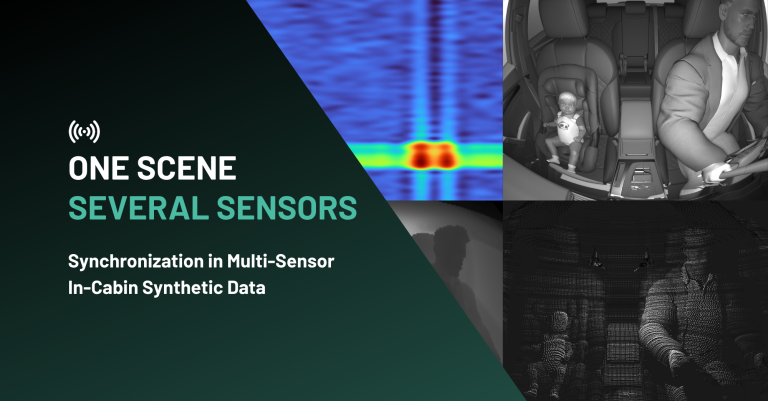
In-cabin monitoring systems rely on multimodal sensor inputs. Our platform supports synchronized simulation of:
- RGB-IR cameras
- NIR
- Radar
- Time-of-flight (ToF)
- Depth sensors
All outputs are perfectly aligned, enabling your AI models to train and validate using sensor-fusion-ready, interoperable data, an outcome that is extremely difficult (and costly) to replicate in real-world testing.
Edge Case Generation at Scale
We procedurally generate hard-to-capture yet critical edge case, such as:
- Drivers with sunglasses, hats, masks
- Children sleeping, seated incorrectly, or unbuckled
- Rear-seat passengers obscured or poorly lit
- Post-crash slumped occupants
- Child seats with or without occupants
- High visual noise, occlusions, or rare cabin setups
This allows teams to access large, highly diverse training datasets in days, not months, boosting both performance and robustness.
Diverse Synthetic Occupants & Cabin Environments
Anyverse simulates occupants across a wide range of ages, ethnicities, body types, and behavioral patterns, helping mitigate bias in training. Our datasets also span multiple cabin configurations, allowing Chinese and other international OEMs to validate for European use cases while retaining flexibility for global deployment.
Rapid Test–Iterate Cycles for ML and Product Teams
With Anyverse InCabin, you can test and iterate virtually before building physical prototypes:
- Identify system failures early in the ML lifecycle
- Optimize sensor placement and algorithm logic
- Avoid late-stage surprises in regulatory testing
Many of our customers report reduction in time-to-validation by integrating synthetic-first workflows at the model development and validation stage.
No-Code Scenario Creation for Cross-Team Agility
Our visual platform supports no-code dataset generation, making it easy for AI, validation, and compliance teams to collaborate:
- Fast onboarding, even without simulation expertise
- More control over scenario parameters and edge case targeting
- Better alignment between AI model needs and regulatory test requirements

Chinese OEMs Leading with Synthetic-First Validation
Several major Chinese vehicle manufacturers are increasingly adopting synthetic data-driven validation strategies early in their DMS development pipelines. By leveraging high-resolution synthetic datasets tailored to diverse European demographic profiles, these OEMs have been able to enhance their distraction detection algorithms, notably improving performance in challenging conditions such as partial occlusions.
In parallel, some manufacturers have developed Euro NCAP-aligned driver fatigue simulation suites that significantly reduce reliance on costly and time-consuming real-world in-cabin data collection before transitioning to on-road testing.
These synthetic-first approaches not only accelerate regulatory compliance efforts but also provide engineering teams with greater control, transparency, and confidence in their systems’ safety performance under rigorous EU validation frameworks.
Other Use Cases: ADAS and Perception System Validation
While DMS is currently in the spotlight, synthetic data and simulation also benefit other safety-critical systems:
- Pedestrian and VRU detection in dense European urban scenes
- Traffic sign and light recognition under varied EU signage conventions
- Scenario testing for Euro NCAP 2025 ADAS protocols, including complex cut-in, intersection, and AEB events
These systems often rely on the driver’s state as context, making driver-aware ADAS validation increasingly important.

Unlock EU Compliance Through Synthetic Safety Validation
Entering the European automotive market requires more than just vehicle readiness. It demands AI system transparency, safety performance, and regulatory alignment.
By leveraging synthetic data and Euro NCAP-aligned simulations, OEMs outside of Europe can:
- Validate DMS and ADAS systems faster
- Generate regulation-grade evidence
- Improve model safety across diverse real-world scenarios
This isn’t just about ticking compliance boxes. It’s about building trust, reliability, and engineering confidence in one of the world’s most demanding safety landscapes.
Want to accelerate your DMS validation strategy for Europe? Let’s talk.