
Table of Contents
Table of Contents
Today’s vehicles aren’t just watching the road; they’re paying attention to what’s happening inside. Driver Monitoring Systems (DMS) are redefining automotive safety by detecting distraction, drowsiness, and impaired behavior before it becomes dangerous. Whether it’s a long day at work, a child unbuckling in the back seat, or a quick glance at a phone, in-cabin monitoring AI is built to act when drivers can’t.
And the need is real. The NHTSA reports that over 100,000 crashes in the U.S. each year are caused by drowsy driving. Even more heartbreaking, an average of 37 children die annually from heatstroke after being left in vehicles, most by accident. DMS and Child Presence Detection (CPD) systems have the potential to save lives, but only if they’ve been trained to recognize these scenarios quickly and reliably.
That reliability starts with data. These systems are only as good as the training data behind them. To perform in real-world conditions, with different lighting, seating positions, body types, and unpredictable behaviors, AI needs exposure to countless scenarios, including edge cases.
And that’s where traditional data collection hits a wall. Real-world data is slow, costly, limited in diversity, and often comes with privacy concerns, especially when involving children.
This is why Anyverse InCabin exists. It’s a purpose-built synthetic data solution designed specifically for developing and validating in-cabin monitoring systems. By generating high-quality, physics-based, sensor-accurate datasets, Anyverse InCabin enables engineering teams to train and validate robust AI that sees more, understands more, and ultimately helps bring you and the people you care about home safe.
But here’s the challenge: teaching AI to understand complex, often subtle human behavior inside the cabin requires more than just a few hours of driving footage. Real-world data (while valuable)has critical limitations when it comes to training high-performing, safety-critical models. If your AI hasn’t seen a certain scenario, it probably won’t know how to respond. That’s a problem when lives are on the line.
Why Real-World Data Isn’t Enough to Keep Us Safe
Traditional data collection for in-cabin monitoring typically involves physical vehicles equipped with cameras and sensors, capturing footage of human participants in controlled environments. While these methods provide real data, they come with major limitations:
- Privacy and Consent: Collecting identifiable images of vehicle occupants raises significant data protection challenges, especially in the EU under GDPR. This can limit both dataset size and diversity.
- Scenario Coverage: Behaviors like driver distraction, drowsiness, or a child climbing into the front seat are difficult (and sometimes unsafe) to capture naturally, yet they’re essential for building robust AI.
- Lack of Environmental Diversity: Lighting changes, glare from windows, varying weather conditions, and sensor noise all affect in-cabin perception, but capturing every combination manually is nearly impossible.
- Cost and Time: Organizing controlled data capture campaigns with numerous participants and configurations is resource-intensive.
Synthetic data offers a new path forward. Using high-fidelity simulations, teams can recreate complex cabin environments and human behaviors at scale. With Anyverse InCabin, it’s possible to generate millions of fully labeled frames, including body keypoints, object segmentation, and depth maps, all without the real-world constraints of privacy, cost, or rarity.

Creating Safer In-Cabin AI Starts with More Accurate Synthetic Data
Anyverse InCabin synthetic data pipeline is built on physics-based simulation, leveraging the science of light, material properties, human anatomy, and sensor technology to recreate real-world conditions with precision.
This makes a critical difference when training AI for driver and occupant monitoring. Here’s how our approach ensures realism and reliability:
- Accurate Light Behavior: We simulate how light behaves in confined spaces, bouncing off surfaces, filtering through windows, interacting with reflective materials, and casting natural shadows. This is crucial for vision models that must perform under a variety of lighting conditions, from bright daylight to dim cabin environments.
- Human Body Dynamics: Our high-fidelity avatars model natural human movement, posture changes, facial gestures, and limb positioning. This helps AI systems detect subtle behavioral cues like drowsiness, inattention, or unsafe movements.
- Sensor-Specific Simulation: We recreate the characteristics of real cameras and sensors—lens distortion, depth mapping, infrared illumination, rolling shutter effects, and sensor noise. This allows us to produce multimodal datasets that closely resemble actual sensor outputs.
- Occlusions and Real-World Interactions: Cabins are full of visual obstructions, hands on the wheel, phones, coffee cups, sunglasses, or seatbacks. We model these interactions so the AI learns to cope with the messy reality of real-world driving.
By focusing on physics and fidelity, Anyverse minimizes the domain gap between synthetic and real data, helping AI models trained in simulation perform reliably in the real world, where performance matters most.

Turning Data Into Safety: How Synthetic Data Powers Smarter In-Cabin AI
AI-powered in-cabin monitoring systems are transforming vehicle safety and passenger comfort by continuously analyzing occupant behavior and environmental conditions. Synthetic data plays a crucial role in making these AI systems reliable and effective in real-world scenarios.
Here’s how synthetic data improves safety and user experience:
- Driver Attention Monitoring: Detects distraction, drowsiness, and fatigue to alert the driver or trigger safety interventions, reducing accident risks.
- Occupant Detection: Identifies the presence, number, and posture of passengers, ensuring seatbelt use and proper airbag deployment.
- Child Safety: Recognizes unbuckled or unattended children in the vehicle to prevent dangerous situations.
- Gesture Recognition: Enables intuitive control of infotainment and vehicle systems through hand and body movements, improving user convenience.
- Personalized Comfort: Adjusts seat position, climate control, and lighting based on occupant behavior and preferences.
- Robustness to Variations: Thanks to diverse synthetic data, AI models handle different lighting conditions, occupant types, occlusions, and sensor noise effectively.
By providing diverse, annotated, and realistic training data, synthetic datasets from Anyverse InCabin empower automotive AI to:
- Minimize false alarms and missed detections
- Respond accurately to complex, dynamic in-cabin scenarios
- Improve overall system reliability and user trust
These improvements ultimately lead to safer roads and enhanced passenger experiences, driving widespread adoption of AI-based in-cabin monitoring technologies.

Industry Momentum: Why OEMs Are Turning to Physics-Based Synthetic Data
The push for smarter, safer in-cabin AI is not just theoretical. It’s happening now. Across the automotive industry, leading OEMs, Tier 1s, and research labs are validating synthetic data as a critical enabler of next-generation safety systems.
The automotive industry is rapidly embracing synthetic data as a practical solution to the limitations of real-world data collection. It’s not just about speed or cost—it’s about building AI that performs reliably in safety-critical situations.
A study published in Springer highlights how synthetic datasets are accelerating the development of both autonomous driving systems and in-cabin monitoring AI, improving safety outcomes while cutting down on development time and expenses.
Meanwhile, Automotive Testing Technology International reports that engineers across the industry are increasingly using synthetic data to:
- Validate edge-case scenarios that are too rare (or too dangerous) to capture in real life
- Enhance AI robustness across occupant types, vehicle models, and lighting conditions
- Improve the repeatability and efficiency of testing pipelines
As development cycles shrink and safety regulations tighten, automakers are looking beyond basic 3D rendering tools. They’re turning to physics-based synthetic data, like that produced by Anyverse InCabin, to train and validate their AI systems with precision and scale.

From Concept to Deployment: How Anyverse InCabin Accelerates Your AI Development
You’ve seen the value of synthetic data. But building production-grade in-cabin AI requires more than just synthetic images. It demands precision, control, scalability, and trust. That’s where Anyverse InCabin stands out. We provide not only data but a full-stack solution to support your journey from early experimentation to validation under real-world standards like Euro NCAP and China NCAP.
Here’s how we partner with engineering teams to deliver better-performing, safety-compliant AI:
1. Tailored, Domain-Specific Datasets
Every project starts with your specific use case:
- Driver state monitoring (distraction, drowsiness, gaze)
- Occupant classification (adult, child, empty seat)
- Child presence detection
- Gesture recognition for HMI control
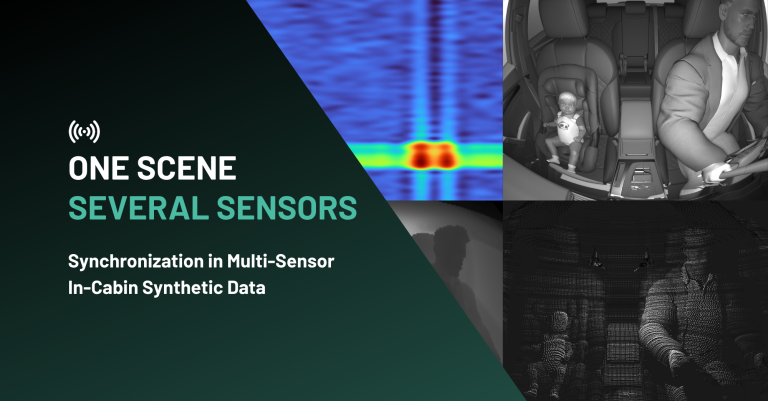
- Multimodal fusion, including RGB, IR, depth, and radar
In addition to a growing library of preconfigured test cases aligned with Euro NCAP protocols, our scene configurator gives you full control over key variables such as occupant behavior, demographics, lighting conditions, seating positions, clothing, and accessories. Whether you’re validating against regulatory benchmarks or designing custom edge cases, we deliver the scale, precision, and flexibility to match your exact specifications.
2. Scalable, Flexible Data Generation
No matter where you are in the dev cycle:
- Iterate fast with targeted test sets
- Scale to millions of annotated frames for production training
- Re-generate or expand datasets as your model evolves
Because it’s synthetic, you can safely model high-risk edge cases or rare behaviors that are nearly impossible to capture in the real world.
3. Sensor-Accurate Simulations
We simulate your exact sensor configuration, down to lens distortion, IR light behavior, frame rate, and noise profile. You can validate across:
- RGB (mono/stereo), NIR, depth, TOF, event cameras
- NIR/IR imaging
- Radar
You train your AI on how your sensors actually see the cabin, not just generic synthetic data.
4. Expert Support from Day One
Our simulation engineers and computer vision experts work with you to:
- Identify blind spots in your real-world data
- Design synthetic scenarios to close performance gaps
- Reduce domain shift and improve generalization
- Validate models with hybrid synthetic/real-world datasets
Whether you’re aiming to meet Euro NCAP, China NCAP, or internal safety KPIs, we help you move faster with confidence.
This comprehensive support model is what makes Anyverse a trusted partner for safety-critical applications. Learn how we align with global requirements like China NCAP and help you pass the Euro NCAP protocols as a trusted and reliable partner. In short, we don’t just deliver synthetic data, we help you deliver better AI.

Reliable, Robust Occupant Monitoring AI: Built with Synthetic Data
The Road to Safer Driving Begins with the Right Data
Synthetic data for in-cabin monitoring AI is no longer a futuristic promise. It’s a critical enabler of today’s safest and most intelligent vehicles. With physics-based simulation at its core, Anyverse InCabin helps automotive teams bypass the roadblocks of real-world data collection, cut development costs, and deliver AI models that perform with confidence in real-world conditions.
Whether you’re building driver monitoring systems, occupant safety features, or intelligent comfort controls, the right data makes all the difference, and that data starts here.
See it in action: request a demo and generate a tailored sample dataset to elevate your in-cabin AI development and validation.