Table of Contents
Table of Contents
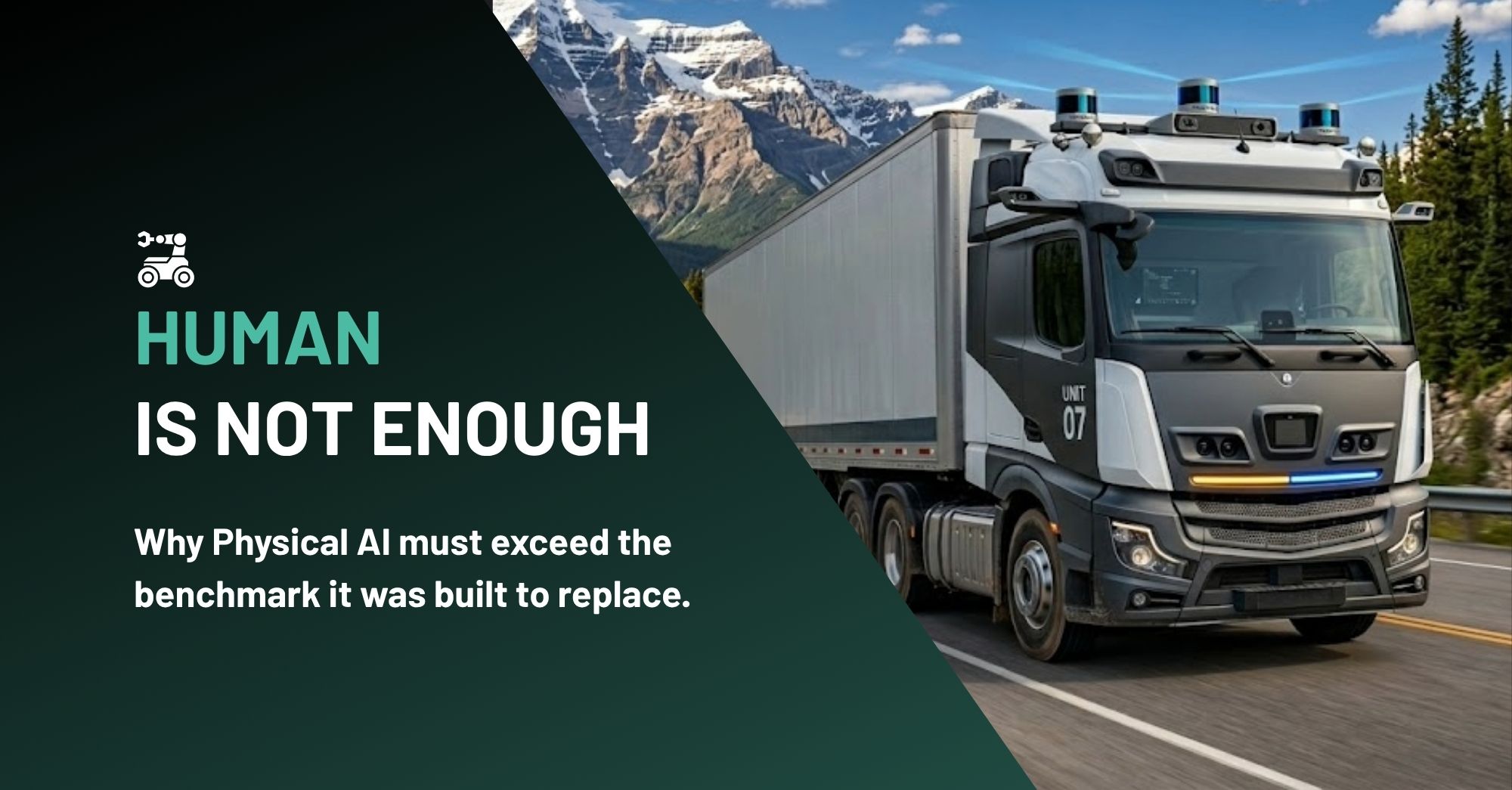
Nobody designs Physical AI to fail. But sometimes the failure is built in before a single line of code is written.
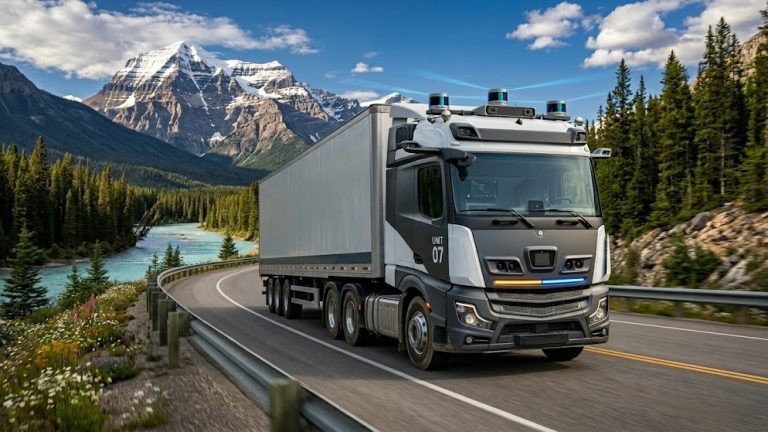
A long-haul driver, seven hours into a night shift on the A1. Legally compliant. Technically within limits. His reaction time has degraded by 247 milliseconds since he left the depot — not enough to fail a legal test, but enough to matter in a lane departure scenario where the intervention window is under 300 milliseconds. His blink rate has nearly doubled. His lane corrections are arriving later and wider than they were at hour one.
Not dramatically. Not enough to trigger an alert. Just enough to matter.
The system watching him had been validated against human attentiveness benchmarks — which meant it had been designed to tolerate exactly what was happening. Because humans tolerate it too.
That is not a sensor failure. It is a philosophy failure.
The Finish Line Was Always in the Wrong Place for Physical AI
For most of Physical AI’s short history, human performance has been the implicit finish line. Build something that drives as well as a human. That monitors as reliably as a trained co-pilot. That handles objects as consistently as an experienced operator. Ship it, celebrate it, move on.
The problem is that humans are not a particularly high bar. Not because people are careless, but because human physiology was never optimised for the kind of sustained, high-stakes attentiveness that Physical AI systems are being asked to guarantee. A nurse administering medication on hour eleven of a twelve-hour shift makes measurably more errors than on hour one — not through carelessness, but because that is what sustained cognitive load does to a human nervous system. A surgeon’s hand tremor increases by an average of 30% over the course of a six-hour procedure. An air traffic controller’s error rate climbs significantly in the final ninety minutes of a shift, regardless of experience or training.
These are not edge cases. They are documented, repeatable properties of human performance under load. And a Physical AI system calibrated to match this baseline inherits every one of these limitations by design, with none of the biological context that makes them forgivable in a human.
Human-equivalent performance in Physical AI is not a success criterion. It is a failure state. The night shift driver on the A1 is not an edge case. He is the baseline.

If Not Human Performance, Then What? The Case for Consequence-Based Standards
So if human performance is the wrong target, what is the right one?
It is a deceptively simple question. And the honest answer is that the industry does not yet have a clean response to it.
Aviation got there first. After a series of catastrophic failures in the mid-twentieth century, the field defined an unambiguous criterion: the probability of a catastrophic failure must be less than 10⁻⁹ per flight hour, roughly one in a billion. That number did not emerge from a comparison to human pilots. It emerged from a calculation about consequence — about what failure rate society could tolerate given the irreversibility of the outcome.
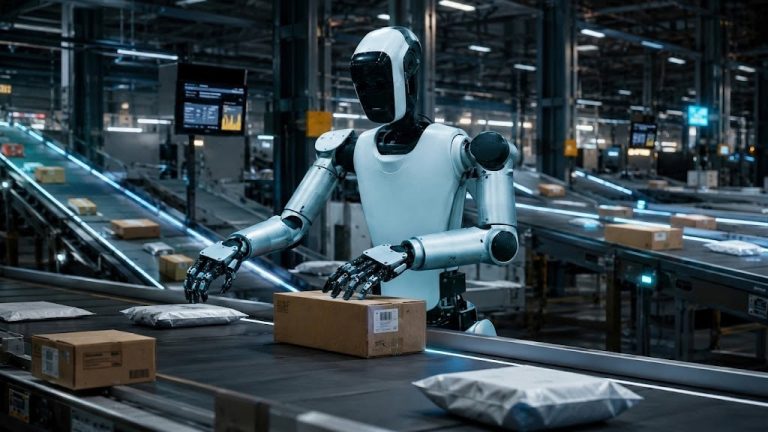
Physical AI is arriving at the same crossroads, and the stakes are already concrete. A warehouse robot is operating three shifts a day alongside human workers. A surgical assistant performing procedures that exceed the precision of the steadiest human hand. A construction site perception system making spatial decisions in conditions that would ground a human operator. In each case, the question is the same: what is the acceptable failure rate, given what failure actually means here?
The answer cannot be “as reliable as the human it is replacing.” The criterion must be set by consequence and operational context — and then validated against it.
The field knows this. It is still working out how to get there.
360 Degrees. No Blind Spots. No Bad Days.
A logistics robot in a distribution centre doesn’t need to see the way a human sees. It needs to track every moving object in a 360-degree radius, simultaneously, at 3am, with the same accuracy it had at the start of the shift. A robotic arm in a microelectronics assembly line doesn’t need human dexterity. It needs sub-micron repeatability across ten thousand cycles without drift. A search and rescue drone operating in a collapsed building doesn’t need human vision. It needs to map structural voids through smoke and debris using radar and thermal imaging, in complete darkness, faster than any human team could safely operate.
None of these systems are trying to be human. That is precisely what makes them worth building — and worth trusting. But it also makes them significantly harder to validate. Because the moment you accept that the target exceeds human performance, the tools you have been using to validate against it become insufficient.
The Higher the Bar, the Harder the Validation
Here is the problem nobody talks about enough. Raising the bar does not simplify the validation challenge. It makes it considerably harder.
If the benchmark is human performance, you can validate against human-derived test campaigns. You can observe what human operators notice, stage the scenarios they would flag, and measure your system against the distribution of conditions a human would encounter on a normal working day. It is imperfect, but it is tractable.

If the benchmark is — as Nishant Bhanot argues — genuinely superhuman, that entire framework breaks down. The scenarios that matter most are precisely the ones that exceed human perceptual limits. A 247-millisecond degradation in driver reaction time is invisible to a human observer in the passenger seat — but it is exactly the gap a DMS operating in a 300-millisecond intervention window needs to detect, consistently, across every variation of lighting, cabin temperature, and driver physiology it will ever encounter. No human test campaign surfaces that scenario systematically. No human annotator flags the subtle postural shifts that precede it. You cannot build a test campaign around scenarios you cannot perceive. You cannot curate a dataset from edge cases you would not recognise as edge cases.
Coverage-first validation was the conclusion of the previous challenge on deploying Physical AI. Here, it becomes something more fundamental. If you are building a system designed to perform where humans cannot, you need a validation programme designed to reach where humans would not look. Coverage-first validation was introduced there as good engineering practice. Here, it is something more fundamental. If you are building a system designed to perform where humans cannot, you need a validation programme designed to reach where humans would not look. That means generating the conditions your test drivers would never encounter, your annotators would never flag, and your benchmarks were never designed to surface. Synthetic data and simulation are not just useful at this level. They are structurally necessary.
The Strictest Benchmark Isn't Written in Any Standard
The hardest acceptance criterion of all is not written in any standard. It is held by the people who will live alongside these systems.
A surgical robot that performs with superhuman precision still has to earn the patient’s trust on the table. An autonomous vehicle with a validated safety record still has to earn the pedestrian’s trust at the crossing. A warehouse robot operating beyond human perceptual limits still has to earn the trust of the human worker standing three metres away. None of those people has read the test reports. None of them cares about the benchmark. They care about one thing: will this system behave safely, in the moment that matters, in a way that I can understand and rely on?
That question cannot be answered by capability alone. It can only be answered by the depth and credibility of the validation behind it — by whether the hard cases were genuinely found and addressed before deployment, not discovered afterward. This is where synthetic data and simulation become not just engineering tools but the foundation of a trust-building process. The ability to generate sensor-accurate scenarios at scale, to systematically cover the long tail before it surfaces in the field, and to demonstrate that coverage transparently — that is what turns a capable system into a trustworthy one. It is what platforms like Anyverse are built to support. That is what platforms like Anyverse are built to support. sensor-accurate synthetic data, across RGB, NIR, LiDAR, radar, and thermal, for teams in automotive, defence, robotics, and aerospace who need to prove coverage, not just claim it.
And it is, in the end, the validation that earns the only thing that matters: trust.
The Bar Was Never Human. It Was Always Trust
Go back to that night shift driver on the A1. Seven hours in. Legally compliant. And already beyond the threshold the system watching him was never designed to find.
That gap did not appear overnight. It was predictable, measurable, and entirely preventable — if the validation programme had been built around the question of what the system needed to detect, rather than what a human observer would have noticed.
Physical AI will not be defined by the systems that match human performance. It will be defined by the ones that go beyond it — consistently, in the dark, at mile 400, without a bad day — and can prove it. Not to a test protocol. Not to a benchmark. To the people whose lives depend on the system getting it right, in the moment the world presents something nobody thought to include in the training data.
That is the bar. It was never about matching humans. And the field is only beginning to understand what building toward it actually requires.