
Table of Contents
Table of Contents
Robust in-cabin monitoring systems demand fusion of multiple sensor modalities. Individual sensors, including radar, RGB cameras, infrared (IR), and Time-of-Flight (ToF), each provide partial and complementary views of occupant behavior but have inherent limitations, such as sensitivity to lighting, occlusions, or subtle motions.
By fusing these data streams, Driver Monitoring AI models achieve a more comprehensive and accurate understanding of occupant state and activity. This sensor fusion reduces blind spots and failure modes present in single-sensor systems, directly translating to improved detection reliability, faster system response, and ultimately enhanced vehicle safety.
These safety gains are crucial for meeting the rigorous requirements of automotive functional safety standards (e.g., ISO 26262) and emerging regulations, such as UN R157, for driver monitoring systems.
However, the complexity of multi-sensor fusion systems introduces new challenges in data collection and validation. Gathering large-scale, synchronized, and annotated datasets across diverse sensors and cabin environments, covering variations in occupant pose, lighting, and sensor conditions, is costly and often impractical.
Synthetic, multi-sensor-ready datasets from Anyverse address this bottleneck by generating realistic, diverse, and fully annotated data at scale. This synthetic data accelerates model development, validation, and compliance workflows, enabling OEMs and Tier 1 suppliers to build safer, more robust in-cabin AI systems while reducing time-to-market and compliance risks.
In this article, we detail how sensor fusion enhances safety in in-cabin monitoring, the challenges inherent to validating multi-sensor systems, and the transformative role of synthetic data in automotive AI pipelines.
What Is Sensor Fusion for Driver Monitoring Systems (DMS)?
Sensor fusion in in-cabin monitoring integrates real-time data streams from multiple sensor modalities to create a comprehensive and accurate model of occupant behavior and state. By combining inputs from radar, RGB cameras, infrared (IR), and Time-of-Flight (ToF) sensors, fusion systems enable detection and tracking of critical safety-related events, including:
- Driver fatigue or distraction
- Seat occupancy and posture
- Vital signs like breathing or heart rate
- Seat belt usage and seating configuration
- Child presence and unattended children
Unlike single-sensor solutions, sensor fusion mitigates modality-specific weaknesses. For example, cameras may fail under challenging or occluded conditions, but radar or IR sensors maintain reliable detection. This complementary integration ensures continuous, high-fidelity monitoring, which is essential to meet stringent safety regulations such as Euro NCAP and global standards

DMS Sensor Fusion + Synthetic Data to Ensure In-Cabin Safety
Why Single-Sensor Systems Fall Short: The Case for Sensor Fusion in In-Cabin Monitoring
Core Sensor Types Used in In‑Cabin Monitoring
Single-sensor systems face inherent limitations that reduce their effectiveness in diverse and dynamic cabin environments. Effective sensor fusion starts with choosing the right technologies:
Radar excels at motion detection even in poor lighting but offers limited spatial resolution.
RGB cameras provide rich visual details but are sensitive to lighting changes and occlusions.
Infrared sensors detect heat signatures and subtle movement, but can be affected by cabin temperature variations.
Time-of-Flight (ToF) sensors provide depth information but have limited range and are prone to interference.
Sensor Type | Strengths | Typical Use |
RGB + IR Cameras | Visual detail, facial recognition, gesture tracking | Handles low light via infrared |
Radar (60 GHz mmWave) | Picks up micro-movements; penetrates blankets/clothes | Essential for CPD and fine motion detection |
ToF Sensors | Generates depth maps; maps posture and movement | Supports 3D spatial understanding |
These individual weaknesses create blind spots that can degrade system reliability, particularly in challenging scenarios like nighttime driving or when occupants’ movements are partially obscured.
Multi-sensor fusion addresses these gaps by combining complementary data streams, improving detection accuracy, system robustness, and ultimately vehicle safety. Read more about their application in our deep dive on radar-based simulation challenges.

Implementing Sensor Fusion in In-Cabin Monitoring: Approaches and Techniques
Sensor fusion in in-cabin monitoring can be implemented at various stages of the processing pipeline, depending on when and how data from different sensors is combined:
- Early Fusion (Low-Level Fusion): Combines raw sensor data before feature extraction. For example, pixel-level integration of IR and RGB video streams allows the model to learn joint representations directly from the raw inputs, capturing fine-grained correlations across modalities.
- Mid-Level Fusion: Features are first extracted independently from each sensor—such as facial landmarks from a camera and motion vectors from radar—and then merged. This approach balances complexity and flexibility, enabling the model to leverage specialized feature representations while still benefiting from cross-sensor information.
- Late Fusion: Independently processed outputs—like detection scores or behavioral classifications—are combined at the decision level. This modular strategy simplifies implementation and sensor substitution but may miss some nuanced cross-modal correlations.
Advanced AI architectures increasingly incorporate dynamic fusion strategies, including attention mechanisms, to weigh sensor inputs contextually. For instance, in low-light conditions, the model may prioritize radar or IR data over RGB, adapting in real-time to optimize performance and robustness.
For a deeper technical dive, the 2021 MDPI Sensors study offers comprehensive insights into multi-level sensor fusion techniques in automotive monitoring.

Sensor Fusion in Action: Real-World Applications in In-Cabin Monitoring
Leading automotive technology providers are already deploying sensor fusion strategies to solve complex occupant monitoring challenges.
Here are several notable examples of sensor fusion in commercial in-cabin AI systems:
- Cipia integrates radar and infrared (IR) fusion systems to monitor occupant posture and breathing patterns with high accuracy, even in low-light and occluded conditions.
- Eyeris fused RGB, radar, and thermal sensors to enable advanced occupant state detection, including heartbeat monitoring and Child Presence Detection (CPD).
- LG Electronics and Rheinmetall integrated cameras, radar, and ToF to develop Driver Monitoring Systems (DMS) aligned with Euro NCAP safety requirements.
- Infineon and partners are advancing ToF + radar fusion for next-gen occupant monitoring capable of depth-aware presence detection and motion analysis.
These implementations demonstrate a clear industry shift: sensor fusion is no longer a nice-to-have; it’s a competitive and regulatory necessity for OEMs and Tier 1s aiming to deliver robust, real-world-ready in-cabin AI systems.

The Data Bottleneck: What’s Slowing Down Multi-Sensor DMS Development
Building high-performing in-cabin AI systems powered by sensor fusion doesn’t stop at model architecture; it starts with data. And for multi-sensor pipelines, data quickly becomes the biggest obstacle.
Collecting large-scale, high-quality datasets from real vehicles that include synchronized RGB, radar, IR, and ToF data is both technically challenging and cost-prohibitive. Each sensor modality introduces its own set of constraints:
- Synchronization & Calibration: Accurate sensor fusion requires precisely aligned data streams in time and space. Achieving and maintaining calibration across sensors in real-world test environments is complex and error-prone.
- Ground Truth Labeling: While annotating RGB images is relatively mature, labeling radar and IR data—especially with occupant posture, motion, or physiological states—is extremely difficult and often imprecise.
- Scenario Coverage: Capturing rare or high-risk events (e.g., a child falling asleep unbelted, a driver slouching at night, or breathing patterns under distraction) across all sensor channels and various cabin configurations is practically impossible with traditional fleet data collection.
- Edge Case Scarcity: Real-world data is biased toward the norm. Rare-but-critical safety edge cases—occlusions, unusual body poses, lighting extremes—are underrepresented or missing entirely.
- Regulatory Pressure: Standards like Euro NCAP require performance across a broad range of conditions, not just best-case scenarios. Without reliable data for these scenarios, achieving compliance becomes a moving target.
The result? Teams spend months (or longer) chasing the right data, delaying development, increasing risk, and limiting their ability to benchmark or validate multi-sensor models at scale.

How Anyverse InCabin Accelerates Multi-Sensor DMS Development with Synthetic Data
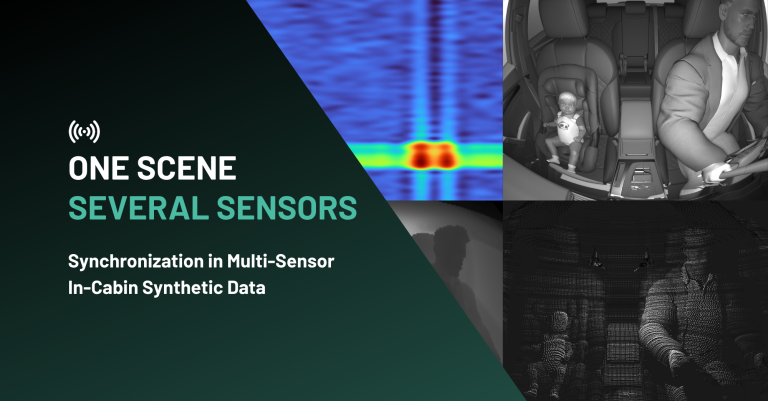
Anyverse InCabin is purpose-built for in-cabin monitoring technology and overcomes the data bottleneck in multi-sensor Driver Monitoring Systems by delivering richly annotated, synchronized synthetic data across multiple sensor modalities, including RGB, near-infrared (NIR), radar, and Time-of-Flight (ToF).
Key Advantages of Anyverse InCabin for Multi-Sensor DMS:
- Multi-Modal Sensor Simulation
Anyverse InCabin accurately simulates multiple sensor streams simultaneously, ensuring pixel-perfect temporal and spatial alignment. This provides engineers with fusion-ready datasets essential for training robust sensor fusion models. - Physically Accurate Sensor Models
Each sensor modality is simulated with physics-based realism, replicating real-world effects such as material reflectance in NIR, radar signal behavior, and ToF depth sensing. This high-fidelity simulation is critical for capturing subtle cues like breathing patterns or small postural changes. - Scenario Diversity and Edge-Case Generation
The platform allows programmable generation of diverse scenarios and edge cases — from varying lighting and occlusions to complex occupant postures and child presence — enabling comprehensive model training and validation. - Annotated Ground Truth at Scale
Every frame includes precise, automatic annotations for key DMS tasks such as driver distraction, fatigue signs, seatbelt usage, and occupant identification. This drastically reduces manual labeling effort and accelerates dataset creation. - Compliance and Safety Readiness
Anyverse InCabin features a comprehensive test case library aligned specifically to Euro NCAP’s in-cabin monitoring tests, the very tests vehicles must pass to meet global safety regulations. This alignment empowers teams to systematically validate their models against regulatory requirements early and continuously. - Accelerated Development Cycle
By eliminating dependency on costly, time-consuming real-world data collection, Anyverse InCabin enables rapid iteration and continuous model improvement, shortening time-to-market for multi-sensor DMS solutions.
Leveraging Anyverse InCabin means your multi-sensor DMS pipeline is fueled with diverse, realistic, and synchronized synthetic data — empowering you to build safer, more reliable in-cabin AI systems faster and more efficiently.
Explore more in our feature on Anyverse In-Cabin: High-Quality Data for Next-Gen AI Validation.

Driving Safer In-Cabin AI with Advanced Sensor Fusion and Data
Sensor fusion in in-cabin monitoring is not just a technical innovation; it’s a critical enabler for building safer vehicles. By integrating diverse sensor data streams, automotive systems achieve the robust perception needed to detect driver states and occupant behaviors across all conditions.
This multi-sensor approach addresses the limitations of individual sensors, providing comprehensive situational awareness that supports proactive safety interventions, from detecting fatigue and distraction to monitoring child presence and seatbelt usage.
But developing and validating robust multi-sensor in-cabin monitoring systems demands access to the right data across multiple sensor modalities. Real-world data collection alone is often impractical due to cost, safety constraints, and the complexity of capturing rare or edge-case scenarios.
Anyverse InCabin addresses these challenges by providing scalable, compliance-aligned datasets that replicate real-world sensor behavior across varied conditions, empowering engineering teams to efficiently validate their AI models with multi-sensor data tailored to meet stringent industry requirements.
The future of mobility depends on in-cabin AI systems that truly understand occupants, and that starts with the right data. Ready to see how Anyverse InCabin can power your multi-sensor DMS development? Book a free demo today and stay ahead in the race to safer, smarter vehicles.