
Table of Contents
Table of Contents
The Challenge of Validating In-Cabin Multi-Sensor Systems
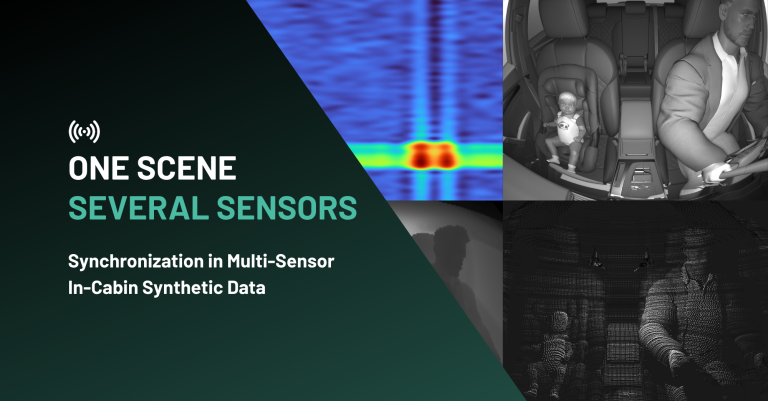
In-cabin monitoring systems are becoming increasingly sophisticated, tasked with detecting everything from driver drowsiness and distraction to child presence and seatbelt usage. To achieve this, in-cabin systems rely on a fusion of multiple sensor modalities: RGB cameras, IR, ToF, radar, and others.
But while the hardware and algorithms continue to evolve, there’s a common bottleneck: data.
High-quality, diverse, and synchronized sensor data is essential to train, validate, and fine-tune these systems. Real-world data collection is expensive, time-consuming, and often constrained by privacy regulations. And cases like children left in hot cars, occluded occupants, or low-light interactions are rare and hard to capture. Even more problematic, synchronizing data across different sensor types (each with its own physical properties and capture mechanics) is extremely difficult in practice.
Without synchronized, modality-accurate datasets, multi-sensor fusion models are left underperforming, especially in safety-critical scenarios.
In this article, we’ll explore how Anyverse InCabin addresses this challenge through a physics-based simulation approach to generate synchronized, multi-sensor synthetic data, enabling system validation and supporting regulatory compliance efforts.
Getting the Right Data: Accurate Simulation of All In-Cabin Sensors
When building in-cabin systems, it’s not just about having “a lot” of data—it’s about having the right data. For multi-sensor systems, this means:
- Frame-level temporal alignment: Each sensor must capture the same scene at the same time.
- Sensor-specific realism: The characteristics of light, distance, and materials must be simulated as each sensor would “see” them.
- Spatial alignment: Accurate positioning, calibration, and FOV configurations must be preserved across sensors.
If your IR frame is half a second off from your RGB, or if your ToF simulation doesn’t correctly model multi-path reflections, you’re not validating the actual behavior of the system. You’re validating a proxy that may not hold up in real-world deployments.
Traditional dataset generation methods (manual capture, limited synthetic tools, or post-processed simulation) often fail to deliver the required synchronization fidelity and sensor realism. That’s where Anyverse InCabin makes a critical difference.

Overview of In-Cabin Sensor Modalities
Modern in-cabin monitoring systems rely on a combination of sensor technologies, each with unique capabilities, limitations, and simulation requirements. Understanding how these sensors operate in real-world scenarios is critical to simulating them accurately for AI development and system validation.
Let’s take a deeper look at the primary sensor modalities:
RGB Cameras (Visible Light)
RGB cameras are the workhorse of most Driver Monitoring Systems (DMS). They capture visual information used in:
- Facial recognition and gaze estimation
- Driver drowsiness and distraction detection
- Seatbelt use and hand position tracking
- Occupant classification (adult, child, pet)
- Gesture and HMI interaction analysis
Simulation Considerations:
RGB simulation requires photorealism, dynamic lighting, shadows, camera optics, motion blur, and lens distortion modeling. Sensor noise, exposure settings, and dynamic range must also be accurately represented.
Infrared (IR) Cameras
IR sensors enable driver and occupant monitoring in low-light or complete darkness. Common use cases include:
- Night-time drowsiness or eye-tracking
- Monitoring behavior when interior lights are off
- Enhancing contrast for facial landmarks (eyes, mouth)
Simulation Considerations:
IR simulation involves modeling active IR light sources (like LED projectors), surface reflectivity in the IR spectrum, emissivity of human skin and materials, and temperature effects. It requires a fundamentally different lighting model than RGB.
Depth / Stereo Vision
Stereo or structured light cameras estimate depth using disparity between two or more RGB or IR images. They support:
- Occupant posture estimation
- Seat occupancy and body tracking
- Gesture recognition and reach zone detection
Simulation Considerations:
Stereo depth simulation must replicate disparities under different lighting conditions, textures, and occlusions. Correct geometric calibration and camera baseline are essential for accurate depth maps.
Time-of-Flight (ToF) Cameras
ToF sensors emit light (usually NIR) and measure return time to create a depth map. Their precision and speed make them ideal for:
- Occupant body segmentation
- Gesture detection in HMI
- Accurate driver presence sensing
Simulation Considerations:
ToF simulation involves modeling active illumination, multi-path interference, temporal resolution, sensor noise, and surface absorption characteristics. Realistic ToF simulation must handle depth artifacts that occur in reflective or translucent surfaces.
Radar
Radar is increasingly used in in-cabin systems to detect micro-movements and presence, even when visual sensors are obstructed. Use cases include:
- Child presence detection (CPD)
- Unresponsive occupant detection
- Breathing and heartbeat monitoring
- Through-blanket or through-seat detection
Simulation Considerations:
Radar simulation requires modeling electromagnetic wave propagation, Doppler shifts, reflections, absorption, and motion over time. Materials must be characterized by radar cross-section (RCS) and dielectric properties.
Each of these sensors “sees” the cabin in a fundamentally different way, due to the underlying physics of light, electromagnetic waves, and sensor behavior. Simulating them accurately is not just about rendering images; it’s about replicating:
- Sensor-specific physical interactions
- Temporal and spatial synchronization
- Environmental conditions like lighting, materials, and occlusion
- Scene variation across demographics, accessories, and behaviors
That’s why Anyverse applies a physics-based rendering and sensor modeling pipeline, enabling consistent and synthetic data generation across all modalities from the same 3D virtual scene.

Inside Anyverse InCabin: Physics-Based Simulation for Every Sensor in the Stack
Anyverse InCabin is built to address one of the most pressing challenges in developing in-cabin AI systems: how to obtain physically-accurate, and scalable multi-sensor datasets that reflect the real-world performance of your actual sensor suite.
Unlike general-purpose simulation platforms, Anyverse InCabin focuses specifically on in-vehicle, in-cabin sensor configurations. It provides full-stack simulation of the most critical sensing modalities—RGB, Near-Infrared (NIR), Time-of-Flight (ToF), and radar, using a physics-based approach to ensure realism, accuracy, and fidelity across all data streams.
Below is a breakdown of how Anyverse simulates each core sensor technology.
RGB, Near-Infrared (NIR), and iToF Cameras
Cameras form the backbone of most in-cabin perception systems. Anyverse InCabin offers simultaneous simulation of RGB, Near-Infrared (NIR), and indirect Time-of-Flight (iToF) cameras, with full temporal and spatial synchronization. This allows engineers to model real-world perception pipelines with pixel-aligned data, suitable for fusion models and machine learning tasks.
Key Use Cases Simulated:
- Face detection and identification
- Gaze and head pose tracking
- Gesture and hand movement recognition
- Object interaction (e.g., phone use, reaching motions)
- Posture and body position estimation
- Seat occupancy and seatbelt status
Simulation Capabilities:
- RGB Cameras capture realistic color image data under varied lighting conditions, modeled using a ray-traced light engine and material reflectivity.
- NIR Cameras extend visibility in darkness using simulated IR emitters, allowing continuous monitoring at night or in tunnels.
- iToF Sensors are modeled to emit and receive light pulses, capturing accurate depth maps with simulated noise, multi-path interference, and real-world timing artifacts.
These camera streams are pixel-perfect synchronized—enabling direct application in deep fusion models or multi-modal validation pipelines. Simulation includes camera-specific optics, sensor noise models, field of view (FOV), lens distortion, exposure behavior, and more.
Depth / Stereo Sensors: Passive 3D Perception for Occupant Awareness
Stereo vision systems provide 3D spatial understanding by analyzing disparities between two or more image sensors. They are often used in in-cabin monitoring when active depth (e.g., ToF) is unavailable or when manufacturers prefer passive sensing methods.
Key Use Cases Simulated:
- 3D body posture estimation
- Occupant localization and classification
- Gesture recognition and reach detection
- Driver/passenger interaction with vehicle systems
Simulation Capabilities:
Anyverse simulates stereo systems by generating matched stereo image pairs from calibrated virtual cameras with known baselines and lens properties. The system models:
- Disparity maps and depth estimation
- Occlusion handling and low-texture regions
- Illumination challenges under real-world cabin lighting
- Calibration and synchronization with other sensors (e.g., RGB, IR)
Unlike simplistic stereo emulators, Anyverse generates left and right images from physically accurate viewpoints with full lighting interaction, ensuring your stereo vision models learn and perform like they would in production environments.
Why it matters: In real-world scenarios, stereo systems are vulnerable to low-texture or high-reflection surfaces (like dashboards or dark clothing). Anyverse’s physically based rendering helps simulate those failure cases, giving teams the ability to proactively train or validate for them.
FMCW MIMO Radar: Sensing the Invisible
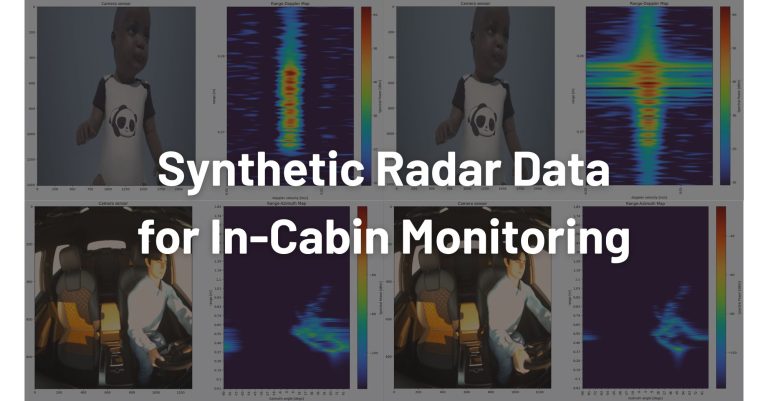
While vision systems excel at capturing surface-level details, they struggle in occluded scenarios or poor lighting. Radar bridges that gap. Anyverse InCabin supports simulation of FMCW (Frequency-Modulated Continuous Wave) MIMO radar, a crucial technology for modern in-cabin applications, particularly Child Presence Detection (CPD).
Radar Enables:
- Micro-motion sensing: Detects breathing, heartbeat, and subtle body movement
- Occlusion robustness: Works under blankets, behind seats, and in darkness
- Continuous presence monitoring: Even in edge cases like sleeping or unresponsive passengers
- Range-Doppler maps and point cloud outputs: Matched to real-world radar specifications
Radar is modeled using Shooting and Bouncing Rays (SBR) techniques, simulating electromagnetic wave propagation, scattering, and reflection based on material and geometry. This ensures that radar signals behave realistically in a virtual vehicle cabin, even across complex occlusions and dynamic scenarios.
According to EE Times Europe, radar is the most promising technology for meeting Euro NCAP and FCC compliance standards for CPD systems, which require the detection of unattended children within 10 seconds. Anyverse supports this by delivering regulation-aligned simulation outputs, including radar point clouds and Doppler signatures.
Built for In-Cabin Sensing Simulation
All sensors in Anyverse InCabin are simulated from the same physically accurate 3D scene, ensuring they are:
- Temporally aligned: All sensor frames are generated at the same simulation timestamp
- Spatially coherent: Sensors share the same calibration, scene geometry, and actor behavior
- Custom-configurable: Position, orientation, intrinsic/extrinsic parameters, FOV, and resolution are all user-defined
This makes Anyverse ideal for multi-modal training, validation, and fusion model development. Whether you’re building a single-modality application or a tightly fused system, you get synchronized data and ground truth across all sensors, every time.
Far-Infrared (Thermal) Cameras
Thermal imaging detects heat signatures and offers an additional layer of detection, especially in poor visibility conditions.
Thermal cameras detect body heat and are especially useful in:
- Low visibility or no-light conditions
- Assessing physiological stress (thermal stress or abnormal patterns such as fever, inactivity).
- Detecting infants through occlusion
Thermal camera simulation in Anyverse InCabin includes:
- Material-specific emissivity profiles.
- Dynamic temperature modeling of occupants, surfaces, and objects.
- Realistic thermal gradients across human skin and fabric layers.
By detecting heat signatures, thermal cameras can reveal hidden occupants even in total darkness. Research from IDTechEx highlights that thermal sensors outperform visible-light cameras in in-car settings.

DMS Sensor Fusion + Synthetic Data to Ensure In-Cabin Safety
Simulating Human Behavior and Real-World Cabin Scenarios
Sensors are only as useful as the scenes they observe. Anyverse InCabin enriches each simulation with human behavior modeling and high-diversity environments.
We create realistic in-cabin actions like:
- A parent handing snacks to a child in the back seat
- A driver nodding off during a long road trip
- A teen unbuckling a seatbelt mid-ride
- An infant slumped sideways in a car seat
Everything is physically and behaviorally accurate, ensuring that AI systems learn to perform across real-world diversity, not just ideal conditions.
Human simulation includes:
- Demographics: varied ages, ethnicities, body types, and clothing.
- Occupant roles: driver, adult passenger, child in booster, infant in child seat, pet.
- Behavior modeling: yawning, distraction, texting, drinking, seat belt misuse, sleep, and reaching movements.
Environmental variation:
- Time of day: daylight, dusk, night.
- Interior lighting: dome light on/off, IR emitter modeling.
- Occlusion scenarios: sunglasses, hats, a child covered by a blanket, a bag on a seat.
- Sensor placements: side pillar, center mirror, overhead console.
This provides the variability required to train reliable AI systems while avoiding the ethical and logistical constraints of real-world data collection.

Customization and Scenario Variability: Simulating Reality, Not Just Ideal Conditions
Sensors are only as useful as the scenes they observe. That’s why Anyverse InCabin goes beyond sensor simulation to provide a deeply customizable and highly diverse simulation environment, modeling the people, behaviors, and conditions that modern in-cabin AI systems must learn to handle.
Behavioral Realism: Diverse Human Actions and Interactions
Each scene in Anyverse InCabin includes physically and behaviorally accurate human simulation, so you can train AI models on edge cases, everyday interactions, and non-ideal behaviors.
Examples of Simulated In-Cabin Scenarios:
- A parent handing snacks to a child in the back seat
- A driver nodding off during a long road trip
- A teen unbuckling a seatbelt mid-ride
- An infant slumped sideways in a car seat
- A passenger texting, stretching, or reaching across seats
These are the nuanced, high-impact situations that are hard to capture with real-world data, but crucial for building robust and compliant occupant monitoring systems.
Human Modeling Features Include:
- Demographics: Variations in age, gender, ethnicity, body size, and clothing
- Occupant roles: Driver, front/rear passengers, children in boosters, infants in child seats, and even pets
- Behavior catalog: Yawning, distraction, phone use, drinking, sleeping, reaching, seatbelt misuse, and more
Environmental Variation: Realistic Conditions, Modeled in Detail
Anyverse simulates a wide range of environmental variables that affect sensor input and system performance. These include:
- Time of day: Daylight, dusk, and night driving conditions
- Interior lighting: Cabin light on/off, IR illumination sources modeled in NIR/ToF simulation
- Occlusions and accessories:
- Sunglasses, hats, hoods
- Blankets covering children
- Bags or objects partially obscuring seats
- Sensor placements and perspectives:
- A-pillar, center mirror, overhead console, headrests
- Configurable FOV, resolution, and framerate per sensor
This variability is critical to ensuring AI models generalize beyond narrow training conditions. Real-world deployment rarely happens in perfect lighting or behavior—Anyverse prepares your models to perform regardless of the scenario.
Custom Sensor Configuration: Your Setup, Simulated Exactly
Every simulation in Anyverse InCabin is tailored to your system’s specs. You can replicate your in-cabin sensor architecture with precision, including:
- Sensor positions and orientations
- Intrinsic and extrinsic calibration
- Resolution, frame rate, and field of view
- Cross-modality alignment for RGB, IR, ToF, stereo, and radar
- Scene-level parameter control: demography, posture, actions, lighting, and occlusion factors
This level of configurability supports seamless integration into your existing data pipelines, validation tooling, and compliance test plans, whether you’re prototyping or preparing for Euro NCAP compliance.
Anyverse doesn’t just simulate sensors, it simulates sensor reality. With this combination of behavioral modeling, environmental variation, and full sensor customization, your team gets the data needed to develop resilient, real-world-ready AI systems, without the ethical, logistical, or privacy concerns of real-world data collection.

Benefits for OEMs, Tier 1s, and Integrators
Anyverse InCabin is built for engineering teams tasked with delivering high-performance, safety-critical in-cabin systems, on time and in line with evolving industry regulations.
By providing synchronized, physics-accurate, and customizable multi-sensor data, Anyverse enables your team to move faster and smarter across every phase of development.
Key Benefits Include:
- Faster development cycles
Ready-to-use synthetic datasets reduce dependency on slow and costly real-world data collection. - Shortened validation timelines
Simulate rare events and edge cases on demand to speed up testing, iteration, and failure case analysis. - Accelerated go-to-market
With scalable, scenario-rich data, your team can reach production readiness faster, especially in AI-driven functions like DMS and CPD. - Euro NCAP-aligned compliance
Generate data tailored for occupant monitoring scenarios defined in emerging Euro NCAP protocols (e.g., CPD detection within 10 seconds), helping teams prepare for regulatory audits and functional safety requirements. - Improved model robustness
Train and test perception systems on diverse demographics, behaviors, and environments that reflect real-world complexity. - Full control and repeatability
Configure sensor layout, FOV, lighting, occupant behavior, and calibration parameters with precision, then regenerate exact scenes for A/B testing or regression analysis. - Seamless integration with your AI stack
Datasets come with pixel-aligned multi-sensor outputs, camera calibration files, metadata, annotations, and scene labels, streamlined for training, simulation-in-the-loop, or validation environments. - Privacy-safe and ethically sound
Bypass the logistical and legal constraints of collecting real in-cabin footage, especially involving children or sensitive scenarios.
Whether you’re validating a sensor fusion algorithm, training a child presence detection model, or preparing for Euro NCAP verification, Anyverse gives you the data infrastructure to build confidently and deploy faster.

Regulatory Compliance and Use Cases: Powering Safer, Smarter In-Cabin Systems
The synthetic data generated by Anyverse InCabin is already being used to develop, validate, and deploy advanced in-cabin perception systems across the automotive industry. These simulations enable high-fidelity training and testing of the most safety-critical AI applications in the vehicle interior.
Key Use Cases Supported by Anyverse InCabin
Driver Monitoring Systems (DMS)
Detecting signs of fatigue, distraction, and drowsiness is vital to keeping drivers alert and reducing accident risk. Anyverse enables simulation of key driver behaviors and occlusions to help train and validate:
- Eye-gaze and blink detection
- Yawning and head nodding
- Hands-on-wheel vs. hands-off-wheel
- Driver identity and attention mapping
Occupant Monitoring Systems (OMS)
Accurate seat occupancy classification and posture tracking are essential for airbag deployment logic, seatbelt alerts, and emergency response. Anyverse provides:
- Seatbelt usage detection under partial occlusion
- Posture and slouch detection
- Seat classification for adults, children, and infants
- Passenger count and body pose estimation
Child Presence Detection (CPD)
Child Presence Detection systems are increasingly mandated by regulatory bodies due to tragic incidents involving children left unattended in vehicles. Anyverse supports:
- Radar simulation for detecting breathing and motion under blankets
- Thermal and IR modeling for heat signatures and occlusion handling
- Full-scene simulation aligned with CPD timing benchmarks (e.g., detection within 10 seconds)
Did you know? Euro NCAP and other regulatory bodies (including China NCAP and the U.S. DoT) are actively pushing CPD and DMS requirements into safety ratings. Anyverse helps teams stay ahead of these evolving standards by generating data aligned with test protocols and sensor performance expectations.
Compliance-Ready Data for Global Markets
Anyverse InCabin enables teams to develop systems with confidence—whether you’re building for:
- Euro NCAP 2026+ protocols
- China NCAP occupant monitoring initiatives
- U.S. Department of Transportation safety regulations
By supporting simulation of the exact conditions, behaviors, and sensor configurations these protocols demand, Anyverse helps OEMs and Tier 1s:
- De-risk development by testing before hardware is finalized
- Validate faster, even across rare or edge-case scenarios
- Launch confidently in global markets with region-specific data coverage
Getting Started with Anyverse InCabin
Ready to explore how Anyverse can fit into your in-Cabin Monitoring Data Pipelines?
Here’s how to get started:
- Define your test scenarios – lighting conditions, demographics, and behavioral patterns.
- Configure your sensor setup – camera/radar placements, specs, and calibration parameters.
- Generate your tailored dataset – or run an evaluation pilot to test our pipeline.
- Iterate and scale – with full support from the Anyverse team.
Train and Validate In-Cabin AI for the Real World - Get Started
Developing in-cabin systems that are safe, accurate, and production-ready demands high-quality, synchronized, physically accurate data. With Anyverse InCabin, you get just that, across all relevant sensors, with full control and reproducibility.
Whether you’re an ML engineer optimizing your AI model or an integrator validating system behavior across sensor stacks, Anyverse gives you the data backbone to deliver with confidence.
Request a demo and explore how Anyverse InCabin can help your team build AI that truly sees the whole picture.