
Table of Contents
Table of Contents
Executive Summary
In-cabin AI has become a strategic cornerstone of the software-defined vehicle. Driver Monitoring Systems (DMS), Child Presence Detection (CPD), and Occupant Monitoring Systems (OMS) are now driven by tightening global regulations (Euro NCAP 2026–2029, EU GSR2, NHTSA) and rising consumer expectations for intelligent, non-intrusive safety and comfort.
As OEMs shift from sourcing hardware to selecting AI partners, the competitive landscape includes end-to-end system providers, pure-play software innovators, Tier-1 integrators, and agile startups. Choosing the right partner requires evaluating four critical pillars: functional safety compliance (ISO 26262/ASIL), algorithmic robustness across real-world variability, mature multi-sensor fusion, and scalable compute efficiency for production deployment.
Looking ahead, predictive behavior modeling, ADAS convergence, and biometric sensing will raise validation complexity. Synthetic data is emerging as a foundational enabler for edge-case coverage, deterministic scenario-based testing, and regulatory certification.
Long-term success will depend not only on algorithms but on data strategy, specifically, the ability to deliver provable robustness at scale.

The New Brains of the Cabin
Modern vehicles are evolving beyond transportation devices into intelligent environments capable of actively monitoring and responding to occupant behavior. While cameras, IR modules, and radar serve as the cabin’s “eyes and ears,” it is the AI software layer that functions as the true “brain,” interpreting raw sensor data to drive both safety and comfort.
Three core domains define the frontier of in-cabin intelligence:
- Driver Monitoring Systems (DMS): Detecting distraction, drowsiness, or cognitive impairment in the driver.
- Child Presence Detection (CPD): Ensuring that children are safely seated, correctly restrained, and accounted for at all times.
- Occupant Monitoring Systems (OMS): Understanding the behavior, posture, and physiological state of all vehicle occupants to optimize safety, comfort, and wellness.
This transformation has ignited a dynamic new ecosystem. A generation of software-first companies, from agile startups to specialized AI vendors, is now competing and collaborating with legacy Tier-1s to define the future of the intelligent cabin. These companies combine domain-specific algorithms, multi-sensor fusion, and comprehensive safety processes to deliver production-ready solutions that meet evolving regulatory standards and consumer expectations.
For OEMs and Tier-1s, the critical task is no longer sourcing sensors, but identifying the right AI partners.


The Stakes: Why the In-Cabin AI Software Market is Exploding
The in-cabin monitoring technology market is undergoing one of the fastest transformations in automotive safety. What was once a narrow niche focused on basic distraction detection has evolved into a core pillar of vehicle intelligence, driven by software-defined vehicles, safety regulation, shifting consumer expectations, and the strategic priorities of OEMs. As a result, the market is no longer defined solely by conventional Tier-1 suppliers. There is a new mix of software-first companies, perception specialists, and AI-native startups reshaping the competitive landscape.
A Regulatory Wave Redefining the Market
New global safety requirements have accelerated the need for sophisticated in-cabin AI, making DMS and CPD essential rather than optional:
- Euro NCAP 2026-2029: Expands the DMS and CPD requirements from simple gaze tracking to comprehensive behavior understanding, child presence detection, and impaired-driving indicators.
- EU GSR2: Mandates distraction and drowsiness monitoring across new vehicle types.
- US (NHTSA) & China (C-Ncap): Increasing emphasis on occupant safety and advanced behavior monitoring.
These regulations are pushing OEMs to adopt richer, multi-modal perception systems blending vision, IR, ToF, and radar, to meet stringent performance thresholds and real-world robustness criteria.
Consumers Are Expecting More Than Passive Safety
While regulations set the minimum bar, consumers are increasingly demanding personalized, comfort-enhancing, always-on safety features that respect their comfort and attention. Consumers now view vehicles as intelligent companions, capable of monitoring driver behavior, managing alerts contextually to avoid being intrusive, and adapting to environmental conditions dynamically. This shift is pushing in-cabin AI from a compliance-driven feature, where the goal is simply to alert, to a core component of a sophisticated, trusted user experience, similar to ADAS adoption a decade ago.
OEMs Are Turning to Specialized AI Companies
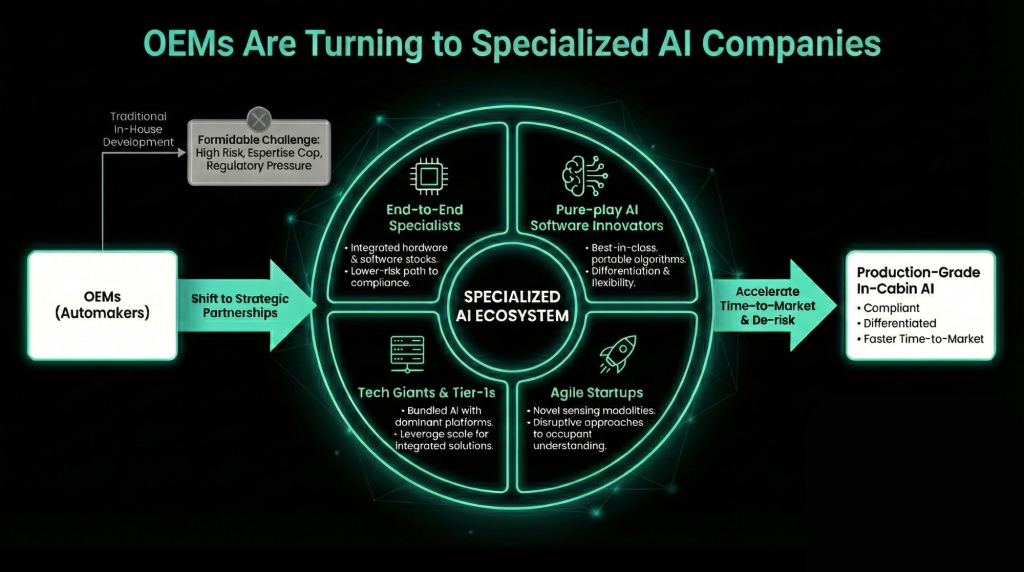
For automakers, developing production-grade in-cabin AI in-house is a formidable challenge. It requires deep, cross-disciplinary expertise in perception modeling, safety validation, and data pipelines, all while meeting aggressive timelines and stringent new regulations. To de-risk development and accelerate time-to-market, OEMs are increasingly turning to specialized AI companies as strategic partners.
This shift has fundamentally reshaped the supply chain into a dynamic ecosystem, characterized by distinct types of players, each offering different value propositions:
- End-to-end specialists who deliver integrated hardware and software stacks, offering a lower-risk path to compliance.
- Pure-play AI software innovators who provide best-in-class, portable algorithms for OEMs seeking differentiation and flexibility.
- Tech giants & Tier-1s who bundle AI with dominant compute platforms or leverage scale for integrated solutions.
- Agile Startups introducing novel sensing modalities and disruptive approaches to occupant understanding.
This diversity gives OEMs more choice than ever, but it also makes the partner selection process more critical. The question is no longer whether to partner, but how to identify the right partner for your specific program goals. In the next section, we map this ecosystem to provide a clear lens for evaluation.
The Contenders: A Landscape of AI Innovators
Understanding the types of business models is key to knowing what kind of partner you’re engaging with. The in-cabin AI space is evolving quickly, with an ecosystem of companies ranging from full-stack system providers to highly specialized AI startups. This diversity accelerates innovation but also complicates partner selection, making it essential for OEMs and Tier-1s to understand each category’s strengths, limitations, and strategic value.
Below is a simplified, decision-focused view of the main categories shaping today’s DMS, CPD, and OMS landscape.
The End-to-End Specialists
These companies deliver full-stack systems: reference hardware, embedded perception software, and the complete validation framework required for automotive deployment. Their value lies in tight integration and proven safety-case execution, making them strong candidates for regulated DMS/CPD programs where predictability and compliance are non-negotiable.
Why they matter:
- Turnkey solutions with lower integration overhead
- Strong functional safety documentation
- Deep integration expertise (sensor tuning, HW/SW co-design)
- Prior OEM program delivery = reduced project uncertainty
Examples:
- Seeing Machines: Provides vision-based driver monitoring validated across multiple OEM programs.Unique in offering the proprietary Fovio chip alongside its software, providing an optimized, integrated silicon-plus-software solution.
- Magna: A major Tier-1 integrator delivering “black box” solutions, combining mirrors/cameras with integrated ADAS software.
- Aptiv: Distinguishes itself by combining hardware, perception software, and deep vehicle integration into a single production-ready stack. Their approach focuses on “interior sensing” as a holistic system rather than a component, leveraging AI to fuse cabin data with safety-critical vehicle functions.

Pure-Play AI Software Players
Sitting at the opposite end of the spectrum are companies focused exclusively on the perception layer. Their strength is algorithmic performance, portability, and fast iteration, making them attractive when OEMs prefer modularity or want to differentiate beyond Tier-1 baseline systems.
Why they matter:
- Camera- and SoC-agnostic flexibility
- Ability to integrate into custom sensor layouts
- Rapid updates and innovation cycles
- Efficient, lightweight models suitable for cost-sensitive ECUs
Examples:
- emotion3D: Provides the CabinEye software stack, specializing in upgrading passive safety cameras into smart sensors for occupant monitoring.
- Tobii: A global leader in eye-tracking that solidified its automotive position by acquiring Xperi’s AutoSense in 2024. They deliver a robust, hardware-agnostic DMS/OMS software library.
- Smart Eye: Combines DMS software with supporting hardware options and regulatory-ready distraction-warning capabilities.
Tech Giants & Tier-1 Suppliers
Large companies bring scale, reliability, and integration capabilities, bundling AI software with their hardware platforms for production-ready solutions. Their model is characterized by bundling: hardware, middleware, and foundational AI delivered as a unified platform.
Why they matter:
- Influence industry reference architectures
- Mature global supply chains
- Ability to industrialize and scale smaller AI innovations
- Strategic alignment with OEM roadmaps
Examples:
- Harman (incorporating Cipia): Following the July 2025 acquisition of Cipia, Harman now integrates Cipia’s Driver Sense and Cabin Sense software directly into its “Ready Care” portfolio, offering a powerful Tier-1 alternative.
- Bosch: Combines vision and radar-based sensing into integrated safety solutions, leveraging their massive global footprint.
- Aumovio (formerly Continental): Following its 2025 spin-off, Aumovio operates as an independent Tier-1 powerhouse, integrating cabin sensing directly into displays and high-performance computers.
Startups to Watch
A new wave of specialists is accelerating innovation, often exploring sensing modalities and behavioral models overlooked by traditional suppliers. Their business model is typically deep specialization, speed, and experimental thinking, qualities that often lead to acquisition or early integration partnerships.
Themes of innovation:
- Multimodal behavior and state estimation
- Radar-based vital-sign and occupancy monitoring
- Predictive behavioral AI
- Efficient edge-AI models for entry-level SoCs
Examples (neutral, model-focused):
- CorrActions: Detects cognitive impairment via micro-motion and signal-based behavioral analytics.
- trinamiX: Uses NIR + AI for vital-sign and presence monitoring within OMS applications.
- Pontosense: Applies mmWave radar and AI to CPD and in-cabin physiological monitoring.
Each model presents a distinct set of trade-offs: end-to-end specialists offer predictability, pure-play AI teams provide flexibility, tech giants deliver scale, and startups drive high-velocity innovation. The optimal choice is dictated by your program’s specific goals, which brings us to the core technical criteria for evaluation.

The Critical Differentiators: How to Identify a Best-in-Class In-Cabin AI companies
With a growing number of players in DMS, CPD, and OMS, OEMs and Tier-1 suppliers need a structured framework to evaluate potential partners. Beyond business models, the following four technical and operational pillars are non-negotiable for any partner aiming for production.
A Proven Safety-First DNA
Functional safety is the foundation of any in-cabin AI system. Companies that succeed in production embed safety from the start across algorithm design, data handling, software validation, and system integration.
Focus: Choose partners whose development pipelines are built around functional safety and regulatory compliance, ensuring the system fails safely, predictably, and in line with automotive standards.
Key indicators include:
- Production deployment: Multiple vehicles in production with verified performance. Demonstrated experience in the complex process of bringing safety-critical software to high-volume production with major OEMs, proving their ability to handle the full automotive lifecycle.
- Standards compliance: Certification against automotive standards such as ASIL-B, ISO 26262 adherence, and transparent documentation of testing processes.
- Safety culture: A development process that prioritizes fail-safe behavior, risk assessment, and redundancy in algorithms.
A partner with a true safety-first DNA reduces regulatory risk, minimizes surprise failure modes, and increases OEM confidence that the system will behave reliably in complex, real-world environments.
Uncompromising Algorithmic Robustness
AI must perform flawlessly outside controlled environments, adapting to the wide variety of real-world scenarios found in vehicle cabins. Algorithmic robustness determines whether an AI system performs consistently across the full diversity of human occupants, cabin environments, lighting conditions, and real-world unpredictability.
Focus: The partner must demonstrate that their AI generalizes across demographics, extreme environmental conditions, and rare but safety-critical edge cases.
Key indicators include:
- Generalization: Ability to handle rare or challenging scenarios without performance degradation. Reliable detection of distraction, fatigue, posture, and occupancy across ages, ethnicities, body types, seating positions, and occlusions.
- Lighting resilience: Reliable operation in all challenging lighting conditions, including direct low-angle sunlight, deep shadow, night driving (relying heavily on IR-camera processing), and the presence of difficult occlusions like IR-blocking sunglasses.
- Continuous improvement & data coverage: Evidence of structured dataset expansion, ongoing validation, and rapid iteration cycles.
Achieving this generalization is the central data challenge. It requires more than just supplementing real-world data; it demands a systematic engineering approach to testing and validation. Forward-thinking partners are addressing this by integrating synthetic data not as a niche tool, but as a core pillar of their development pipeline.
Sensor-realistic synthetic data and simulation technology enable this in three critical ways:
- Complementing & Scaling Real Data: It generates the vast, perfectly labeled datasets needed to complement real-world collections, providing balanced coverage across demographics, scenarios, and rare but critical safety events.
- Engineering Robustness Proactively: It allows for the precise creation and iteration on safety-critical corner cases, like fully occluded children, drivers in micro-sleeps with IR-blocking sunglasses, or complex multi-occupant interactions, that are impossible to stage safely or at sufficient scale in the real world.
- Building a Foundation for Certification: It provides the deterministic, reproducible scenario-based validation required to prove robustness to assessors. This shift from statistical confidence based on limited real data to evidence-based confidence from exhaustive simulation is becoming essential to meet evolving protocols like Euro NCAP 2026+.
Partners who master this synthetic-data-centric approach are not just closing data gaps; they are building AI with provable, trustworthy performance that can withstand both real-world variability and rigorous regulatory assessment.

Sophisticated Multi-Sensor Fusion
As cabins become more complex, single-sensor systems struggle to maintain reliability across all conditions. Leaders are now building perception stacks that combine RGB, IR, ToF, radar, and occupancy sensors into unified, context-aware models.
Focus: The partner should demonstrate the intelligence and architectural maturity to integrate complementary sensor modalities into a coherent, real-time understanding of the cabin.
Key indicators include:
- Synchronized architecture: Pixel-accurate temporal and spatial alignment across camera, depth, and radar streams.
- Modal resilience: Ability to maintain performance when one sensor is occluded, degraded, or misaligned, for example, using radar micro-movement signals to maintain CPD detection when a blanket obscures the camera.
- Feature richness: Capacity to detect nuanced behavioral cues such as micro-movements, stress patterns, or cognitive load.
- Adaptive fusion: Advanced AI techniques (e.g., attention mechanisms) that dynamically weigh sensor signals based on their contextual reliability.
A partner with strong multi-sensor fusion capabilities is better equipped to deliver reliable perception across the diverse conditions that real cabins present.
Scalability and Computational Efficiency
For widespread deployment, AI systems must be optimized for production environments. Scalability is not just about adding vehicles. It also involves maintaining performance and cost-effectiveness.
Focus: The partner should show that their algorithms are optimized for the realities of automotive hardware and diverse OEM integration requirements.
Key indicators include:
- Compute efficiency: Algorithms designed to run on cost-effective automotive-grade SoCs without sacrificing performance.
- Production readiness: Easy integration across multiple vehicle platforms without custom hardware redesigns.
- Flexible architectures: Solutions that can scale from entry-level vehicles to premium models with minimal reengineering.
Partners with scalable architectures help OEMs reduce integration effort, manage per-unit costs, and deploy advanced in-cabin capabilities fleet-wide.
By evaluating companies against these four pillars, safety-first foundations, algorithmic robustness, multi-sensor fusion maturity, and scalable compute efficiency, OEMs and Tier-1 suppliers can separate true production-ready partners from those still operating at a prototype stage. These criteria help ensure long-term reliability, regulatory alignment, and the ability to scale across diverse vehicle platforms.
As the industry continues to shift, driven by evolving safety protocols, new sensing modalities, and rising expectations for intelligent interiors, the benchmarks for a strong partner will also evolve. Understanding this trajectory provides valuable context for what comes next in the in-cabin space and frames the developments shaping the years ahead.
The Future of In-Cabin Monitoring: 2026 and Beyond
The current focus on meeting Euro NCAP protocols for DMS and CPD is merely the baseline. As OEMs and Tier-1s look beyond compliance toward predictive safety, health monitoring, and multimodal sensing, the partner landscape will shift once again. Understanding these trends is essential for evaluating which companies are architected for the future and which are optimized only for today’s requirements.

The Regulatory Evolution: Beyond 2026 Mandates
While Euro NCAP 2026 mandates CPD and tightens DMS requirements (moving to assess cognitive distraction and advanced out-of-position scenarios), the roadmap doesn’t end there:
- Behavioral Prevention: Future assessment categories will increasingly reward systems that predict risky behaviors or pre-empt driver incapacitation, not just detect the moment it happens.
- Post-Crash Intelligence: Occupant classification and positioning will influence next-generation restraint systems, requiring cabin AI to operate reliably even after a collision or power fluctuation.
- Global Harmonization: Regulations in the US (Infrastructure Investment and Jobs Act) and emerging markets (like Bharat NCAP) will continue to align with EU standards, creating a global floor for in-cabin safety. Partners with experience across multiple regulatory regimes will become indispensable.
For OEMs selecting long-term partners, this means choosing companies whose roadmaps look beyond 2026, not those narrowly optimized for its checkboxes.
Predictive Behavior Modeling: Anticipating the Human Element
The shift from “Is the driver distracted now?” to “Is the driver about to be distracted or incapacitated?” ( reactive to predictive safety) marks the next frontier for in-cabin AI.
- Micro-Behavior Analysis: Subtle posture shifts, grip tremors, and glance-pattern irregularities will signal rising cognitive load before distraction occurs.
- Impairment Prediction: Beyond fatigue, next-generation systems will use multimodal cues to pre-empt impairment from alcohol, drugs, or acute medical events, enabling safer handover to assisted driving systems (L2+/L3).
Partners investing in micro-behavior and physiological prediction today are better positioned to deliver next-gen value tomorrow.
The Converged Safety Domain: Bridging In-Cabin AI and ADAS
The ultimate evolution of in-cabin monitoring is its seamless integration with Advanced Driver-Assistance Systems (ADAS) to create a unified vehicle safety domain. Today’s systems largely operate in silos. Tomorrow’s will fuse interior occupant state with exterior environmental perception to enable context-aware, cooperative safety interventions.
- Context-Aware Interventions: An ADAS system could understand that a detected lane departure is more critical if the in-cabin AI simultaneously identifies a distracted or drowsy driver, prompting a more assertive corrective action or alert.
- Handover & Readiness Assurance: For Level 2+/Level 3 vehicles, the in-cabin system will not just monitor readiness for takeover, but will proactively communicate driver state (e.g., cognitive load, engagement level) to the driving automation system, allowing for smoother, safer transitions of control.
- Holistic Scenario Management: In a potential collision scenario, pre-crash occupant positioning data from the OMS could be fused with exterior sensor data to optimize restraint system deployment (e.g., airbag force, seatbelt pre-tensioning) milliseconds before impact.
This convergence moves safety from a collection of independent features to an intelligent, cooperative network. It demands that in-cabin AI partners possess not only deep interior perception expertise but also an architectural vision compatible with centralized vehicle computers (e.g., zone or domain controllers) and the data pipelines of exterior perception systems.
Expanded Cabin Wellness and Biometric Sensing
The Occupant Monitoring System (OMS) is evolving from a safety mechanism into a holistic wellness layer, leveraging the same sensors used for safety.
- Vital Sign Monitoring: Radar and thermal imaging will enable continuous, non-contact tracking of respiration and heart rate, unlocking early detection of stress spikes, panic episodes, or medical anomalies.
- Adaptive Personalization: Using biometric signals, vehicles will auto-tune climate, seat ergonomics, and acoustics to increase comfort and reduce stress.
OEMs evaluating partners should look for those capable of fusing safety, wellness, and personalization, three domains that will increasingly converge.
The Increasing Role of Synthetic Data in Certification
As systems fuse vision, radar, thermal, depth, and biometric inference, the validation burden expands dramatically. Real-world data alone cannot cover the combinatorial explosion of cabin states, lighting conditions, occupant postures, and sensor degradations.
- Standardizing Validation: Future Euro NCAP methodologies will lean heavily on scenario-based digital validation. Synthetic data will not be optional. OEMs will need deterministic, reproducible evidence across thousands of edge cases.
- Reproducible Safety Evidence: Only through simulation and synthetic data can OEMs and Tier-1s guarantee the safety-critical requirements of DMS and CPD are met against every potential edge case, providing the deterministic, traceable evidence required by new Euro NCAP assessment methodologies.
This push toward predictive modeling and biometrics will make the data challenge more acute, cementing synthetic data’s role from an R&D accelerator to a necessary component of the certification workflow.
When choosing partners, OEMs should prioritize those with a clear, scalable synthetic data strategy, not as a side tool, but as a core pillar of their development and validation pipeline.

Building the Intelligent Cabin of Tomorrow
The diversity of AI innovators is a testament to the market’s vitality. Yet, as our framework shows, they all converge on a single, monumental challenge: data. No matter the business model, geography, or sensing philosophy, every in-cabin AI company is ultimately constrained by the same universal bottleneck: the quality, diversity, and completeness of the data used to train and validate its models.
As the push toward predictive behavior modeling, multimodal sensing, and biometric inference accelerates, the data requirements grow exponentially. Real-world collection bound by cost, safety, ethics, and practicality, simply cannot keep pace. The most safety-critical scenarios for CPD and DMS are, by definition, the hardest or the most dangerous to capture: infants concealed under blankets, drivers in microsleep episodes wearing IR-blocking sunglasses at sunset, or occupants in post-crash states. And even when captured, real-world datasets remain incomplete, shaped by narrow demographics, climate, and hardware constraints that leave dangerous blind spots in the long tail of edge cases.
This is why the industry is undergoing a fundamental shift. Synthetic data has moved far beyond a niche R&D shortcut and has become the strategic enabler that allows companies to overcome the data barrier systematically. The leaders securing production programs today are those who have embraced this paradigm, leveraging physically accurate, sensor-realistic synthetic data pipelines to generate rare edge cases on demand, achieve perfect ground truth, and rigorously test multi-sensor fusion architectures under every conceivable condition.
For OEMs and Tier-1s evaluating partners, this is the defining filter: which companies are architected for a world where synthetic data is not optional, but essential? The next generation of in-cabin safety will be built not just on algorithms, but on data engines capable of simulating reality at scale.
Which partners can ensure their AI reliably generalizes to every occupant, every posture, every lighting condition, and every safety-critical scenario, even those no real-world dataset could ever hope to contain?
The intelligent cabin of tomorrow will be built on three mutually reinforcing pillars:
- Innovative sensor hardware delivering precise, reliable signals
- Advanced perception software translating those signals into meaningful, safety-critical decisions
- High-fidelity synthetic data providing the diversity, scale, and edge-case coverage needed for true robustness
The reliability of the system is only as good as the data at its core.
FAQs: In-Cabin AI Software Innovators
What is scenario-based digital validation and how does it differ from field testing?
Scenario-based digital validation evaluates AI performance against predefined, reproducible test cases covering specific behaviors, environmental conditions, and edge cases. Unlike traditional fleet-based field testing, which relies on statistically accumulated mileage, digital validation enables deterministic repetition of rare or safety-critical events.
This approach is increasingly aligned with Euro NCAP 2026+ methodologies and allows OEMs to build structured safety cases supported by traceable evidence.
What distinguishes production-grade DMS from basic gaze-tracking solutions?
Basic gaze-tracking systems estimate eye direction and issue alerts when the driver looks away from the road. Production-grade Driver Monitoring Systems (DMS), however, incorporate contextual behavioral modeling. They analyze head pose, blink rate, eyelid closure (PERCLOS), gaze dispersion patterns, and temporal attention metrics to detect cognitive distraction, fatigue, and impairment.
Under Euro NCAP 2026+, systems are evaluated not only on detection accuracy but on robustness across lighting, occlusions, and demographic variability, making validation maturity a key partner differentiator.
What is the difference between end-to-end specialists and pure-play AI software partners?
End-to-end specialists provide complete hardware-software stacks, validation frameworks, and OEM-ready integration, minimizing risk and integration overhead. Pure-play AI software partners focus solely on perception algorithms, offering flexibility, portability across sensors, and rapid innovation. The choice depends on whether the OEM prioritizes turnkey reliability or custom differentiation.
How do Tier-1 suppliers and tech giants differ in delivering in-cabin AI?
Tier-1 suppliers and tech giants bundle AI software with mature hardware platforms and global supply chains. They offer scale, industrialization expertise, and integration with centralized vehicle computers. Their strength lies in reliability and roadmap alignment, whereas smaller innovators may lead in niche sensing modalities or predictive modeling.
What does “fail-safe behavior” mean in in-cabin AI systems?
Fail-safe behavior ensures that when a system detects uncertainty, sensor degradation, or internal faults, it transitions to a predictable and safe operational state.
For example, if eye tracking confidence drops due to occlusion, the system may escalate alert thresholds conservatively or request driver engagement confirmation. Partners with strong safety-first DNA design redundancy, confidence estimation, and fallback strategies directly into their perception stack.
What makes a partner “production-ready” in in-cabin AI?
A production-ready partner demonstrates proven deployment in multiple OEM programs, verified performance across demographics and edge cases, compliance with ISO 26262/ASIL standards, and scalable integration into diverse vehicle platforms. They provide full documentation, safety cases, and support for ongoing validation, reducing development risk and accelerating time-to-market.